
1000 Miglia 2026
The 1000 Miglia 2026: dates, route and where to watch this year's race.
This article tells the history. For the modern event, the 44th re-enactment from 9 to 13 June, with the full figure-of-eight route from Brescia to Rome and the best places to watch, see our 2026 guide.
Before dawn in Brescia, in the years when the Mille Miglia was the most famous race in the world, the cars left one at a time. They were released at intervals through the night and the small hours of the morning, each car numbered for the minute it set off, so that the slowest went first and the fastest tore away into a sky only beginning to grey. To tell the history of the Mille Miglia is to follow a single thousand-mile loop of open road from Brescia to Rome and back, run flat out as a race for thirty years between 1927 and 1957, then reborn afterward as the careful re-enactment now known as the 1000 Miglia.
A red arrow, the emblem of the race, marked the road south. Ahead lay a thousand miles of open Italy: the plain of the Po, the Apennine passes, the long run down toward Rome, and the road home again. For a day and a night a whole country gave its roads to the race, and along every mile people stood in the half light and waited to be passed by a few seconds of engine noise and dust. There has never been anything quite like it, and there is unlikely to be again.
That sentence is easy to write now and would have been impossible to write in 1927, when the whole thing began as an act of wounded pride.
In this article
Mille Miglia history: a race born of a grudge
Brescia had hosted the first Italian Grand Prix in 1921. The following year the race moved to a new permanent circuit at Monza, and it did not come back. For a city that thought of itself as a capital of Italian motoring, the loss was a humiliation, and four men set out to answer it. Aymo Maggi was a local count and a serious racing driver. Franco Mazzotti was his friend and fellow aristocrat. Renzo Castagneto was a gifted organizer, and Giovanni Canestrini was a motoring journalist at the Gazzetta dello Sport. They did not lobby for the Grand Prix to return, they decided to build something Monza could not match.
The four men devised something simple and enormous: a loop of roughly 1,600 kilometers, a thousand imperial miles, run on ordinary public roads from Brescia to Rome and back in a single push, with no stages and no rest. Canestrini set out the idea plainly, that the race should prove a normal production car could travel the roads of Italy at speed, in safety and to a schedule. The route drew a rough figure of eight across the center and north of the country, running down through Lombardy, Emilia, Tuscany, and Lazio and crossing itself at Bologna. It was less a sporting spectacle than an argument about what Italian engineering could do, made at scale and in public.
The first edition started on the morning of 26 March 1927. Seventy-seven cars left Brescia, and roughly half of them reached it again. The winners, Ferdinando Minoia and Giuseppe Morandi, drove an OM 665 Superba, a car built by Officine Meccaniche in Brescia itself, and they covered the distance at an average speed of just over 77 kilometers an hour. The number is the surprise, a fit cyclist on a long descent moves faster than that: yet in 1927 it was a marvel, proof that an ordinary car could cross the spine of Italy through dust, fog, and cobbled town centers and come back in a little over twenty-one hours. The wager had paid off, and the race the four men invented would outgrow anything they imagined for it.
How the Mille Miglia became the world's most famous road race
Through the 1930s the Mille Miglia became the most celebrated road race in the world, and one of the most dangerous, and the two facts were never separable. The cars grew faster every season. The crowds grew with them: the roads stayed exactly what they were, public, lined with people, defended by nothing more than a few bales of straw. It was the great age of Alfa Romeo, whose cars and drivers took win after win, and it produced one story that has outlived all the others.
In April 1930 Tazio Nuvolari, from nearby Mantova, was chasing his rival Achille Varzi through the final hours in an Alfa Romeo 6C 1750. Varzi led on the road and believed the way behind him was empty. In the dark before dawn, with his co-driver Giovanni Battista Guidotti beside him, Nuvolari is said to have switched off his own headlights, closed on Varzi unseen, then lit them again and gone past in the last miles to Brescia. Whether every detail is exact matters little now. It is the kind of story a country chooses to keep about itself, and it fixed Nuvolari, the small fierce Mantuan, at the center of Italian sporting mythology.
The race was so Italian in those years that a foreign victory felt like an intrusion. It happened only rarely: a Mercedes-Benz won in 1931, and then the most unsettling win of all came in 1940. By then the war had begun, the classic route to Rome had been judged too risky, and the event was reduced to nine laps of a flat triangular circuit between Brescia, Cremona, and Mantova, run under a new name. A German BMW 328 won it outright, driven by Fritz Huschke von Hanstein and Walter Bäumer, the only running of the race that never left the province of Brescia. There would be no more until 1947. The thing that had begun as a celebration of a country went quiet along with the country itself.
The 1938 Mille Miglia, the fastest yet run and won by Clemente Biondetti in an Alfa Romeo, ended in a tragedy the later disaster tends to erase, and it deserves its place. On the way through Bologna a car left the road at a level crossing and struck the crowd, killing ten people, seven of them children. The reaction was immediate: the Fascist government banned the race, and there was no Mille Miglia in 1939. The danger that would finally end the event nineteen years later was already plain to everyone who cared to look, and the race came back anyway, because the appetite for it, in the country and among the men who built it, was stronger than the warning.
Ferrari, Stirling Moss and the postwar Mille Miglia
The Mille Miglia returned on 21 June 1947, into an Italy that was poorer, shaken, and hungry for something of its own to be proud of. The race obliged. That first postwar edition was won by Biondetti again, now in his late forties, in an Alfa Romeo, after a hard duel with Nuvolari, who was older still and visibly failing and who nearly stole the win in a far smaller Cisitalia, the lightweight new sports car that Piero Dusio had begun building in Turin in 1946. Biondetti would go on to win the Mille Miglia four times in all, in 1938 and then three years running from 1947 to 1949, the only driver ever to do so. A Sardinian from a working family who had come late to the sport, he became, at an age when most drivers had stopped, a national figure.
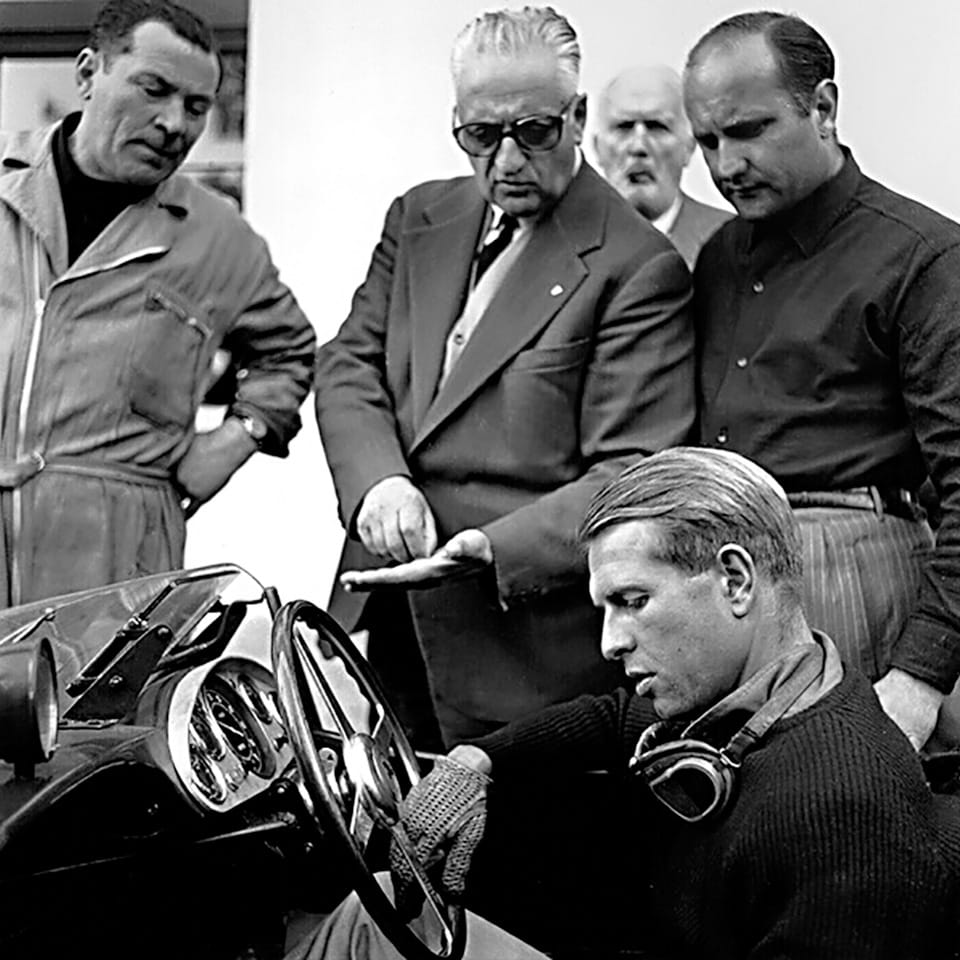
This was the era that bound the Mille Miglia to Ferrari. Enzo Ferrari called the Mille Miglia the most beautiful race in the world, and he meant it as more than a compliment: it was where he built his name. His early sports car, the 166 MM, carried the race in its very title, the two letters standing for Mille Miglia, and Ferrari won the event eight times in its eleven postwar runnings. To watch from the verge in those years was to wait for a red car, and usually to get one. Across the full span of the race the honors fell to a familiar set of marques: Alfa Romeo in the great prewar decade, Mercedes-Benz in 1931 and again in 1955, the lone German BMW of 1940, and Ferrari through the postwar years, with the Brescia-built OM owning the very first running of all.
In 1955 the race produced what many still consider the single greatest drive in the history of motorsport. The Englishman Stirling Moss, with the journalist Denis Jenkinson beside him reading pace notes from a long roll of paper wound onto a spindle, took a Mercedes-Benz 300 SLR over the full course in 10 hours, 7 minutes, and 48 seconds, at an average of 157.65 kilometers an hour. He beat the reigning world champion, Juan Manuel Fangio, by more than half an hour. No one would ever go faster, because the conditions that made such a drive possible were about to be taken away for good.
Why the Mille Miglia ended: the 1957 Guidizzolo disaster
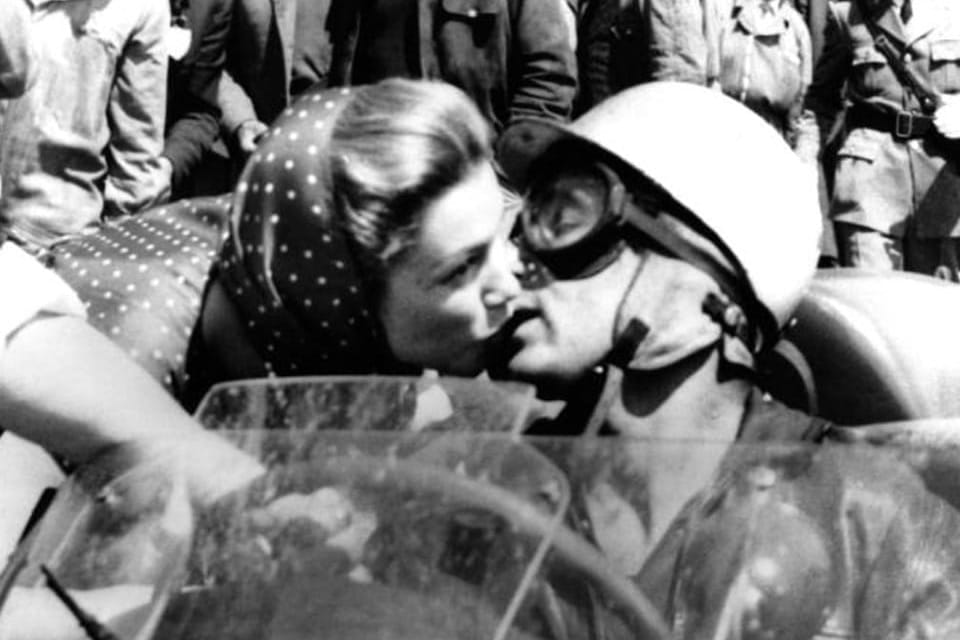
It ended on the afternoon of 12 May 1957, on a dead straight stretch of road near Guidizzolo, in the province of Mantova. A front tire failed on the Ferrari 335 S of Alfonso de Portago, traveling at roughly 240 kilometers an hour, less than fifty kilometers from the finish at Brescia. The car left the road and went into the people watching from the verge. De Portago died, and so did his co-driver, the American Edmund Nelson, and nine spectators. Five of the nine were children. It was the last running of the Mille Miglia as a race.
In the weeks that followed, the Italian government banned motor racing on open public roads. The decision did not fall on the Mille Miglia alone. It reached the Targa Florio in Sicily and the whole idea of racing flat out through inhabited country. After thirty years and a long roll of the dead, the argument that the founders had won so brilliantly in 1927, that cars and crowds could share the same roads, had finally lost.
For two decades after 1957 there was no real Mille Miglia, only a few cautious attempts run largely at legal speeds with a handful of timed sections, and they did not hold. The roads between Brescia and Rome carried ordinary traffic and little else. What had ended was not only a race but a way of watching one, the willingness of a country to stand a few meters from machines moving faster than anything else it had ever seen. What remained was the route, and the memory of what had once traveled along it, kept alive by the people who had been there and the towns the race had passed through year after year.
The 1000 Miglia today: the modern rievocazione
In 1977 the name came back to Brescia, and the change in its nature is the whole point. The new event was a rievocazione, a re-enactment, not a race. Only cars built no later than 1957, of the types that had taken part in or been entered for the original runnings, were allowed to take the start. There would be no winner of the old kind. Crews now drive to set average speeds and are judged on precision and timing, not on who reaches Brescia first. The route still runs to Rome and back. It still starts and finishes on Viale Venezia, by the Rebuffone gardens where the cars left in 1927. It still threads the same towns and the same passes. This is the distinction worth keeping clear: the historic Mille Miglia was the open-road race of 1927 to 1957, while the 1000 Miglia is the modern regularity event that honors it, and the old name now travels well beyond the asphalt, lent even to a famous Swiss watch line.
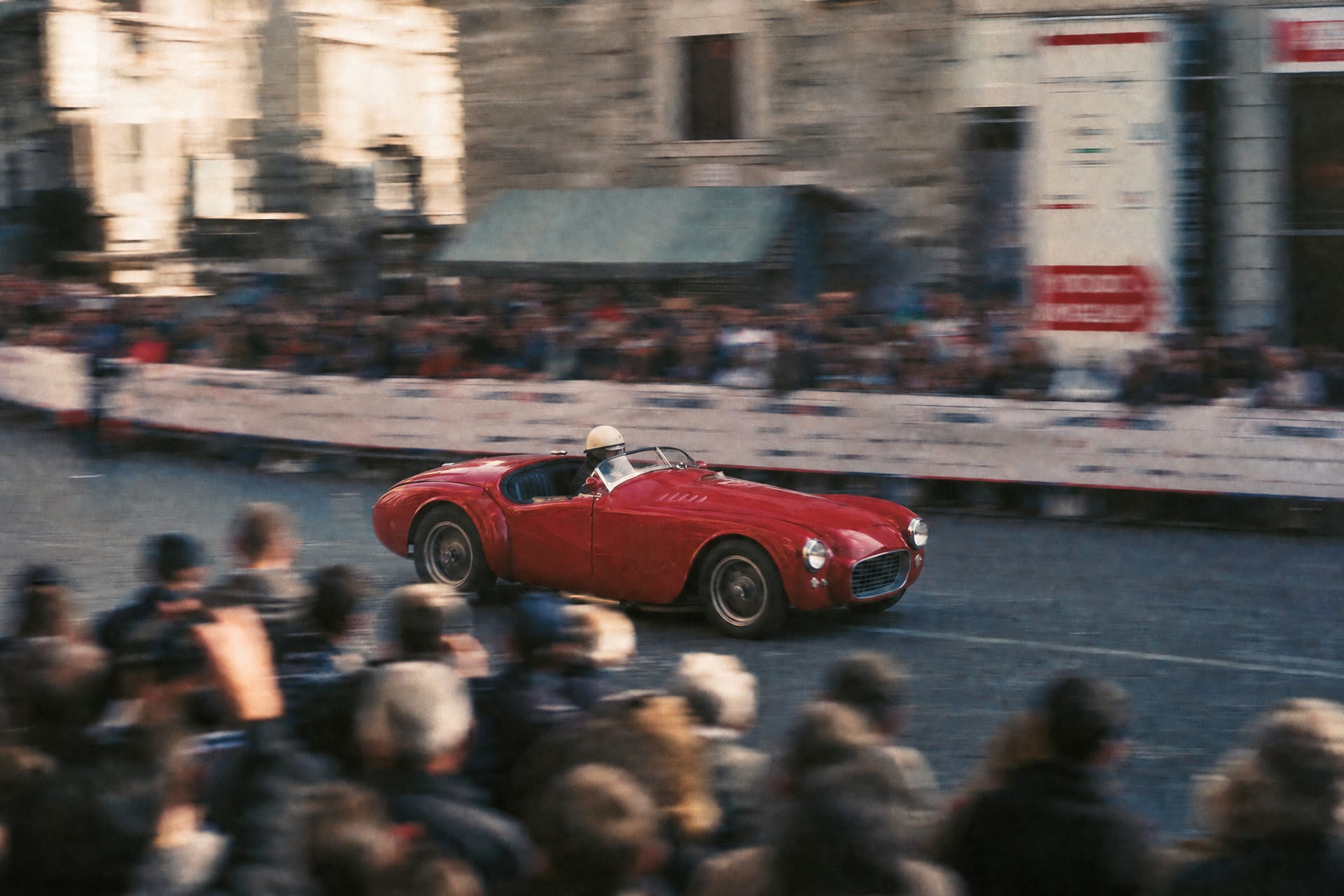
What changed is the verb. The Mille Miglia had been a conquest of the road, a thing done against the clock and against the odds. The 1000 Miglia is a passage along it, done in homage. The event today unfolds over several days each June, a slow river of pre-war and early postwar machinery moving south and then north again, watched by crowds that have grown rather than thinned.
The 2026 1000 Miglia route and dates
The 1000 Miglia 2026 runs from 9 to 13 June, the forty-fourth edition since the revival and the last before the centenary in 2027. More than four hundred cars leave Brescia on the morning of 9 June and return five days later, following a figure-of-eight course that recalls the earliest editions, with the outbound and return legs crossing at Ferrara rather than retracing the same road. The loop still reaches Rome at its turning point and still finishes on Viale Venezia in Brescia.
1000 Miglia 2026
Plan your visit to the 1000 Miglia 2026: the route, the dates and where to stand.
Now that you know how the race began and ended, follow it back onto the road. Our companion piece covers the 2026 edition stage by stage, from Brescia to Rome and back, with the best vantage points along the way.
The Museo Mille Miglia in Brescia
Since 2004 the race has also had a "permanent home": it sits just east of Brescia, in the former Benedictine monastery of Sant'Eufemia della Fonte, a complex founded in 1008 and restored to hold the collection. The museum opened as the Museo Mille Miglia and, at the start of 2026, was renamed the Museo Auto Storiche. Inside, the story runs in nine chronological sections, seven of them given over to the original races from 1927 to 1957, alongside a rotating display of cars that still leave the hall each June to run the modern event.
What the road remembers
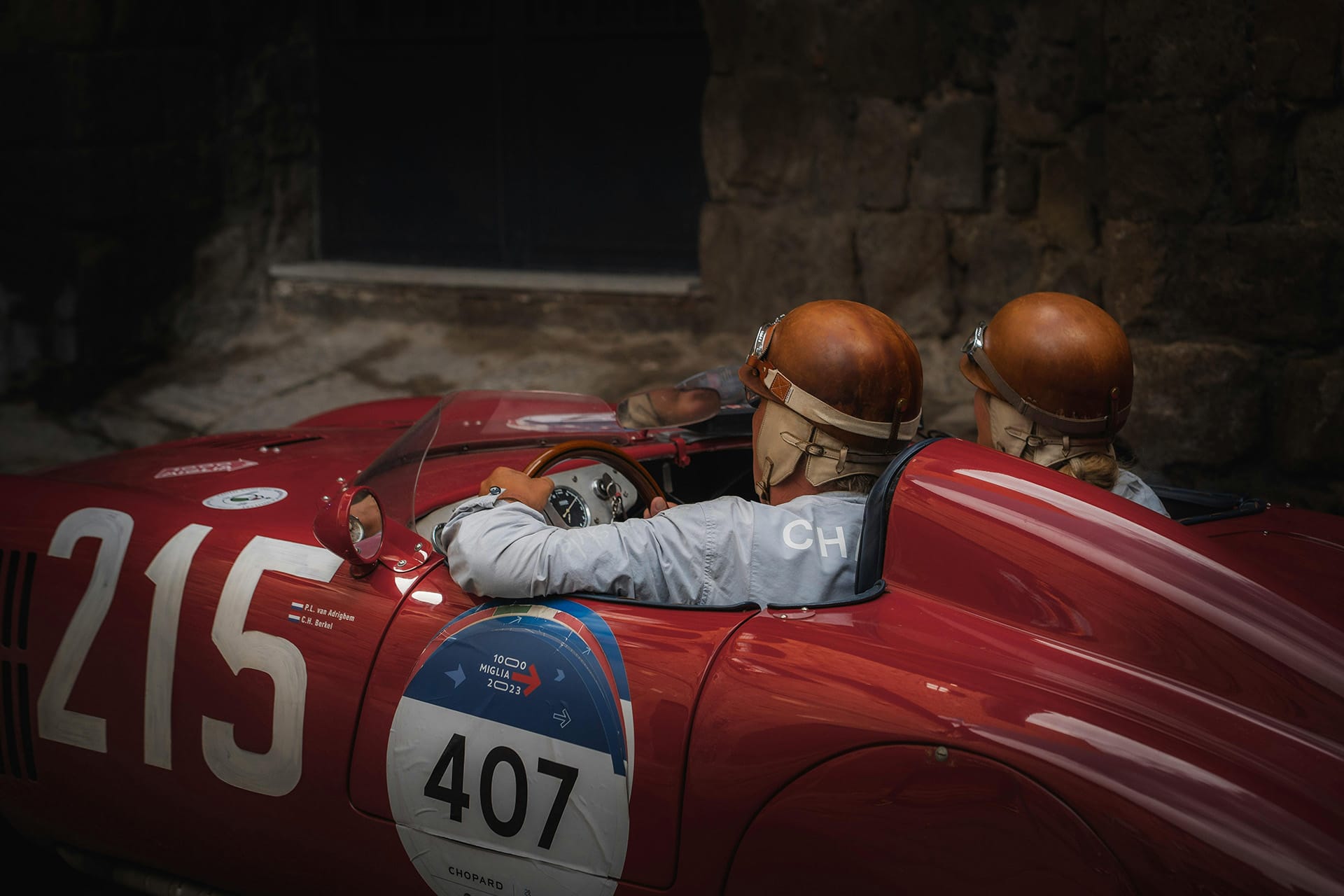
The cars that run now are far slower than the men who founded the race could have imagined anyone wanting them to be, and that, in the end, is the point. Speed was what the Mille Miglia proved, and speed was what destroyed it. The rievocazione keeps neither the danger nor the contest. It keeps the roads. Each spring the same line through Lombardy, Emilia, Tuscany, and Lazio fills again with the sound of old engines, and for a few days a country looks once more at the landscape its most famous race first revealed to it: the climbs, the river crossings, the piazzas that a thousand-mile loop once strung together into a single continuous thought.
A race is a fast thing, and fast things are forgotten quickly. A road is slow, and it stays. The Mille Miglia gave Italy a way of seeing its own country, drawn at speed and at terrible cost, and when the speed had to be given up the way of seeing did not. That is what returns every June, at a careful pace, on purpose. The race is gone. The road it taught a country to love is still there, and once a year someone drives it slowly, so that the way is not lost.
Latest Info
You can also find all the latest information on the official 1000 Miglia website.
1000miglia.it
Guide to Italy is a letter from an Italy that doesn't write to everyone.
Become a member


