
Before the sun is fully up over Brescia, the sound arrives first. Not a roar, not the assault of a modern race, but something closer to a chord: engines tuned decades ago, each with its own register, moving in procession through streets still cold and barely lit. The crowd standing along Viale Venezia does not cheer so much as watch, in the particular silence of people witnessing something they half-expected to feel but find themselves feeling more than they anticipated. By the time the last car has passed, Italy has already changed shape.
The 44th rievocazione storica of the 1000 Miglia 2026 runs from 9 to 13 June, departing from and returning to Brescia. The route covers the Italian peninsula over five days in a figure-of-eight that traces, as closely as the living road network permits, the geometry of the original race.
In this article
The history of the 1000 Miglia classic car race
The original race ran twenty-four times between 1927 and 1957. It was an open road circuit from Brescia to Rome and back, roughly a thousand miles of ordinary Italian road driven at full speed. In its early years it was almost entirely an Italian affair, and the names it produced became inseparable from the race itself.
Tazio Nuvolari, who in 1930 chased down his Alfa Romeo teammate Achille Varzi through the pre-dawn darkness with his headlights switched off (following Varzi's tail lights in silence at over 150 km/h, appearing alongside him only in the final three kilometres) won in a moment that motor racing has never quite stopped discussing. With his navigator Battista Guidotti, Nuvolari crossed the finish line first, completing the race at an average of 100 km/h: the first time in Mille Miglia history anyone had broken that threshold.
By the 1950s the field had opened, and Formula 1 World Champions Juan Manuel Fangio and Alberto Ascari, alongside Stirling Moss, all drove the Brescia to Rome axis. In 1955, Moss and his navigator Denis Jenkinson completed it in a Mercedes-Benz 300 SLR at an average of 157.6 km/h, a record that has never been broken. Jenkinson had spent months preparing a paper scroll of pace notes, over seventeen feet long, encoding every bend and crest of the course. The two men drove for ten hours, seven minutes and forty-eight seconds without stopping, except once, in Rome. Two years later, in 1957, the Spanish driver Alfonso de Portago lost a tyre near Guidizzolo, less than fifty kilometres from the finish. He died, as did his co-driver Edmund Nelson and nine spectators, five of them children. The race never ran again in its original form.
The history
The history of the Mille Miglia: how a thousand-mile race made and lost a legend.
Before you follow this year's route, meet the race behind it. Our companion piece tells the full story of the Mille Miglia, from its 1927 origins to the 1957 tragedy that ended it and the re-enactment it became.
From an open road circuit to the modern rievocazione storica
The rievocazione storica, established in 1977, revived the format as a regularity event in which precision over the route replaces raw speed. Only vehicles whose model competed in at least one of the original editions are eligible to enter, making the convoy a moving inventory of early automotive machinery: Alfa Romeo, Fiat, Ferrari, the occasional Porsche or Jaguar. Around 400 cars are selected each year from applicants representing twenty-nine countries, each paired with a driver and navigator, moving against a fixed time schedule across five days.
The governing logic of the event has not changed since 1977. The cars are not reproductions. The roads, where they survive, are the same roads. The distance (approximately 1,600 kilometres in the modern route) is somewhat shorter than the original circuit, but the sequence of landscapes it traverses remains faithful to the race's founding idea: that Italy, driven through at speed, reveals itself differently than it does to anyone standing still.
Italy, unscripted
Privately yours.
A monthly masterclass in Italian culture. Decode the local lifestyle through expert analysis and hidden gems.
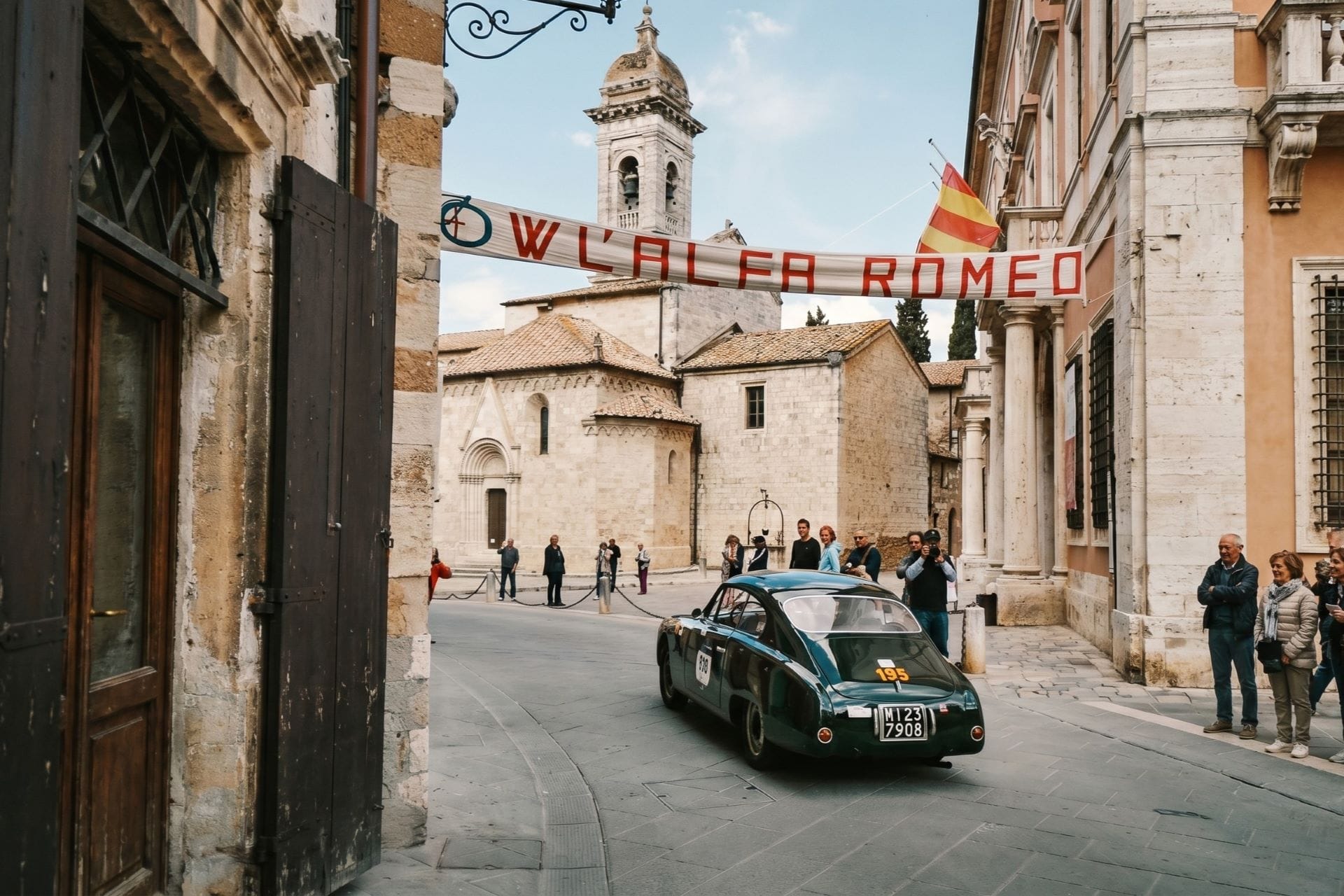
Mapping the 1000 Miglia 2026 route from Brescia to Rome
Rather than a curated scenic drive, the 1000 Miglia 2026 route slices through a cross-section of the Italian peninsula dictated entirely by history. The 2026 edition follows a figure-of-eight course in which the outbound and return legs cross at Ferrara rather than retracing the same road.
The convoy leaves Brescia on the morning of 9 June, moving east through the Valle Trompia and over the Passo del Cavallo before descending to Lake Garda, then on to Vicenza and Padova, the first overnight stop. The following day carries the cars westward across the Po plain: Ferrara, Modena, Reggio Emilia, and then the climb over the Passo dell'Abetone into Tuscany, ending at Montecatini Terme.
On the third day, 11 June, the convoy moves toward the Tyrrhenian coast through Versilia and Pietrasanta, a town whose workshops have supplied marble carving to sculptors from Michelangelo's time to the present, before turning inland for lunch at Siena's Piazza del Campo. South of Siena, the route enters the volcanic lake country of Lazio: the basalt-rimmed shores of Lago di Bolsena and Lago di Vico, the tufa towns above them, Viterbo, and the long descent toward Rome. The city acts as a time control checkpoint, a stamp on a card, a brief pause of a few hours before the convoy turns north.
The return leg, beginning on 12 June, takes a different axis entirely. From Rome the cars pass through Assisi, where, in 2026, the eighth centenary of the death of St Francis is being marked, then Gubbio, one of the best-preserved medieval towns in Umbria, before threading through the Gola del Furlo, the narrow limestone gorge on the old Via Flaminia where the road was cut through solid rock by Roman engineers in the first century AD. The fourth stage ends at Rimini, on the Adriatic. The fifth and final day, 13 June, crosses the salt pans of Cervia and the lagoon at Comacchio, reaches Ferrara where the outbound and return routes intersect, and concludes with a last lunch at Mantova before the final run into Brescia and the finish on Viale Venezia.
Mille Miglia 2026
Where to watch the Mille Miglia 2026 — the best places to see the race along the route.
Planning to follow the race in person? Our companion guide picks the finest places to watch, from the Brescia start to a square in Siena and a gorge in Umbria, with practical notes on getting around and where to stay.
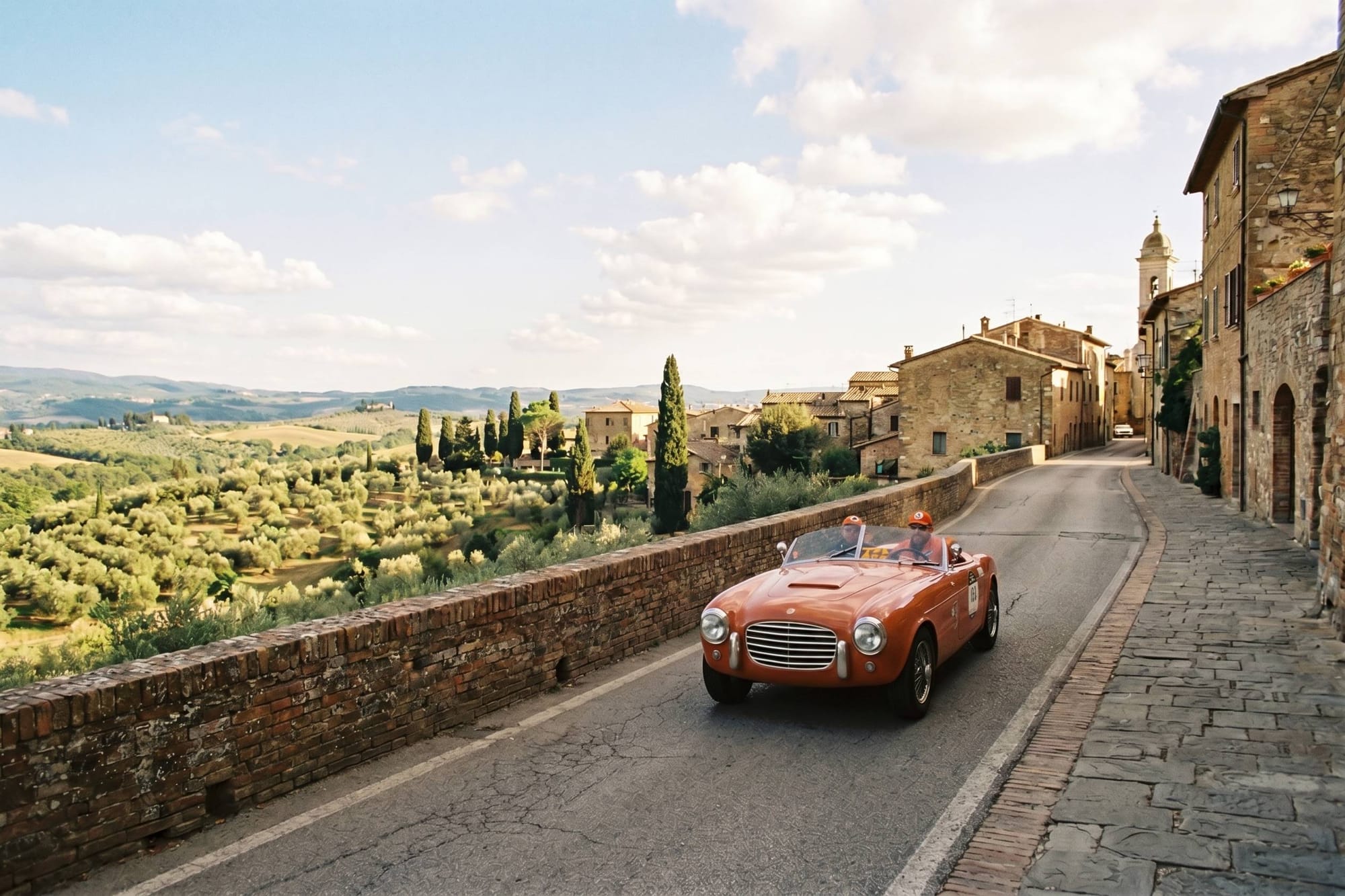
Why the historic Mille Miglia route reveals the authentic Italy
The 1000 Miglia does not discover Italy. What it does is enforce a particular kind of attention. Moving continuously across the peninsula over five days, the convoy registers transitions that any fixed itinerary would miss: the shift in building stone as Tuscany gives way to Umbria, the exact moment the Apennines release into the Arno basin, the way the volcanic Lazio landscape around Bolsena does not announce itself but simply appears, dark and very still, at the edge of the road.
The vintage vehicles, while beautiful, serve primarily as a catalyst. They draw spectators into corners of the country that the main circuits of Italian tourism rarely reach, not because those places are obscure, but because there has never previously been a reason for them to fill on a Wednesday morning in June. The Gola del Furlo is a case in point: an extraordinary piece of Roman engineering on an ancient road that predates the Apennine tunnels by two thousand years, traversed by the 1000 Miglia because it was traversed by the original race, which used it because it was always the fastest way through. The race follows the logic of the land.
What the 1000 Miglia provides is something harder to name: it gives a reason for a piazza in Gubbio to fill on a Friday morning, or for someone in a village above Lago di Bolsena to stand at the edge of the road and watch something pass that has been passing, in one form or another, for nearly a century. The cars are beautiful objects in a landscape worth crossing even without them. The race simply makes that landscape briefly, precisely, visible.
Essential guide to watching the 1000 Miglia 2026
- Dates: the 2026 edition runs from 9 to 13 June, with technical scrutineering on 7 and 8 June in Brescia.
- Route: a figure-of-eight course of approximately 1,600 kilometres over five days, from Brescia to Padova, across to Montecatini Terme, south through Siena and the Lago di Bolsena to Rome, then north via Assisi, Gubbio, the Gola del Furlo, Rimini, Comacchio and Mantova back to Brescia.
- Eligibility: only vehicles whose specific model competed in at least one of the original twenty-four editions between 1927 and 1957 are allowed to enter.
- Participants: around 400 cars start each year, carefully drawn from applicants representing more than twenty countries.
- Access: the event is completely free to watch from the roadside along the entire route. Full timing and stage details can be found at 1000miglia.it.
Guide to Italy is a letter from an Italy that doesn't write to everyone.
Become a member


