
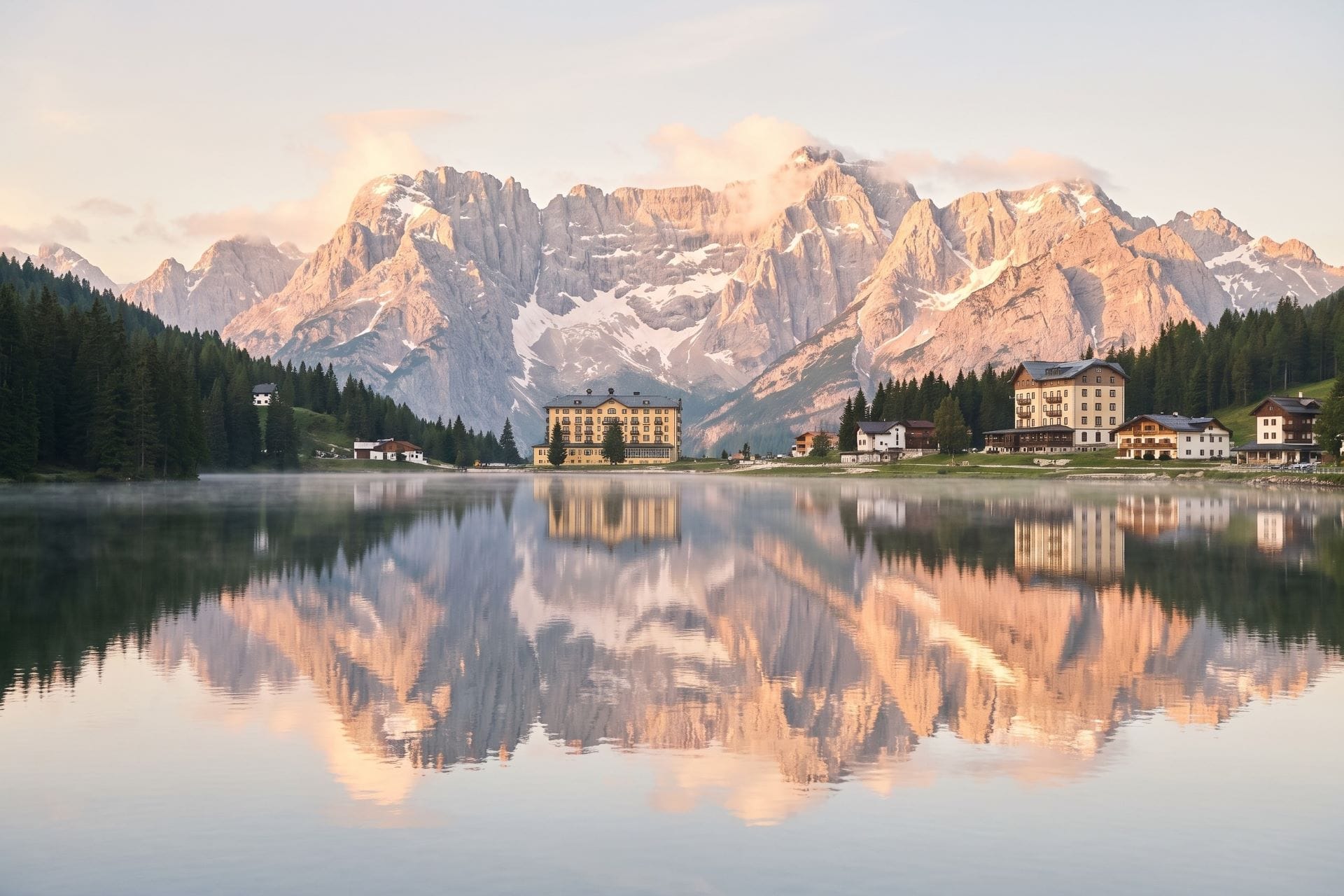
At first light on a Dolomite ridge the rock changes color. The pale carbonate shifts to the shade of a peach skin, then deepens toward ember and rose, the phenomenon the valleys have named enrosadira, the alpine glow that climbs the stone at dawn and returns to it at dusk. The air at that hour holds the particular cold of altitude in August, thin and resinous with larch and stone pine, fifteen degrees below what the valley floor will reach by noon. This is the sensation that defines northern Italy in summer, and it has an exact counterpart a few hours to the south and west, on the long bright surface of the great lakes, where the same season arrives not as something escaped but as warmth held and slowed by deep water. The north carries two summers at once, the vertical and the horizontal, and the distance between them is short enough to cross in a single journey.
In this article
- 01 Why northern Italy in summer is the season the crowds miss
- 02 The Dolomites in summer: peaks, mountain huts and via ferrata
- 03 The Aosta Valley and western Alps in summer
- 04 The Italian lakes in summer: Como, Garda and Maggiore
- 05 Planning a northern Italy summer: routes, transport and timing
- 06 What northern Italy does best in summer
- 07 The case for two summers in northern Italy
Why northern Italy in summer is the season the crowds miss
Air temperature falls by roughly six degrees for every thousand meters of ascent, so a valley floor at thirty degrees becomes a hut terrace at eighteen, and the nights turn genuinely cold. That is the plain arithmetic behind the sensation. While the coast and the art cities absorb the great bulk of the Italian summer, the alpine north and the lakes take only a fraction of it, and the relief they offer in exchange is the one thing the season cannot otherwise supply. Beside the lakes the relief is a matter of pace and of light: deep water moderates the air, the worst of the heat breaks by late afternoon, and the long reflective surface does something to the light that no stretch of coastline manages.
The Dolomites and the western Alps are vast enough to absorb their own visitors: a trailhead can be crowded and the ridge above it empty within the hour. Space is the second part of the argument. The lakes are smaller and more concentrated, and in high season the famous shores of Como do fill, but the country immediately behind them opens the moment one turns inland or climbs.
The north rewards a traveler willing to read a place rather than tick it off, and that is the part that takes a season or two to learn. Its rewards are specific and they do not advertise themselves: a named pass, a particular face of rock at a particular hour, one garden on one island.
Summer 2026
Italy in summer 2026: the complete guide to an unscripted season
The northern register is one of three. Read the full editorial on Italy in summer 2026, from the coast and the cities to the alpine north and the lakes.
The Dolomites in summer: peaks, mountain huts and via ferrata
The Dolomites are not the Alps, and the distinction matters. They are a separate range of pale dolomitic limestone, rock that began as a coral reef and lagoon on the floor of the Triassic sea and was lifted, folded and weathered over millions of years into the towers, pinnacles and sheer walls that give the range its character. UNESCO inscribed the Dolomites as a World Heritage Site on 26 June 2009, a serial property of nine distinct areas recognized both for scenic beauty and for the geological record exposed in the rock, which preserves the recovery of marine life after the greatest extinction event in the planet's history. The range straddles the autonomous region of Trentino-Alto Adige/Südtirol and the province of Belluno in the Veneto, and that same pale stone produces the enrosadira named at the opening of this guide.
The peaks that anchor each valley, from the Tre Cime to the Marmolada
The Tre Cime di Lavaredo (Drei Zinnen in German, the region being bilingual and in places trilingual) are the three blunt towers of the postcard, the tallest of them the Cima Grande at just under three thousand meters, circled on a roughly ten-kilometer loop from the Rifugio Auronzo. The Marmolada, at 3,343 meters the highest summit in the Dolomites, is known as the queen of the range and carries its largest glacier, a body of ice that has retreated markedly over recent decades. The serrated wall of the Sassolungo (Langkofel) rises above the Val Gardena; the Catinaccio (Rosengarten) keeps in its German name the legend of King Laurin's rose garden, said to flush the rock red at dusk; the broad, flat-topped Sella massif is ringed by the four passes that make up the celebrated Sella Ronda circuit; and the slender spires of the Cinque Torri, easily reached above Cortina, stand among the restored trenches and gun positions of an open-air First World War museum. Each anchors a different valley and a different day on foot.
Hut to hut on the Alta Via 1
Summer is the season the range was built for, and the classic way to take it is hut to hut. The Alta Via, the high route, is the name for the numbered long-distance trails that link the massifs from north to south. The Alta Via 1, the most traveled and the gentlest of them, runs for roughly 120 kilometers from the cobalt water of Lago di Braies (Pragser Wildsee) toward Belluno over about ten days, climbing to its high point at the Rifugio Lagazuoi at 2,752 meters and demanding no technical climbing along the way. Each night is spent in a rifugio (plural rifugi), the staffed mountain inn that serves meals and dormitory beds and is the social heart of dolomitic walking, a destination in itself rather than mere shelter. The huts fill early: a summer traverse means reserving beds months in advance, and the reliable window runs from roughly mid-June to late September.
Via ferrata and the First World War routes cut into the ridgelines
For those drawn to contact with the rock there is the via ferrata, literally the iron path, a route protected by fixed cable and steel rungs that lets a walker move over ground which would otherwise call for a climbing rope. Many of the originals were cut into these mountains during the First World War, between 1915 and 1917, when the front between Italy and Austria-Hungary ran along the highest ridgelines and the fighting became a war of altitude. Above the Passo Falzarego the Lagazuoi still holds the tunnels and mine galleries the soldiers dug into the limestone, now restored as walkable routes reached by a cable car and among the most vivid open-air records of that mountain war. A ferrata calls for a helmet, a harness and a shock-absorbing lanyard, and the harder lines are best taken with a guide.
Why 2026 matters: the Milano Cortina Olympic legacy for summer travelers
The Milano Cortina 2026 Winter Olympic Games were staged across alpine sites that included Cortina d'Ampezzo, Bormio, Livigno, Anterselva and the Val di Fiemme, the Games running from 6 to 22 February and the Paralympics from 6 to 15 March. The organizing model relied heavily on what already stood: eleven of the thirteen competition venues, about eighty-five percent, were existing or temporary, and new construction was kept deliberately low. The legacy that matters to a summer walker is not the sport but the everyday infrastructure the Games brought forward and left in place. Medical services were modernized across the mountain districts, the Codivilla hospital in Cortina, the health center at Livigno and the San Martino hospital in Belluno among them; the venues were upgraded for energy efficiency; and the transport plan was built around trains and shuttles rather than the private car. The valleys are better connected and better equipped in 2026 than they were two years earlier, in August as much as in February.
Destinations
The ultimate guide to the Dolomites
Which valleys to base in, how to plan a hut to hut traverse, and when the high routes open: our full editorial on the Dolomites, valley by valley.
The Aosta Valley and western Alps in summer
The Aosta Valley (Valle d'Aosta), against the French and Swiss borders at Italy's far northwestern edge, is one of the least visited corner of the alpine north. It is the smallest of Italy's regions and a special-statute autonomous one, officially bilingual in Italian and French, with a Franco-Provençal patois still spoken in the side valleys. The doubled language is the first sign of a borderland that has kept a culture distinct from the rest of the country.
A Roman and Romanesque valley, from Augusta Praetoria to Sant'Orso
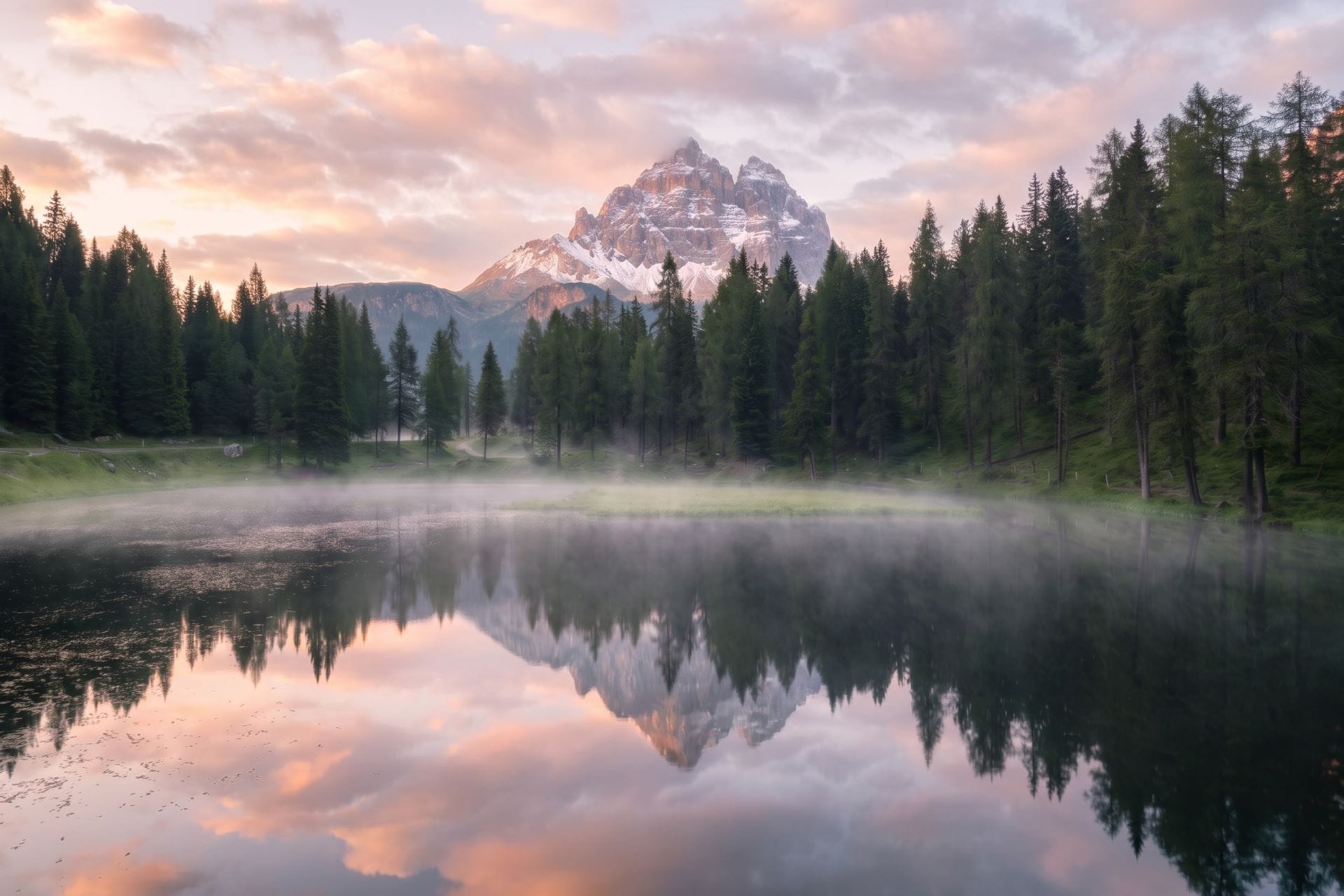
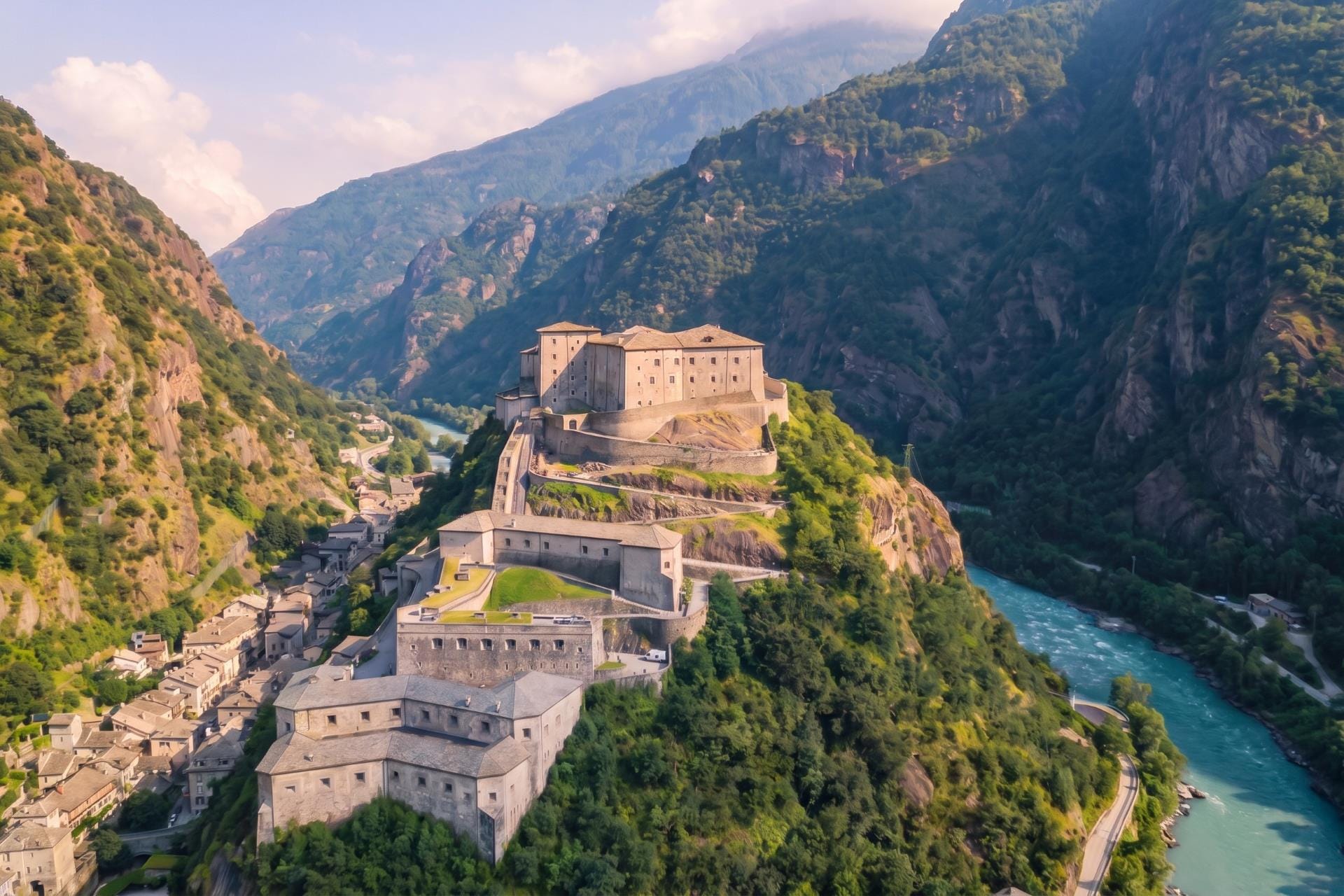
Rome founded the valley's capital in 25 BC as Augusta Praetoria, and the modern town of Aosta still turns on that Roman grid: the Arch of Augustus, the Porta Praetoria and the standing wall of the Roman theater are part of the daily street plan rather than a fenced ruin. From the Middle Ages the valley kept a Romanesque heritage, above all the collegiate church of Sant'Orso, with its Ottonian fresco cycle concealed above the vaults and a cloister whose carved capitals are among the finest of their kind in the Alps. The road to the high passes was guarded by castles, and many survive: Fénis with its concentric walls and painted courtyard, and the Forte di Bard, the great fortress that closes the lower entrance to the valley and now holds museums.
The highest mountains in the Alps: Mont Blanc, the Matterhorn and Gran Paradiso
The mountains here are the highest in Western Europe. Mont Blanc (Monte Bianco), at 4,808 meters the highest summit in the Alps, rises directly above the resort town of Courmayeur, which the Mont Blanc tunnel links to Chamonix on the French side; the Skyway Monte Bianco cable car, opened in 2015, climbs from the valley to Punta Helbronner at 3,466 meters in rotating glass cabins that turn through a full circle as they rise. The Matterhorn (Cervino), at 4,478 meters the unmistakable pyramid on the Swiss border above Breuil-Cervinia, and the Monte Rosa massif, the second highest in the Alps, whose summit, the Dufourspitze, reaches 4,634 meters and is the highest point in Switzerland, close the valley's other heads. The Italian valleys below Monte Rosa, around Gressoney, are still home to the Walser, a people of Germanic origin who settled these high pastures in the Middle Ages and keep their own alpine dialect. South of Mont Blanc stands the Gran Paradiso, at 4,061 meters the only mountain above four thousand meters that lies entirely within Italian territory, and the national park that carries its name. King Victor Emmanuel II declared these slopes a royal hunting reserve in 1856, a decision that, for all its sporting motive, saved the Alpine ibex from extinction; his grandson Victor Emmanuel III ceded the land to the state, and on 3 December 1922 Gran Paradiso became the first national park in Italy. It remains contiguous with the French Vanoise park, the two managing between them the ibex herds that cross the shared watershed, all of them descended from that protected remnant.
Thermal baths, fontina and the food of the high valleys
The thermal baths at Pré-Saint-Didier, fed by a hot spring below Mont Blanc, have drawn visitors since the spa age. The cooking is mountain food built for cold and altitude: fontina, the washed-rind cow's-milk cheese aged in mountain cellars and carrying protected-origin status, which anchors the local fonduta, set beside cured hams and dark rye breads, and génépy, the herbal liqueur distilled from high-altitude artemisia. Even the vineyards climb. Around the villages of Morgex and La Salle, at the foot of Mont Blanc, the white Blanc de Morgex et de La Salle is pressed from ungrafted Prié Blanc vines grown near 1,200 meters, among the highest in Europe, on a slope so cold that the phylloxera louse which devastated the rest of the continent's vineyards never reached it. Few foreign travelers reach this valley in summer, and that scarcity is precisely its argument.
The Italian lakes in summer: Como, Garda and Maggiore
The three great lakes share a latitude and very little else. Choosing among them is the most useful single decision a northern summer asks, and the differences are differences of kind, not of degree.
Lake Como, for depth, villas and literary weight
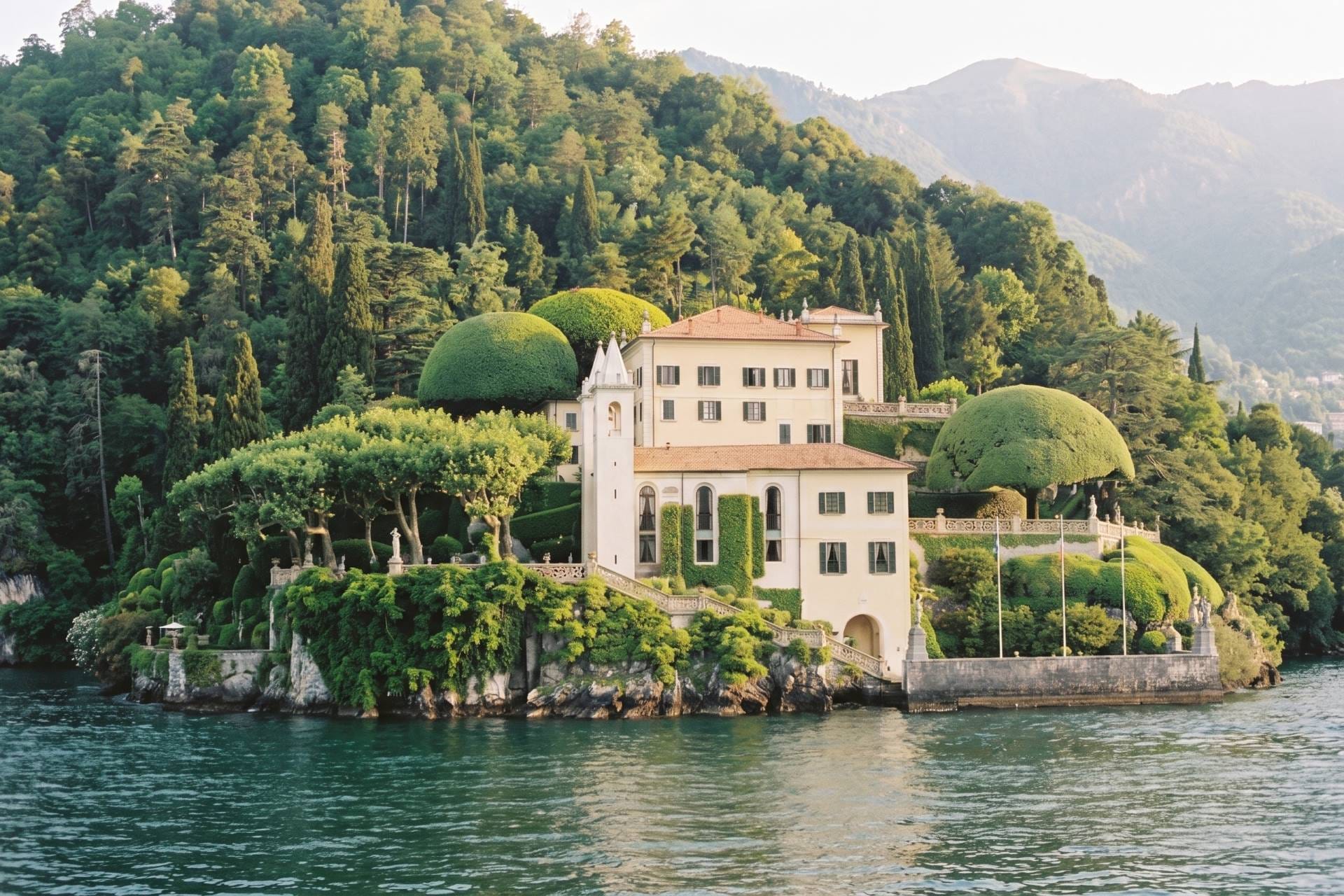
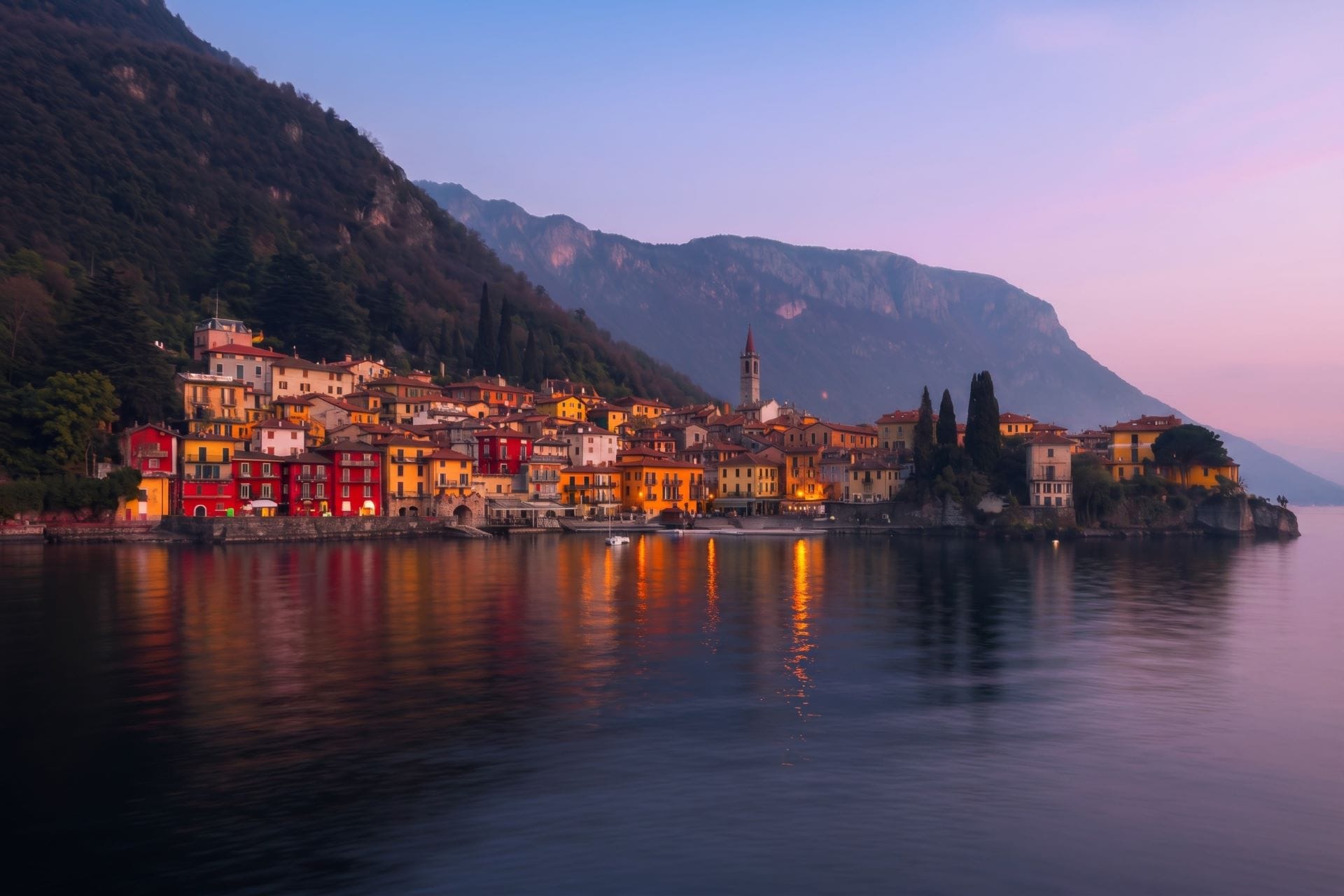
Lake Como is the intimate and literary one. Shaped like an inverted Y, with the promontory of Bellagio, long called the pearl of the lake, standing where the two southern branches divide, it is narrow, steep-sided and more than four hundred meters deep, among the deepest lakes in Europe, and its mountain walls hold the water in a kind of permanent enclosure. This is villa country, and has been for two thousand years: Pliny the Younger kept two villas on these shores in Roman times, and the line runs unbroken through Villa del Balbianello on its wooded point at Lenno, now in the care of the FAI, the Italian national trust, and reached only by boat or a path through the woods; Villa Carlotta at Tremezzo, whose botanical garden flares with azalea and rhododendron in late spring; and Villa Melzi below Bellagio. It is also the country of the page. Alessandro Manzoni set the opening of I Promessi Sposi (The Betrothed), the founding novel of modern Italian prose, on the lake's eastern branch, and the silk looms of the city of Como, which still weave for the Italian fashion houses, have dressed European fashion for generations. Como holds a single island, Isola Comacina, and on the weekend nearest 24 June it stages the festa di San Giovanni, when the bay is lit with fire and the night turns to spectacle, the clearest single expression of what the Como register offers in late June. The deep, cold water warms enough to swim by midsummer at the lidos of Lenno and Menaggio, and Varenna, on the quieter eastern shore, makes the most restful base.
Destinations
The ultimate guide to Lake Como
The villas, the gardens and the quieter eastern shore, with where to base and which towns reward the turn inland: our full editorial on Lake Como.
Lake Garda, two climates in one lake
Lake Garda is the largest of the Italian lakes and by far the most varied, a single body of water that contains two climates. Its northern end, around Riva del Garda and Torbole, is genuinely Alpine, a fjord of vertical cliffs swept by two dependable winds, the Pelèr that blows from the north in the early morning and the Ora that returns from the south in the afternoon, which together have made it one of Europe's serious sailing and windsurfing waters. From Malcesine, on the eastern shore, a cable car with cabins that rotate through a full circle climbs to the ridge of Monte Baldo at around 1,760 meters, a mountain so rich in plants it is known as the garden of Europe; the village's Scaliger castle is the one Goethe stopped to sketch in 1786, on the journey recorded in his Italian Journey, where he was briefly taken for a spy. Its southern end is almost Mediterranean: olive groves that press one of the most northerly olive oils in the world, the white wines of Lugana and the light red Bardolino, the lemon houses (limonaie) terraced above Limone sul Garda, and the long thermal peninsula of Sirmione, with the Roman villa ruin known as the Grotte di Catullo at its tip and the moated Scaliger castle at its root. The shallower south is also where the water is warmest for swimming. The same lake offers lemon terraces in the morning and a sheer Alpine wall by the afternoon.
Lake Maggiore, the Borromean islands and the older grammar of leisure
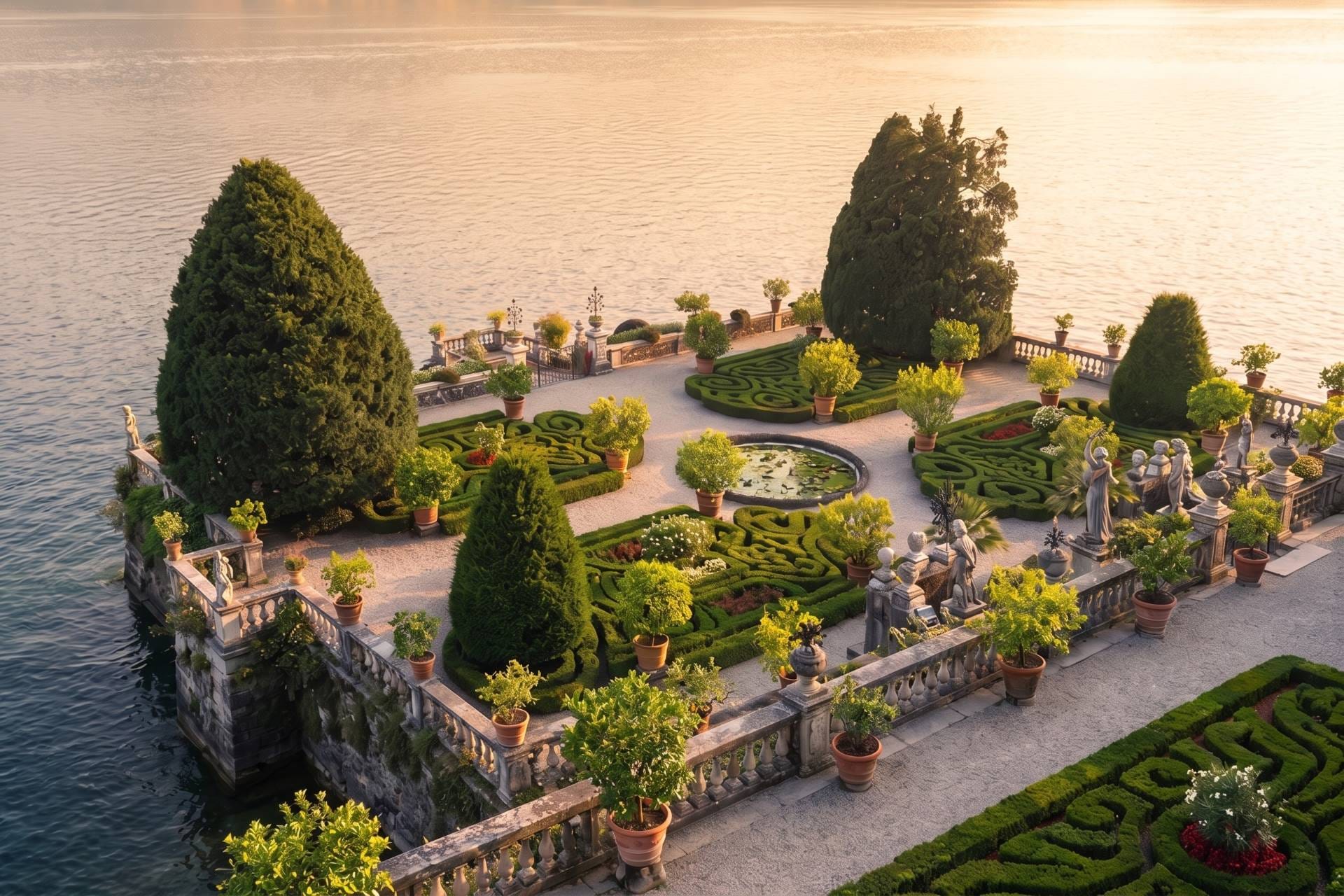
Lake Maggiore belongs to an older tradition of aristocratic leisure, and it wears it openly. The second largest of the Italian lakes, it reaches north across the border into Swiss Ticino, and on the old Grand Tour the English so admired its gardens that Ruskin called it an Eden. Its set piece is the group of Borromean islands off Stresa: Isola Bella, Isola Madre and the fishermen's Isola dei Pescatori. Isola Bella carries a baroque palazzo and a terraced Italian garden laid out for the Borromeo family from the seventeenth century, stage upon stage of clipped greenery, statuary and white peacocks rising straight out of the water in a piece of pure theatrical design, while Isola Madre, the largest, keeps a gentler English-style botanical garden around a venerable Kashmir cypress more than two centuries old. The belle-époque grand hotels of Stresa face the islands across the channel; in one of them, the Grand Hotel des Îles Borromées, Ernest Hemingway convalesced from his First World War wound and set part of A Farewell to Arms. Across the water at Verbania the gardens of Villa Taranto, planted from the 1930s by a Scottish captain, Neil McEacharn, gather species from across the world, and on the eastern shore the monastery of Santa Caterina del Sasso clings to the cliff above the lake. Maggiore is the lake of the slow promenade and the long view, and it asks to be taken at that register.
Swimming, ferries and the smaller lakes
By midsummer the deep water that keeps the lakeside air mild has itself warmed enough for swimming, and the shallower southern reaches of Lake Garda reach the most comfortable temperatures of the three. The public ferry network that crosses Como, Garda and Maggiore is transport and pleasure at once, the slow zigzag between shores being one of the most agreeable ways to spend a hot afternoon. Beyond the three great lakes lie quieter alternatives of the same family: Lake Iseo, ringed by the sparkling-wine vineyards of Franciacorta, and small Lake Orta with the monastic island of San Giulio at its center.
How to choose between Como, Garda and Maggiore
The basis for the choice is character before scenery: Como for depth, enclosure and literary weight; Garda for range, movement and two climates in one lake; Maggiore for formal grandeur and the older grammar of leisure. Beyond character, the practical differences sort themselves quickly. Como sits closest to Milan, barely forty minutes by train, and rewards the traveler who comes for villas, gardens and a certain glamour rather than for the water itself; its shores are steep and its central towns fill in high season, so its calm is found early in the day or on the quieter eastern arm. Garda is the most varied and the easiest to swim, with sailing and a near-Alpine edge in the north and warm shallows, beaches and wine towns in the south; it suits a longer, more active stay and a party of mixed ages, and it lies east toward Verona rather than Milan. Maggiore is the slowest and most genteel, a lake of islands, grand hotels and botanical gardens, best suited to those content to move by ferry from one garden to the next. There is a geography to combining them, too. Como and Maggiore both sit on the Milan side and pair naturally into a single western loop, while Garda, on the road to Verona, falls more easily into a journey that continues east toward the Dolomites.
Planning a northern Italy summer: routes, transport and timing
Altitude first then water, or water first then altitude: the order of a two-part northern journey is a real decision rather than a detail. Altitude first suits the high-summer traveler, who takes the mountains in the worst of the July and August heat, when the cool air is the whole point, and descends to the lakes in the softer edges of the season. Water first suits the reverse calendar, the lakes in early summer before they fill and the high routes later, once the snow has cleared from the passes and the rifugi are fully open. A week given to each half is a realistic minimum, and a fortnight holds both without haste.
Getting there and getting around, airports and the rail spine
Milan is the gateway for the lakes and the western Alps. Its three airports serve different traffic, Malpensa the intercontinental flights, Linate the close-in European ones, Bergamo Orio al Serio the low-cost carriers, and all feed a rail network from which direct trains reach Como in about forty minutes, Stresa on Lake Maggiore, Varenna for the middle of Lake Como, and Desenzano and Peschiera for the southern shore of Garda. The Aosta Valley is reached from Milan or Turin by regional train and road along the valley floor. The Dolomites are reached from Verona or Venice, whose airports open the eastern side of the north, and from there the Brenner line runs toward the Austrian frontier, with fast trains to Trento and to Bolzano (Bozen) and a branch at Fortezza (Franzensfeste) into the Val Pusteria; beyond the railheads the regional buses climb into Val Gardena, Alta Badia and Val di Fiemme. Cortina d'Ampezzo has no station of its own; the approach is by rail to Calalzo or to Dobbiaco (Toblach) and then by road, and it is precisely this last connection that the Milano Cortina 2026 transport upgrades have improved. With this spine of fast trains, regional lines and mountain buses in place, a car is useful for the side valleys but never strictly necessary.
Practical details
The shape of a northern summer
Lift seasons, trail openings and ferry timetables shift from one year to the next. Confirm each against the official operator before fixing a date.
What northern Italy does best in summer
The first of these pleasures is gastronomy at altitude. A rifugio lunch eaten on a terrace with a rock face in front and the valley a vertical kilometer below is a particular kind of meal, and the cooking of the high Dolomites, where the Italian and Austrian traditions meet over dumplings, cured meats and mountain cheese, is among the most distinctive in the country. The second is the South Tyrol wine bar at dusk. Under the painted porticoes of Bolzano (Bozen), at the heart of Alto Adige (Südtirol), a glass of the deep local Lagrein or the lighter Vernatsch as the heat lifts from the stone is a small and exact pleasure, and the whole story of the region's table, its growers, its cellars and its mountain kitchens, is told in [South Tyrol wine and dining]. 〔link → Spoke 06: "A table in the mountains: South Tyrol wine and dining"〕
The third is silence. A Dolomite sunrise watched from a hut terrace, the enrosadira moving down the rock as the light comes up, is as near to stillness as an Italian summer offers. The fourth is its opposite, and just as composed: the terraced garden of Isola Bella at the hour the day boats leave, the baroque stages going gold above the water as the lake settles. The north holds both extremes, the wild and the cultivated, within a few hours of each other, and it does each of them better than the rest of the country manages in the heat of August.
The case for two summers in northern Italy
The north resists the way Italy is usually taken in summer, which is quickly and in quantity. It does not reward the traveler who means to collect it. Its pleasures are specific and unhurried: a single pass at the right hour, a single garden after the crowds have gone, the particular cold of a high dawn and the particular warmth of a lake at evening. They are also, and this is the point, close together. The enrosadira on a Dolomite wall at sunrise and the terraces of Isola Bella going gold at dusk belong to the same short span of travel, joined by little more than a morning on a train. The argument of this guide has been that these two registers, the vertical and the horizontal, altitude and water, are not alternatives to be chosen between but a single season to be taken whole. The contrast is the reward.
A journey that holds both leaves with the rarer thing: not a sequence of sights but a sense of how a country breathes when the rest of it has gone to the coast. The high north stays cold and clear through the hottest weeks; the lakes stay calm and slow. Between them lies the part of the Italian summer that the heat and the crowds have never reached.
Summer 2026
The whole season: Italy in summer 2026
This guide covered the altitude and the water. For the coast, the islands and the art cities in the same months, return to the season's main edition.
Guide to Italy is a letter from an Italy that doesn't write to everyone.
Become a member


