
On the evening of the race, the streets that climb toward Piazza del Campo carry a sound that arrives before the square comes into view: the drums of the contrade, the rise and fall of the district songs, the pull of an entire city moving in one direction. By the time the Campo opens out below, it is already a sea of people, the medieval shell of brick and stone holding tens of thousands in the gold light of a Tuscan summer evening. For a few hours, one of the most refined small cities in Europe gives itself over completely to something far older than tourism.
The race itself lasts barely ninety seconds, yet it draws tens of thousands into a square with no shade and a single way in. Almost everything that determines the quality of the day, where to stand, where to sleep, how to secure a view, happens long before arrival. Approached without preparation, it can mean six hours pinned in a baking square with no way out and no idea what is unfolding. Approached with knowledge, it is unforgettable for the right reasons.
This guide gathers what matters in practice: when to come, where to watch, how seats are genuinely obtained, where to stay and eat, the makers worth seeking out, and the unwritten code that separates a welcome guest from an intrusion. The race itself is quickly told. Ten of Siena's seventeen contrade, the city's historic districts, are drawn by lot to run, and the horses gallop bareback for three laps of the Campo, roughly a kilometre in all, in about ninety seconds. The start, the mossa, is held between two ropes, and the last district to line up, the rincorsa, chooses the instant the field is launched. A horse that loses its rider can still win, the cavallo scosso, so long as it crosses the line first. For the full history, the seventeen contrade and their rivalries, and how the race is contested in detail, the companion article, The Palio di Siena, covers that ground in full.
In this article
The complete guide
The Palio di Siena: history, the contrade, and how the race works
This practical guide is one part of our full editorial on the Palio. For the origins, the seventeen contrade and their rivalries, and how the race itself is contested, start with the main piece.
When to go to the Palio di Siena: 2 July or 16 August
The first decision is which race to attend: 2 July, the Palio della Madonna di Provenzano, or 16 August, the Palio dell'Assunta, for the Assumption. The two dates do not shift for the calendar, both are the same event in form, and both fill the Campo completely, but they differ in ways that matter to a traveler.
The July race falls before the most punishing heat and before the mid-August holiday, when much of Italy is on the move and Siena is at its fullest. It tends to be marginally easier for travel, for rooms, and for movement around the region. The August race carries the heavier historical weight, as the older of the two civic feasts, and it arrives with the full intensity of high summer, hotter, busier, and for many contrada members the one that matters most. Neither is objectively better. A traveler whose Tuscan itinerary naturally falls near one date should simply commit to that one and plan around it early.
In rare years the city stages a third race, a palio straordinario, for an anniversary it judges historic. These are announced well in advance and have no fixed date. In an ordinary year, the choice is July or August, and the rest of this guide applies equally to both.
What happens in the four days before the race
The race is the final ninety seconds of a four-day sequence, and treating the Palio as a single afternoon is the most common mistake visitors make. The days before it hold much of the meaning, and most of the value for a visitor who has planned well. The full cycle opens three days before the race and builds, hour by hour, to the moment the rope drops.
The tratta: the morning draw that assigns the ten horses
The sequence begins on the morning of the third day before the race, 29 June for the July Palio and 13 August for the August one, with the tratta. After veterinary checks and trials, ten horses are selected from a larger pool and assigned to the ten running contrade by public draw in front of the Palazzo Pubblico. The decisive point, and the one that surprises most newcomers, is that no contrada chooses its horse: a district that has waited a year for its turn can draw a strong animal or a weak one entirely by chance. From that instant the contrada enters a heightened state, the horse is guarded day and night, and the Capitano, the contrada's elected race captain, begins the negotiations on which the race may turn.
The six trial races, the prove, in the Campo
Over the following three days the assigned horses run six trial races, the prove, two each day, one in the morning and one in the early evening, in the Campo. The trials let horse and jockey learn the steep, banked track and read the field, and they are the informed traveler's quiet advantage: entry to the center of the square is free, the crowds are a fraction of race day, the contrada colors fly, and a real start is run. The fifth trial, on the evening before the race, is the prova generale, the closest rehearsal to the real thing. The sixth, the provaccia, runs on the morning of race day and is deliberately taken at little effort to spare the horses before the afternoon.
The eve: the cena della prova generale, the contrada dinner
The night before the race belongs to the cena della prova generale. The streets of every running contrada fill with long communal tables for an open-air dinner of hundreds, the jockey often seated among them, the district singing late into the night. Outsiders are genuinely welcome to take a place if they ask in advance through the contrada's society, and the modest cost buys something no grandstand can: an evening inside the community rather than alongside it. For a visitor who wants to understand what the race means, this single dinner does more than any other moment of the four days.
Race day: the blessing, the Corteo Storico, and the start
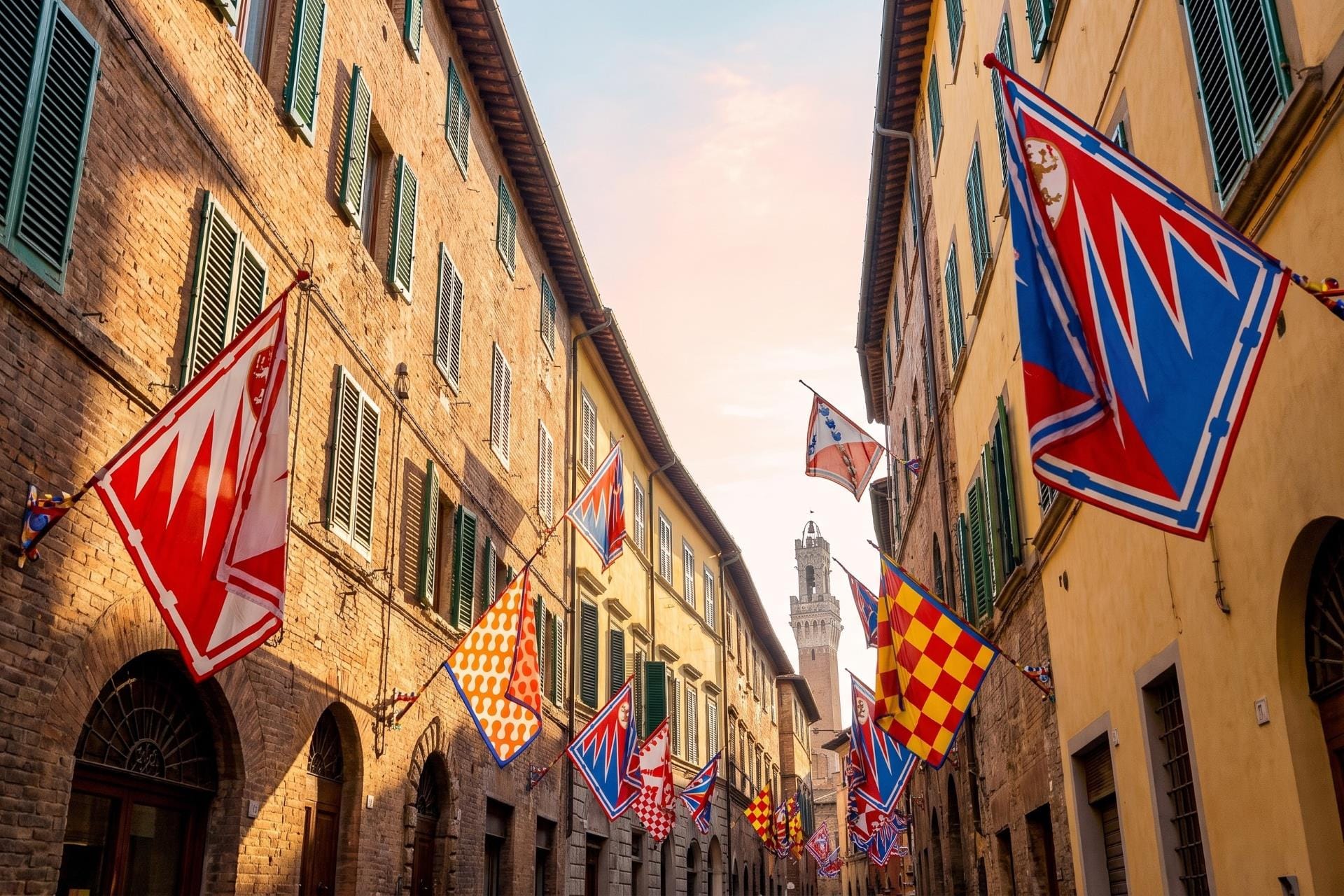
Race day opens with the morning provaccia and, by early afternoon, moves to its most charged ritual of all, inside each contrada's own church, where the horse is led to the altar and blessed with the words va' e torna vincitore, go and return a winner. The districts then form up for the Corteo Storico, the long procession in fifteenth-century costume that files into the Campo through the afternoon, with drummers and the synchronized flag-throwing of the sbandierata. Only when the procession is complete do the ten horses come out, and the city falls silent for the start.
Where to watch the Palio di Siena: the center, the stands, and the windows
There are essentially three ways to watch the race, and the gap between them is enormous.
The free center of Piazza del Campo
The center of Piazza del Campo, the earth-floored space inside the track, is free and open to all, and it is where the Sienese themselves gather. It is also an ordeal that should not be underestimated. The crowd packs in for hours under a high-summer sun, the entrances are sealed roughly forty-five minutes before the start, and once the square is full there is no leaving and returning, no shade, no seating, and no facilities. Anyone choosing the center should arrive by mid-afternoon, carry water and sun protection, and accept the wait as the price of standing where the emotion is most raw.
The grandstands, the palchi, from about €160 to €400
Temporary grandstands, the palchi, are built around the perimeter of the track and sell for roughly €160 to €400, with the positions near the start and finish commanding the most. A seat in a stand means a guaranteed place reached at leisure rather than hours held standing in a crowd, which for many travelers justifies the cost on its own. The stands sell out well ahead and are best arranged by the spring before the race.
The windows and balconies, from about €350
Above the stands, the windows and balconies of the private palazzi offer the finest sightlines and the steepest prices, generally from around €350 and climbing past €1,000 for a balcony over the start. They are the most comfortable and the most coveted vantage of all, looking straight down onto the track and the dangerous corner of San Martino, and the best of them are spoken for many months in advance.
How to get Palio di Siena tickets and secure a seat
There is no central box office for the Palio, which is the single fact that surprises nearly every first-time visitor. The grandstand places are controlled by the businesses in front of which they stand, the windows and balconies by the families who own the buildings or managed quietly through local brokers. For a traveler, relying on a premium hotel concierge or a private travel designer is almost always the most reliable route.
The best positions are arranged months ahead, and for a window over the start, six to twelve months is not excessive. Prices and availability are also genuinely opaque, and a traveler is paying as much for access and certainty as for the view itself. For those who decide late, or who balk at the cost, the trial races remain the rational fallback, free, far less crowded, and run in the same square by the same horses.
It helps to picture the booking as a single ladder. Windows over the start go first, spoken for six to twelve months ahead. Rooms inside the walls follow, gone six months to a year in advance and often carrying multi-night minimums. Grandstand seats are best secured by the spring before the race, and the better restaurant tables book out in the weeks beforehand. Only the free center and the trial races ask for no commitment at all.
The spending follows the same shape. A grandstand seat runs from roughly €160 to €400 and a window from €350 upward, but the larger figure is usually the room: during Palio weeks the best addresses charge a steep premium and impose minimum stays, so the realistic budget is the seat plus several nights in a city at its most expensive.
Where to stay in Siena for the Palio
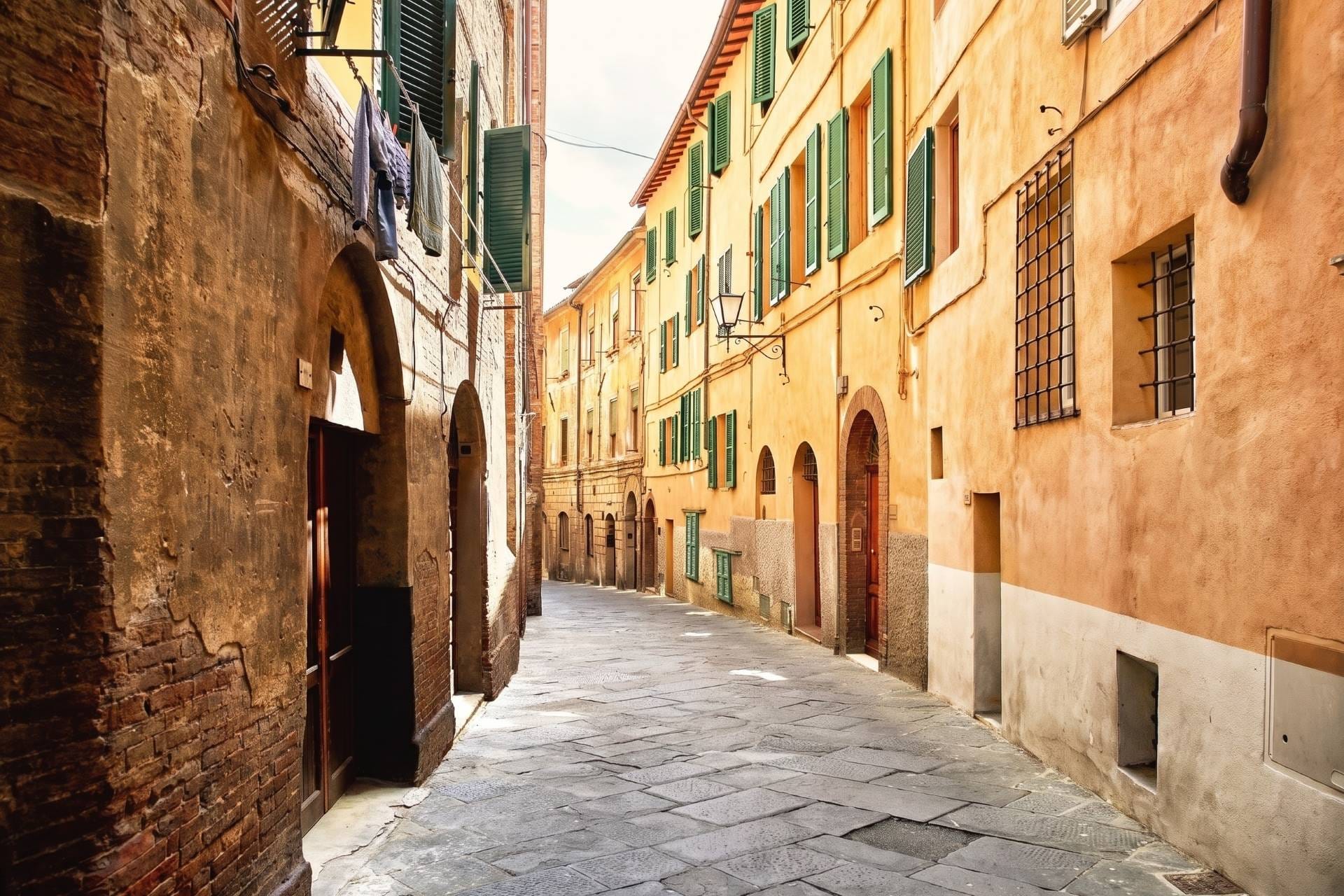
Siena inside its walls is small, and during Palio weeks its rooms are the most sought-after in Tuscany. Accommodation books out six months to a year ahead, prices rise sharply, and many properties impose minimum stays of several nights. Reserving early is not an optimization here; it is the difference between staying in the city and not.
Where to stay inside Siena's walls
For a base within the walls, the Grand Hotel Continental, on Via Banchi di Sopra, is the only five-star in the historic center, set in a sixteenth-century palazzo and a member of The Leading Hotels of the World. Campo Regio Relais is an intimate boutique property featuring antique furnishings, whose terrace gives one of the loveliest private views over the rooftops to the Duomo, while Palazzo Ravizza, a historic residence with a quiet garden near the southern edge of the center, offers period character at a gentler register. All three are rare during Palio and should be approached as early as possible.
Destination guide
Where to stay, eat, and what to see across the city through the year, beyond the days of the race. Our full insider guide to Siena.
Where to stay in the countryside: the Val d'Orcia and beyond
South of Siena, in the Val d'Orcia, basing in the countryside trades a short drive for calm and a far wider choice of serious places to stay, and the visit becomes coming into the city for the days that matter rather than surrendering to its crush. Rosewood Castiglion del Bosco occupies a five-thousand-acre estate with its own Brunello di Montalcino winery and a Michelin-starred dining room, roughly forty-five minutes from the city. West toward Casole d'Elsa, Belmond Castello di Casole commands a hilltop over the hills it once farmed. Either makes a refined home from which to approach the Palio without losing a moment of the surrounding Tuscany.
Destination guide
The Val d'Orcia: the complete guide
The valley south of Siena, a considered rural base for the Palio and a destination in its own right. Where to stay and what the landscape rewards, season by season.
Where to eat in Siena during the Palio
Siena rewards serious eating, and during Palio the better tables book out well in advance, so reserving ahead is essential.
Refined Sienese restaurants near the Campo
For refined Sienese cooking, Osteria Le Logge, on Via del Porrione a few steps from the Campo, has been a benchmark since 1977, with a wine cellar carved into an ancient vaulted tunnel. Antica Osteria da Divo serves ambitious Tuscan cooking in vaulted rooms cut from soft volcanic rock, and La Taverna di San Giuseppe, near the Duomo, is the address for truffle and aged Tuscan beef in medieval cellars. Tre Cristi, in a fifteenth-century building and trading since the early nineteenth century, leans toward refined seafood, an unusual register for the city, while Particolare di Siena pairs contemporary cooking with an elegant, modern space defined by clean lines and contemporary design.
Two tables with a direct Palio connection
Salumeria Il Cencio, named for the Palio banner itself, is one of the rare addresses with a small balcony onto the Campo, ideal for a considered lunch of cured meats and panini above the square. And Trattoria Bagoga, opened in 1973 by Pierino Fagnani, a former Palio jockey for the Selva contrada, is about as close as a restaurant comes to the race itself, a proudly regional kitchen run by a man who once rode in it.
What to buy in Siena: crafts and edible souvenirs
The most meaningful things to bring home from Siena are made by hand, often by families who have worked the same craft for generations.
Crafts tied to the Palio: barberi, flags, and ceramics
For objects tied directly to the Palio, Siena passione e follia, the workshop of Simone Bocci on Via San Pietro, produces barberi, the painted wooden balls of the children's Palio game, alongside contrada flags and district-themed pieces. For ceramics in the old Sienese tradition, Antica Siena, the workshop founded by Marisa Martini on Via del Capitano and now run by Leonardo Giorgi, makes and ships pieces worldwide. And for something closer to the city's sacred art, the Bottega d'Arte of the Perinetti Casoni family on Via di Stalloreggi paints icons in tempera and gold leaf, in the manner of the medieval Sienese masters.
Edible souvenirs: panforte and ricciarelli
Antica Drogheria Manganelli, on Via di Città and trading since 1879, is the most atmospheric place in the city to buy panforte, the dense spiced fruit-and-nut cake, and ricciarelli, the soft almond biscuits, both Sienese to the core. Nannini, the historic Sienese pasticceria, is the other name to know for the same specialties. For those who want to take the Palio itself home, Foto Studio Donati on Via di Città keeps a large archive of race photography and runs photographic workshops in the surrounding countryside in summer.
Palio etiquette: the unwritten code
The Palio is not a performance staged for visitors, and the surest way to be welcomed is to behave as a guest rather than a spectator.
How to behave inside a contrada
In the days before the race, the colors worn, the songs sung, and the rivalries observed all carry meaning, and wearing the scarf of a contrada one has no tie to, particularly that of a district's declared enemy, is a real misstep. At a contrada dinner, a guest who has been invited is expected to respect the seating, the toasts, and the fierce pride of the table, and to understand that the evening belongs to the community, not to the visitor enjoying it. Treating the contradaioli as people first and subjects second is, in the end, what earns the kind of access that no ticket can buy.
Where photography is welcome, and where it is not
The blessing of the horse inside the contrada church is a solemn religious moment, and cameras there are generally unwelcome, while the Campo and the Corteo Storico are fair game and expected. The simplest rule is to read the room: where a moment is devotional or private, the camera rests, and where the city is performing its history in public, it does not.
On race day: heat, timing, and getting around Siena
Coping with the heat and timing an arrival
July and August in Siena are punishing, the square offers no shade, and the waits run for hours, so water, a hat, and sun protection are not optional for anyone in the center. Those with a seat in a stand or window have an easier day but should still plan to be in position well before the Corteo Storico begins, as the streets around the Campo grow dense and slow in the final hours.
Getting around Siena's closed center on Palio days
Siena's historic center is closed to traffic, and on Palio days the restrictions tighten further, so a car is of no use inside the walls and parking is confined to lots outside the gates. The city is well connected by train and bus, and for those staying in the countryside a driver or transfer arranged through the hotel removes the parking problem entirely. The center is steep and cobbled throughout, which is worth bearing in mind for anyone with limited mobility, as the crowds and closures on race day make the gradients harder still.
Watching the 2026 race
Why the Palio di Siena rewards the effort
The Palio cannot be consumed in passing, and that is precisely its value. It asks for a little preparation and a measure of respect, and it returns something almost no other event in Italy can: not a show arranged for an audience, but an entire city briefly visible as itself, running a ritual it has never stopped performing. A traveler who arrives knowing when to come, where to stand, and how to behave is no longer a tourist watching from outside. They are a guest, for a few extraordinary days, in one of the last places in Europe where the past is not preserved but lived.
The Campo will be covered in earth again on 2 July and 16 August, as it has been for centuries, indifferent to who has come to watch. To be there well, and knowingly, is one of the great experiences that Italy still offers. The planning is the easy part, and the time to begin it is now.
Continue reading
The Palio di Siena: the complete guide
Return to the main editorial on the Palio for the full story behind the four days described here: the contrade, the history, and the meaning of the race to the city.
Latest Info
You can also find all the latest information on the official Palio di Siena website.
palio.comune.siena.it
Guide to Italy is a letter from an Italy that doesn't write to everyone.
Become a member


