
Summer 2026
Our summer 2026 guide to Italy, season by season and shore by shore.
The festa di San Giovanni is part of our summer 2026 coverage. For where to go and when across the Italian season, start from our "Summer 2026" hub.
Just before half past ten on a Saturday night in late June, the only island on Lake Como begins to burn. Several hundred red flares ignite in sequence along its low rock, a recorded voice moves across the water, music rises, and for the better part of an hour the Isola Comacina appears to be on fire while the lake beneath it holds a second blaze in reflection. This is the festa di San Giovanni, also known as the Sagra di San Giovanni, the most famous fireworks display on Lake Como, an event where the sheer scale of the modern spectacle, drawing thousands of spectators to the lakeshore road, often obscures the historical memory of the red light.
What the fire re-enacts is a memory of one real night. On 24 June 1169, the feast of St John the Baptist, the island was sacked and put to the torch as an act of political revenge. The standard way to experience the evening, pressed onto the Statale Regina among the crowd with the noise of a closed road behind, is precisely the way to miss what makes it singular. Understanding what is being commemorated, and choosing a vantage on the water rather than on the tarmac, turns a folkloric spectacle into the most resonant night of summer on the Lario, the old name for Lake Como.
In this article
- 01 An act of retribution: the 1169 burning of Isola Comacina
- 02 The festa di San Giovanni today: two evenings on Lake Como
- 03 The island after the curse: eight empty centuries, then artists
- 04 How to see the festa di San Giovanni: watching the fireworks from the water
- 05 The island that became its own fire
An act of retribution: the 1169 burning of Isola Comacina
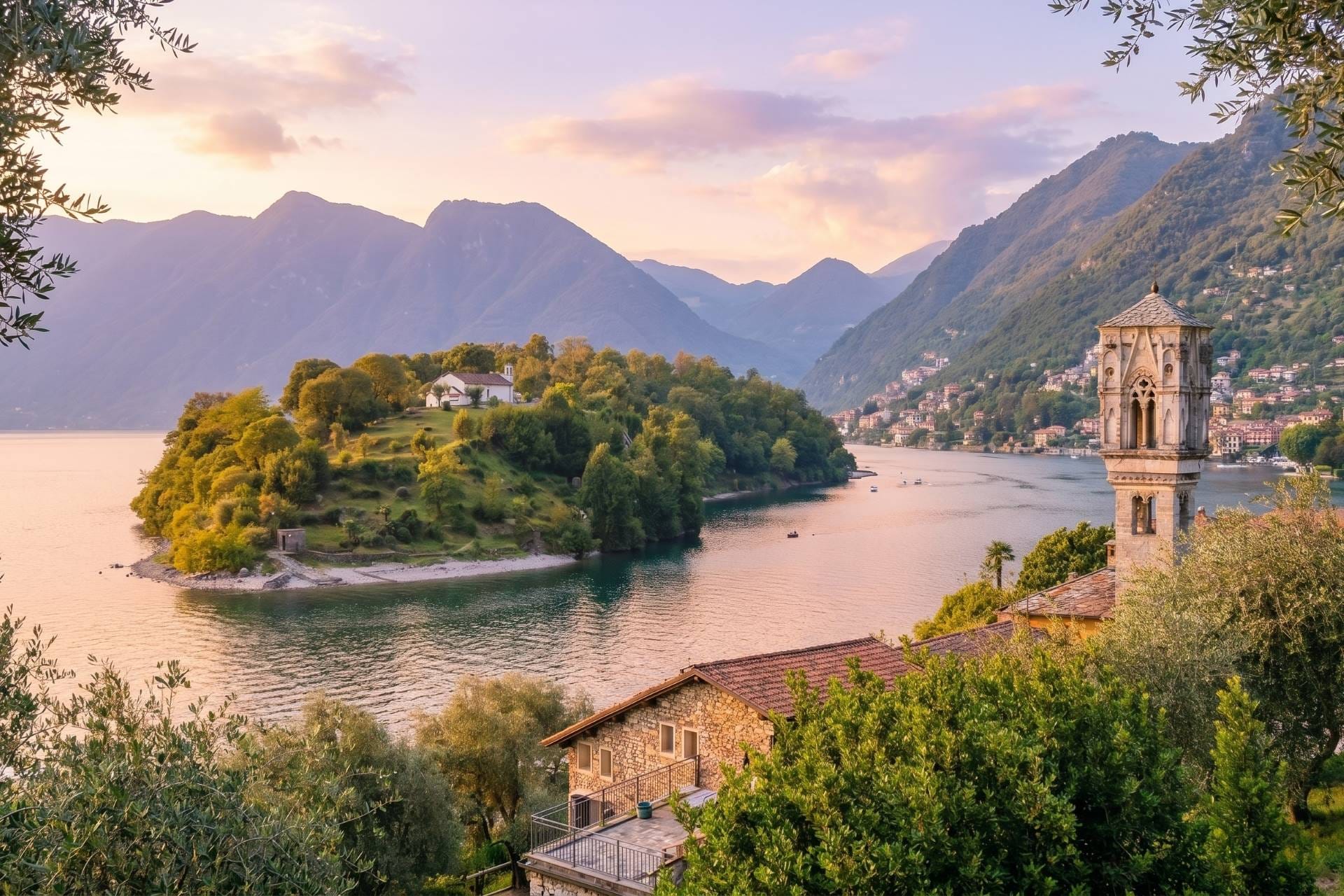
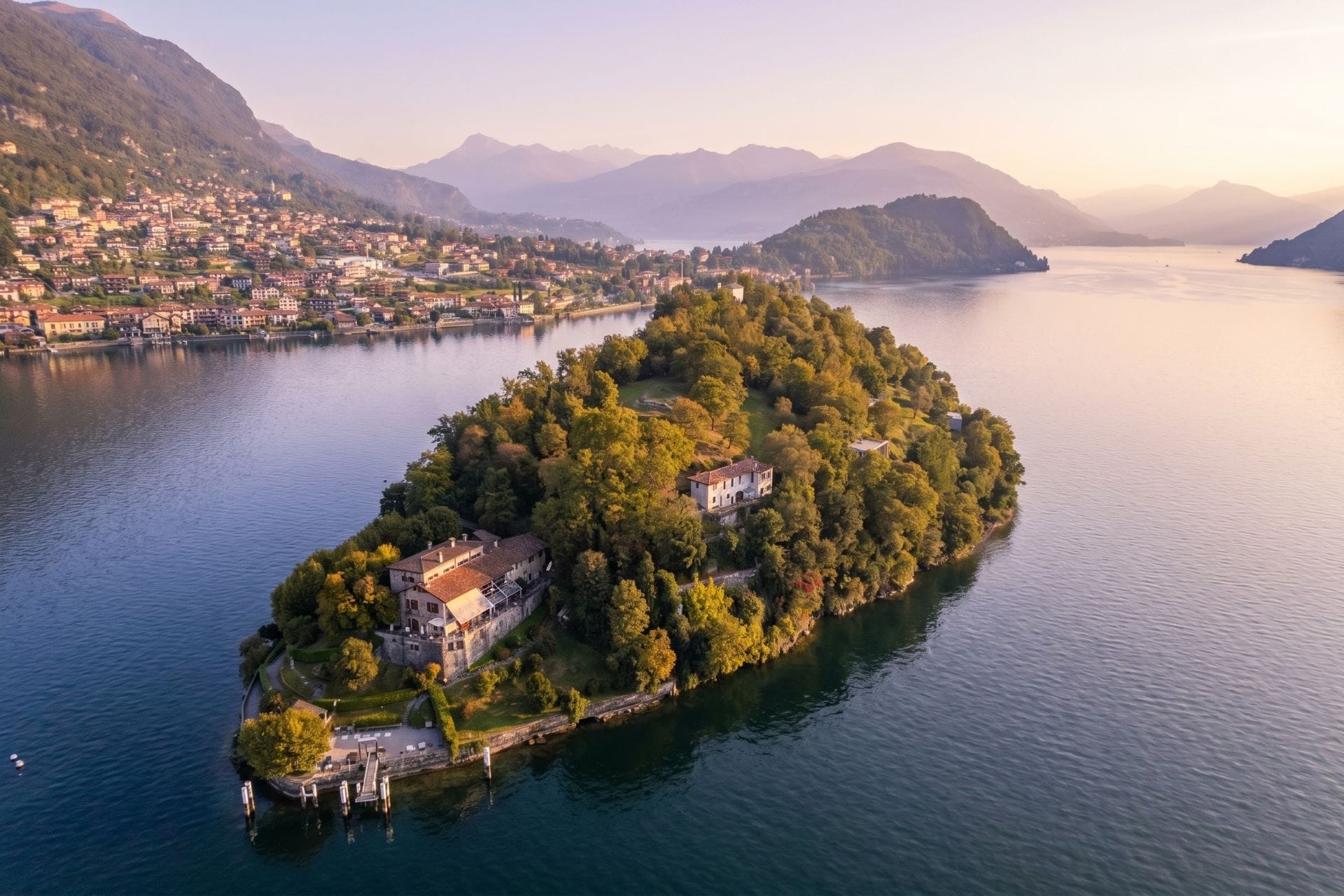
The Isola Comacina is the only island on Lake Como, a low wooded rock roughly six hundred meters long lying a short distance off the shore between Ossuccio and Sala Comacina, in the Comune di Tremezzina on the western side of the Centro Lago. In the twelfth century it was anything but quiet. During the rivalry between Como and Milan known as the Ten Years' War, which began in 1118, the island and much of the Lario sided with Milan. Como was conquered in 1127, then rebuilt its strength in alliance with the Emperor Frederick I, called Barbarossa. The reckoning came on the night of 24 June 1169, the feast of St John the Baptist, when Como and its imperial ally sacked the fortified island and burned it. The nine churches that stood on the rock were destroyed, among them the basilica of Sant'Eufemia, and the survivors fled across the water to Varenna on the eastern shore, which tradition says took the name insula Nova, the new island. The Comacina itself was effectively abandoned for centuries.
Tradition holds that the destruction carried a second, stranger consequence that the festa keeps alive. The bishop of Como, named in the sources as Vidulfo, is said to have pronounced an anathema over the ruined island: no bell would ring there again, no stone be set upon stone, and no host ever keep an inn, on pain of violent death. Whether those exact words were ever spoken is impossible to confirm, and the curse is best understood as legend rather than documented speech. What is not in doubt is its effect on the island's reputation. For most of the next eight centuries the Comacina stayed empty, and the red flares that climb its rock each June recreate the 1169 fire, narrated aloud so that the burning is unmistakably the burning of 1169 and not a generic show.
The festa di San Giovanni today: two evenings on Lake Como
In 2026 the festa falls across the weekend of 27 and 28 June. The feast of St John is fixed on 24 June, and when that date does not land on a weekend the celebrations move to the nearest Saturday and Sunday, which is why the fire and the procession separate into two distinct evenings.
The piromusical spectacle takes place on the night of Saturday 27 June, beginning at around half past ten. Several hundred flares, a figure local organizers have put at roughly five hundred in recent years, are set off in sequence to light the bay in front of the island, the Zoca de l'Oli, while a narrating voice and music recount the history of the sack. The display runs for something close to forty minutes and is reflected across open water, which is the reason it is so widely held to be the finest fireworks on the lake. Exact timings and the precise number of flares are confirmed by the Comune di Tremezzina each spring, so the scale matters more than any single published figure.
Earlier in the afternoon a regatta of Lucia boats, the flat-bottomed wooden craft traditional to the Lario, crosses the water before the fire. From around seven in the evening, a gastronomic and dancing evening fills the parco comunale at Ossuccio, where the traditional plate is polenta with snails, polenta e lumache. The snails are not incidental.
The sagra dei lumaghitt and the legend of the snail-shell lamps
The festa is known locally as the sagra dei lumaghitt, the festival of the little snail lamps, and the name reaches back to an agrarian story older than the historical re-enactment. In it, villagers whose June harvests were repeatedly ruined by hailstorms invoked St John the Baptist and processed by boat to the island, where a small church carried his name. The storms ceased, the procession was repeated each year, and the night was marked with floating lights. Those lights were the lumaghitt themselves: empty snail shells filled with oil and fitted with a wick, small lamps set out by the hundred. The custom survives in the candles carried on the boats today, and the festa holds both stories at once, the agrarian thanksgiving and the medieval fire, without choosing between them.
On the Sunday morning the religious half of the festa takes over. A historic procession in period costume forms on the mainland and crosses to the island by boat, embarking from the Campo landing stage at Lenno, and Mass is celebrated at around eleven among the ruins of Sant'Eufemia, moved into the church of San Giovanni if the weather turns. It is the same saint, the same island and the same water as the night before, observed in daylight and near silence.
Italy, unscripted
Privately yours.
A monthly masterclass in Italian culture. Decode the local lifestyle through expert analysis and hidden gems.
The island after the curse: eight empty centuries, then artists
For most of the eight centuries after 1169 the Comacina stayed empty, and that long abandonment is where the island becomes genuinely unusual. The curse held, in practical terms, for a very long time: the island stayed uninhabited save for a chapel, its ruins slowly returning to wood and grass. Its modern chapter began in the early twentieth century, when the island passed to King Albert I of Belgium, who in 1917 gave it to the Italian State. The State entrusted it to the Accademia di Brera in Milan with the idea of an artists' colony, a European convention by which a place of beauty and isolation is set aside for work.
Pietro Lingeri's Case per Artisti and Italian Rationalism on the lake
The architect Pietro Lingeri, born in 1894 at Bolvedro di Tremezzo a short distance along the same shore and a graduate of the Brera academy, was commissioned in 1933. His first, more ambitious schemes, a hotel and a larger settlement of houses for Italian and Belgian artists, were rejected, and what he built instead, between 1933 and 1940, were three small Case per Artisti, houses for artists. They are a precise example of Italian Rationalism reconciled with local building tradition: rectangular plans on three levels, large windows opening onto the lake, modern in vocabulary but built from the materials and methods of the Lario. Conceived for short summer stays, they were abandoned by the late 1990s, then restored in a conservation project begun in 2005 and completed around 2009 and 2010 under the direction of the architect Andrea Canziani. They function today as artist residences rather than a public attraction, opened only occasionally for guided architectural visits, a quiet modernist counterpoint to the medieval ruins a few steps away.
The Locanda dell'Isola Comacina and the ritual against the curse
In 1948, undeterred by the anathema, the silk manufacturer Carlo Sacchi and the powerboat champion Sandro De Col engaged the host Lino Nessi to open the Locanda dell'Isola Comacina on a rock then inhabited mainly by snakes. Both backers soon died in unusual circumstances, De Col in a powerboat accident and Sacchi shot at the Villa d'Este, the grand hotel at Cernobbio, events the restaurant's own telling links directly to the curse. The Locanda's answer became a ritual: after a fixed historic menu, the proprietor would flame brandy and coffee in a copper pan while recounting the island's history, a staged exorcism meant to lift the medieval anathema once and for all. It ran for some seventy years. The rite, however, is not currently performed. The Locanda has not operated since 2019, and the restaurant and bar on the island remain closed; while a long-term concession was launched in 2025 to restore the property, the counter-curse remains a suspended tradition rather than a nightly event as of the 2026 season.
How to see the festa di San Giovanni: watching the fireworks from the water
Approaching the festa di San Giovanni merely as a fireworks display watched from the nearest stretch of road strips the night of its deeper context. It trades the historical and human core of the weekend for a purely visual spectacle, invariably ending in a slow departure through heavy lakeside traffic. The correction is partly about knowledge, which the preceding sections supply, and partly about position.
The lakeshore between Argegno and Lenno is the wrong place to stand. On the Saturday, the Statale Regina (SS340) running along the western shore is closed to traffic between Argegno and Lenno; the official window for 2026 runs from 20:00 to midnight, with access limited exclusively to bicycles and motorcycles. Roadside parking is held to a few hundred ticketed spaces, and some twenty thousand people converge on a narrow band of shoreline. Watching from the shore costs nothing, but the view is shared with a crowd and framed by a closed road, and a place near the front means arriving by early evening at the latest.
The water is the better vantage, in three forms with honest trade-offs. A private boat charter positioned off the island gives the most control over where and how the night is seen, at the highest cost and with the longest lead time, since the few operators able to hold a good position on this night are fully booked by early May. The public excursion boats are the middle path: Navigazione Lago di Como, the lake's public ferry operator, runs dedicated San Giovanni evening sailings, with an aperitivo aboard and departures from Como and from the Centro Lago, on a fixed route and timing that typically sell out by late April. The third option keeps both feet on land but faces the right way: a lake-facing table or terrace on the Tremezzina shore, directly opposite the island, which trades the freedom of a boat for comfort and a reserved place. From any of the three the fire reads best where it can be seen whole against open water, with the reflection doubling it below.
For a night rather than an evening, the two logical bases are the Tremezzina shore itself, the villages of Lenno, Mezzegra and Tremezzo that look straight across at the island, and the Bellagio promontory a short way down the lake. The flagship properties of each, the Grand Hotel Tremezzo on the Tremezzina waterfront and the Grand Hotel Villa Serbelloni at Bellagio, anchor a category that also takes in smaller converted villas and lake-house residences along both shores. Any of them places the Centro Lago, and the island, within easy reach for the Saturday and the Sunday both.
The case for staying through Sunday is the heart of the matter. Most visitors leave after the fireworks and never return, which means they see the spectacle and skip the part that explains it. The Sunday procession, the Lucia regatta and the Mass among the ruins of Sant'Eufemia are the older and quieter half of the festa, smaller in scale and far larger in meaning. The fire is the most recent chapter of the island's story. The morning after is the rest of it.
Good to know
The festa di San Giovanni 2026 at a glance
The island that became its own fire
The Comacina spent eight centuries as the lake's cautionary tale, a rock no one would build on, a name fixed to a curse. What is remarkable is not that it burned, but that the burning became the thing people travel to see. Once a year the island is destroyed again, deliberately, in front of a crowd, and the destruction is the celebration. Few places in Italy stage their own history this literally, and fewer still layer it so densely: the medieval sack, the agrarian thanksgiving of the lumaghitt, the Rationalist houses raised for artists who came and went with the summers, the Locanda that once answered a curse with a flame. The fireworks gather all of it into forty minutes of red light on black water. To watch from the road is to see only the light. To read the fire for what it is, and to stay for the quiet that follows it on the Sunday morning, is to see the island whole, which is the only way it was ever worth seeing.
Lake Como
The complete guide to Lake Como, from the Centro Lago to the quiet shores.
The Isola Comacina is one chapter of a much larger lake. For the towns, villas, gardens and waters of the whole Lario, read our main guide to Lake Como.
Latest Info
You can also find all the latest information on the official Isola Comacina website.
isola-comacina.it
Guide to Italy is a letter from an Italy that doesn't write to everyone.
Become a member


