
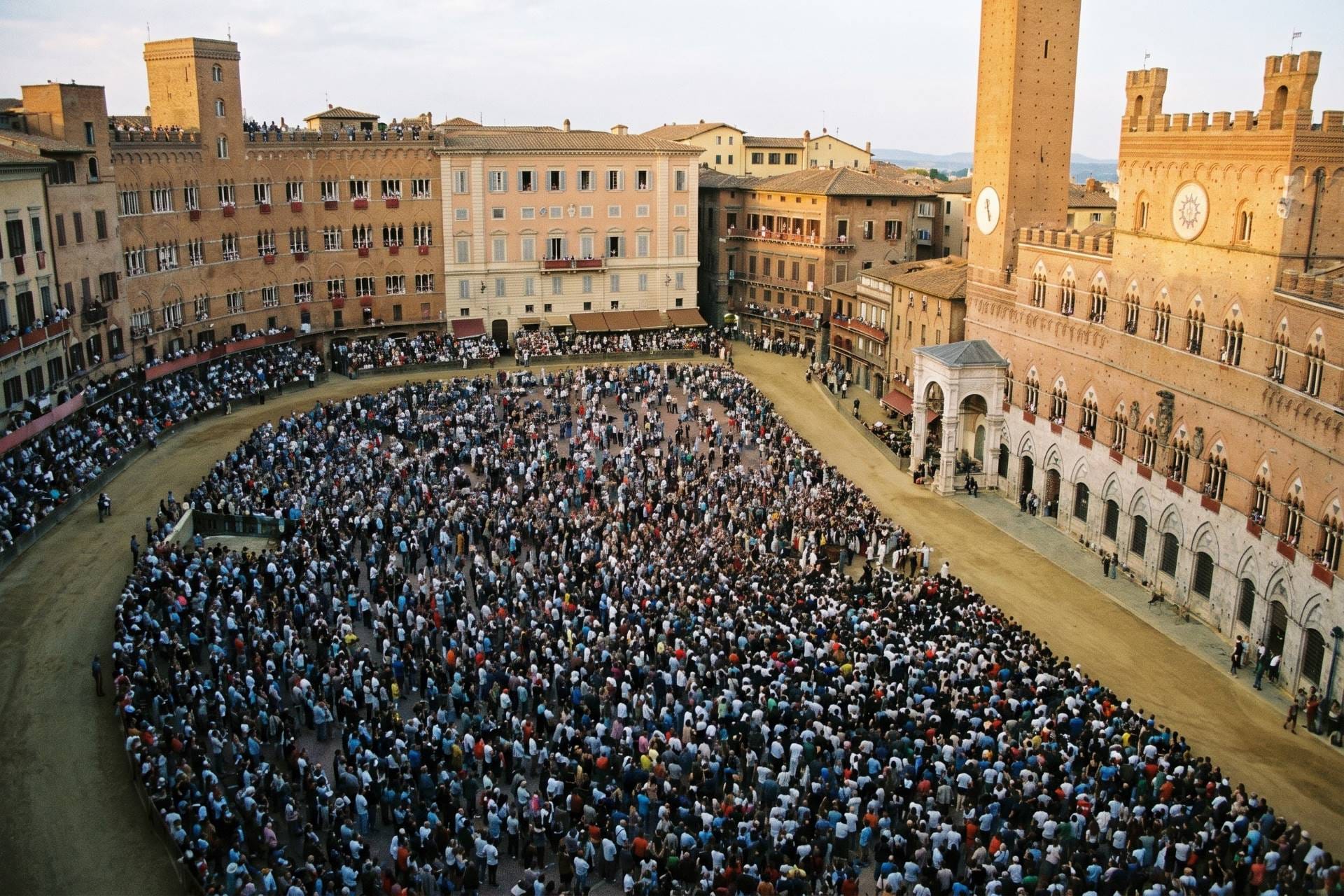
By the late afternoon of a Palio di Siena race day, the shell of Piazza del Campo is already full, and the heat lifts off the packed earth of the track in slow waves. Tens of thousands stand shoulder to shoulder in the center, hemmed inside the ring of the course, while every window, balcony, and rooftop of the surrounding palaces carries its own crowd of faces. The bell of the Torre del Mangia, the great bell tower of the Palazzo Pubblico, has fallen silent. The flags have stopped. For hours the square has roared, and then a single mortar shot announces the horses, and the roar collapses, in one breath, into silence.
Nine horses gather at the rope. The tenth waits behind them, and the city waits with it, every person in the Campo watching for the one movement that will set loose a year of preparation, a lifetime of belonging, and centuries of inheritance. When the rope falls the silence breaks into a wall of sound, and the riders throw themselves bareback down the first slope toward the descent of San Martino. Three laps. Ninety seconds. Then one contrada is in tears, and from the faces alone it is impossible to say whether the tears are triumph or loss.
This is the Palio di Siena, and there is nothing else in Italy that feels remotely like it.
In this article
- 01 What the Palio di Siena really is
- 02 The two Palios: Provenzano and the Assunta
- 03 The seventeen contrade of Siena
- 04 A history of the Palio di Siena
- 06 How the Palio di Siena race works
- 07 Palio week in Siena, day by day
- 09 How to see the Palio di Siena and where to stay
- 10 The Palio di Siena 2026: dates and contrade
- 12 FAQs: Frequently asked questions about Palio di Siena
- 13 Why the Palio di Siena is worth traveling for
What the Palio di Siena really is
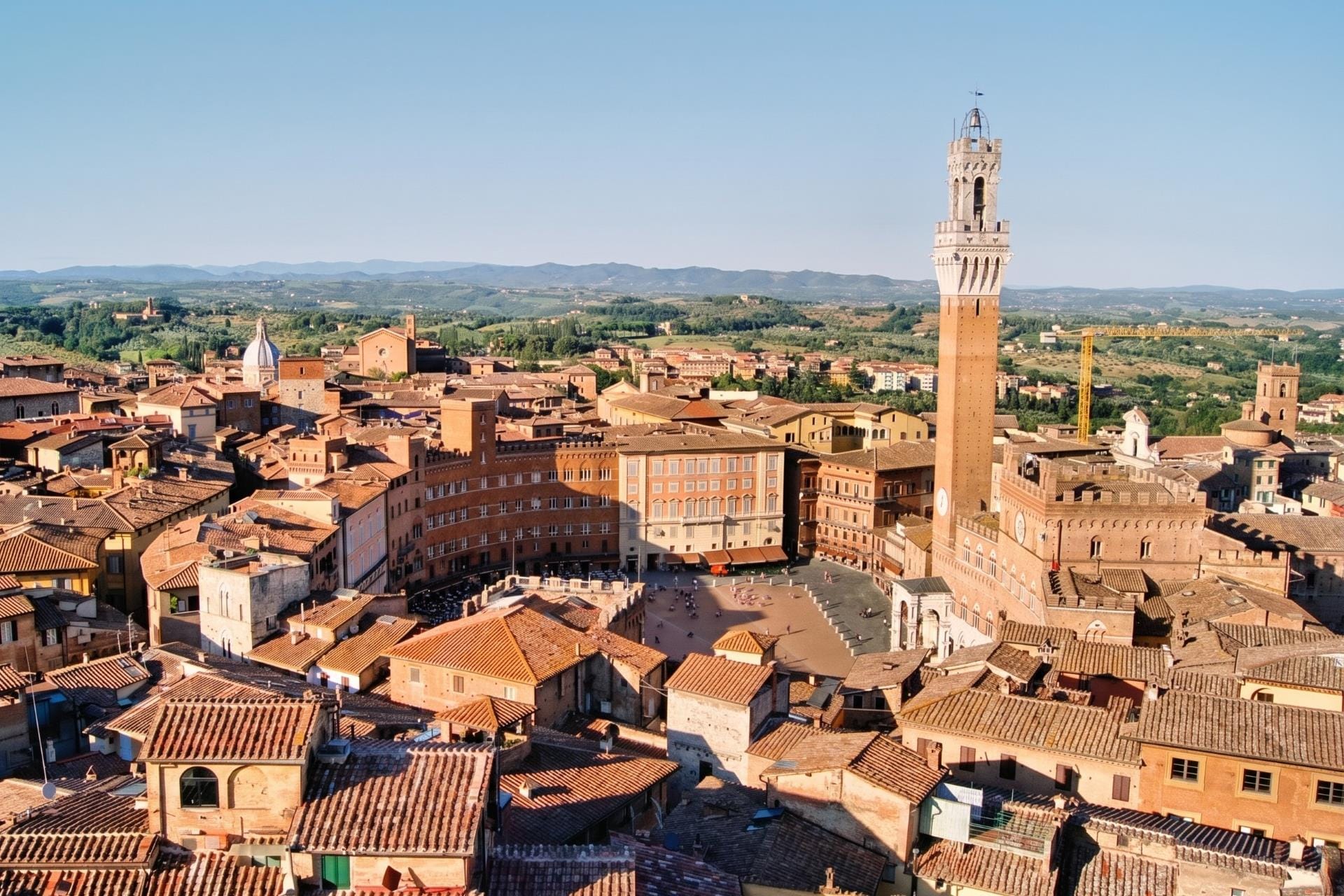
The Palio di Siena is the most intense surviving expression of civic identity in Italy, and almost no one watching it for the first time understands what they are seeing. The temptation is to file it as a costumed horse race, a medieval pageant performed for the cameras. It is the opposite of that. The Sienese do not run the Palio for visitors. They run it for themselves, and the presence of the rest of the world in the square is incidental to a ritual that would happen exactly the same way if no outsider were ever to come.
Strip the event to its mechanics and it is brief to the point of absurdity. Ten horses run three laps of a sloping medieval square, bareback, in something close to ninety seconds. Around that fragment of time the city builds an entire year: dinners, alliances, betrayals, secret payments, processions, hours of negotiation, and an emotional weight that can leave grown adults weeping in the street. The disproportion is the point. The Palio compresses the loyalty a person might spread across a nation, a religion, and a family into a single neighborhood and a single afternoon.
Knowing this in advance changes everything. Understanding the rules, the rivalries, and the grammar of the contrade is the difference between standing in a hot crowd wondering why everyone is shouting, and reading the square the way the Sienese read it. The race is the same either way. The experience is not.
The two Palios: Provenzano and the Assunta
There is not one Palio each year but two, and both are religious before they are anything else. The first runs on 2 July in honor of the Madonna di Provenzano, a venerated image whose cult grew in Siena in the sixteenth century. The second runs on 16 August, the day after the Feast of the Assumption, dedicated to the Madonna Assunta, patron and, in the old language of the Republic, queen of the city. The dates are fixed and do not move for the calendar: the race falls on those days whatever the weekday.
The August Palio carries the heavier historical charge. The Assumption was the central feast of the Sienese Republic, the moment when the subject towns and castles of its territory came to offer candles to the Madonna in the cathedral, an act of devotion and of submission at once. The July race is the younger of the two as a regular fixture, and to many contrada members it feels marginally lighter, though no one in Siena would describe either as minor. When a contrada wins, it wants to win both.
In rare years the city adds a third race, a palio straordinario, called for an anniversary or an event the community judges significant, such as a national centenary. These are exceptional by definition and have no fixed date. In an ordinary year, July and August are the whole calendar.
The seventeen contrade of Siena
Nothing about the Palio makes sense without the contrade. Siena is divided into seventeen of them, districts whose present boundaries were fixed in 1729 by a decree of Violante Beatrice of Bavaria, then governor of the city, issued to end the constant quarrels over territory. They were once far more numerous, several dozen in the medieval city, named for a gate, a street, a fountain, a church, or a noble family of their ground, and from the beginning they carried a mix of devotional, administrative, military, and social purpose before settling, over the centuries, at the present seventeen.
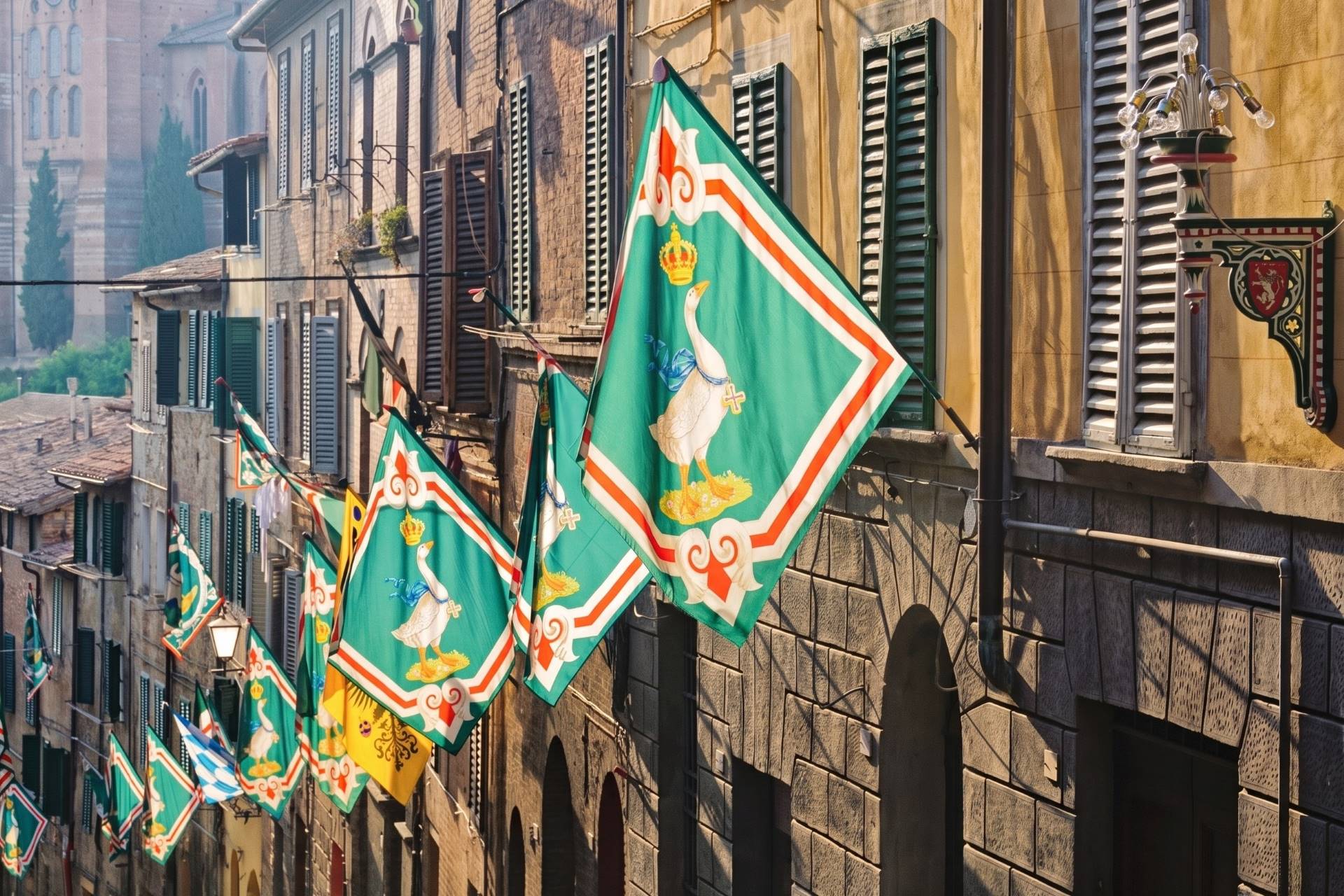
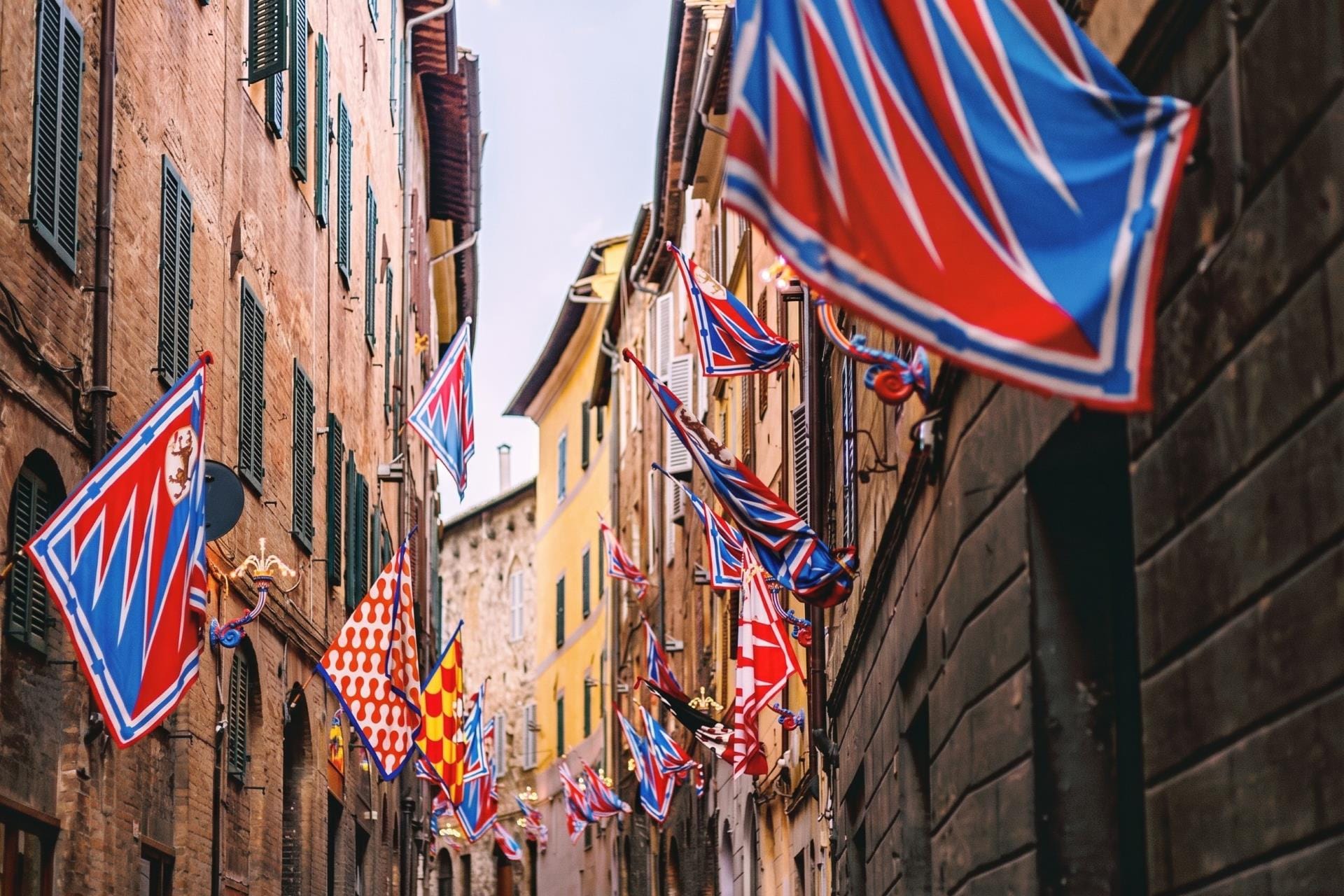
The seventeen are the Aquila (eagle), Bruco (caterpillar), Chiocciola (snail), Civetta (owl), Drago (dragon), Giraffa (giraffe), Istrice (porcupine), Leocorno (unicorn), Lupa (she-wolf), Nicchio (seashell), Oca (goose), Onda (wave), Pantera (panther), Selva (forest), Tartuca (tortoise), Torre (tower), and Valdimontone (ram). Walking the city, a stranger can read which contrada the ground belongs to from the flags overhead, the plaques on the walls, and the small fountain on the corner.
Today each contrada is effectively a small sovereign world. It has its own emblem and colors, its own patron saint and feast day, its own church and museum, its own anthem, and its own treasury funded by the people who belong to it. It is governed through the year by a Priore and a council, and in the days of the Palio command passes to a Capitano, who is granted near-absolute authority to negotiate the alliances and the secret pacts on which a victory may turn.
Belonging is not a matter of choice or of a current address. A Sienese is born into the contrada of their territory and received into it twice, once at the font in church and once, by tradition, at the contrada's own fountain, in a baptism that binds a person to the community for life. That membership runs from the cradle to the funeral, and it shapes friendships, marriages, rivalries, and the entire rhythm of the year.
The horse that runs does not carry a hired athlete. It carries the name and colors of a community a person is born into and will be buried with, which is why the race produces emotion so far beyond its length.
Historical note
Siena once counted more than seventeen districts. Six were suppressed over the centuries, leaving the seventeen fixed by the 1729 boundary decree. The number has not changed since.
A history of the Palio di Siena
The oldest surviving document describing a horse race at Siena dates to 1238, and the race then took the form of a palio alla lunga, a straight gallop that ran through the streets from inside Porta Romana to the cathedral, as the climax of the great August feast of the Assumption. That feast was the closest thing the Sienese Republic had to a national day, the moment when the subject towns and castles of its territory came to offer candles to the Madonna, an act of devotion and of political submission at once. The word palio itself comes from the Latin pallium, the length of precious cloth given as a prize, which in time named first the race and then the whole festival.
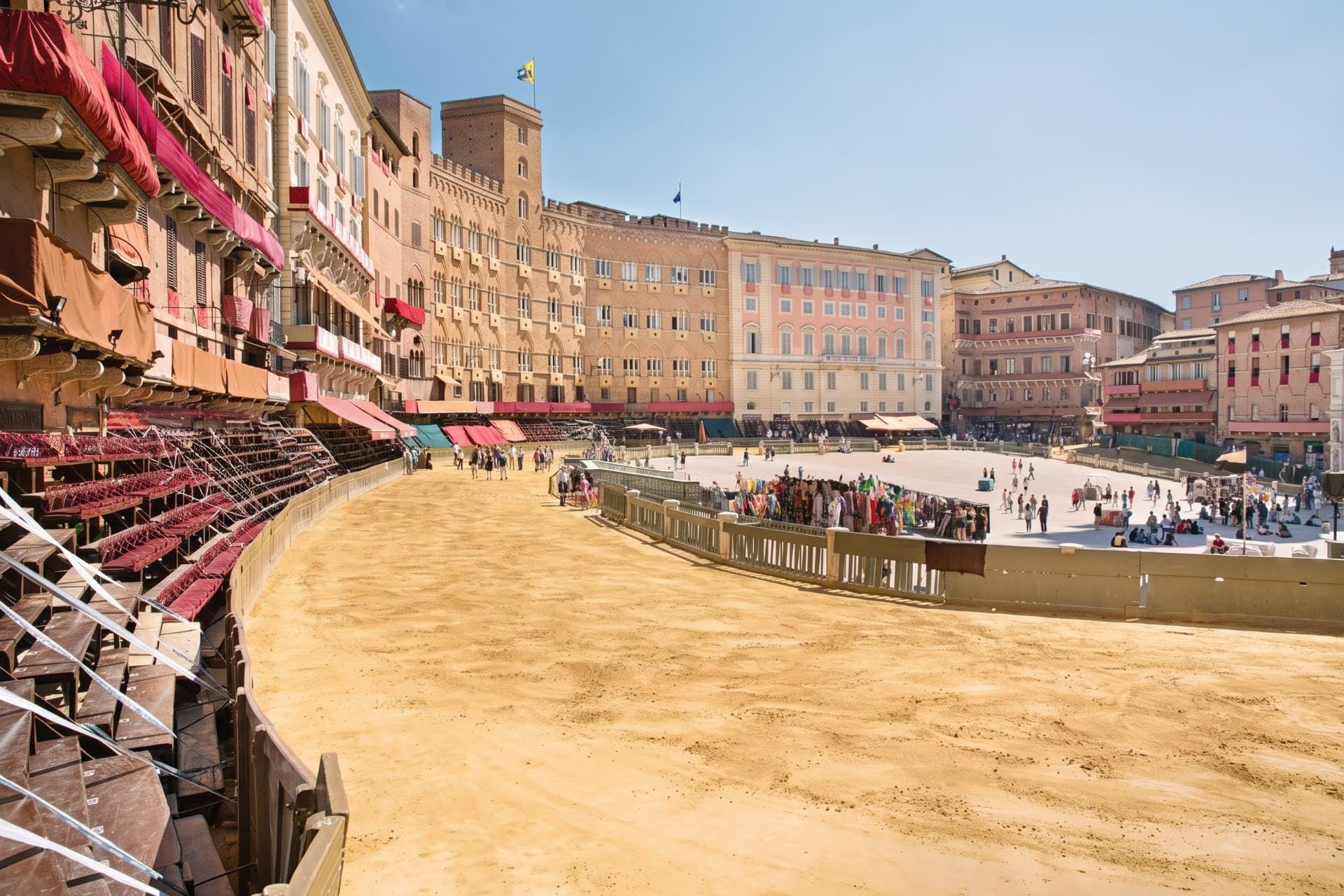
The contrade came to the spectacle later, and by a rougher road. Through the sixteenth century the districts tested themselves in buffalo contests and mass street games before turning to horses run in a circuit around Piazza del Campo, the palio alla tonda, so called to set it apart from the old straight course. The shell-shaped square, a natural amphitheater, proved the ideal theater, and a race of this kind is documented there as early as 1633. By 1656 the form had settled into something essentially modern, now also dedicated to the Madonna di Provenzano, whose cult had risen sharply in the city. The custom of laying earth over the paving to protect the horses followed soon after, as did riding bareback, fixed by 1657.
The second race was born of a single act of pride. The contrada of the Oca, having won the July Palio of 1701, asked to stage another at its own expense for the Assumption that August, a rematch other districts and private patrons soon took up, until the end of the 18th century the city formally adopted both the July and August races as its own. The modern rulebook is older still, set out in a 1721 decree of the Balìa, the governing magistracy of the Sienese Republic, that regulated the hours, the stands, the procession, the prizes, and the entry of the contrade. Since then the Palio has run, with breaks only for war and pandemic, exactly twice a year.
This is not a revival, a reconstruction, or a heritage performance assembled for an audience. It is an unbroken practice the Sienese have carried forward for centuries without needing anyone's attention, and that continuity is precisely what sets it apart from the costumed festivals staged elsewhere in Italy.
A thousand years in the making
The Palio's roots reach into the medieval city. The oldest surviving document describing a horse race at Siena dates to 1239, when the contest took the form of a palio alla lunga, a straight dash through the streets of the city to the cathedral, run as the climax of the Assumption celebrations of the Republic. The word itself comes from the Latin pallium, the length of precious cloth given as a prize, which in time gave its name to the race and then to the whole festival.
The race as it survives today, run in a circuit around Piazza del Campo, took shape in the seventeenth century. The square, a shell-shaped natural amphitheater, proved the ideal theater, and by 1656 the palio alla tonda had assumed a regular and essentially modern form. The custom of laying a protective layer of earth over the paving followed soon after, as did the practice of riding bareback and of assigning horses to the contrade by lot. In 1774 the city formally recognized both the July and August races, completing the two-race year that has run, with interruptions only for war and pandemic, ever since.
What matters for a traveler is not the chronology but its consequence. This is not a revival or a reconstruction. It is an unbroken practice that the Sienese have carried forward without needing anyone's permission or attention, and that continuity is precisely what makes it unlike the costumed festivals staged elsewhere.
How the Palio di Siena race works
Only ten of the seventeen contrade run in any given Palio, and the selection is fixed by a rule that is part custom, part lottery. The seven that did not run the corresponding race the previous year take part by right. The remaining three are drawn by lot from the other ten. This is why a contrada can go two consecutive years without running, and why the question of who is in and who is out is settled weeks before anyone thinks about a horse.
The single fact that surprises most newcomers is that the contrade do not choose their horses. Three days before the race, after veterinary checks and trials, ten horses are selected and assigned to the ten contrade by public draw, an event known as the tratta. A contrada that has waited a year for its turn can find itself with a weak horse, or a strong one, entirely by chance. From that moment the animal, not the jockey, is the protagonist, which is why a horse can and does win the Palio scosso, having thrown its rider somewhere along the course.
The fantini and the rules of the race
The riders, the fantini, are professionals, frequently outsiders hired for the day, and their loyalty is famously contingent. The race itself runs almost without restriction. A jockey may strike not only his own horse but his rivals, using the nerbo, a stiffened length of dried ox sinew, and the jostling at speed on a steeply banked dirt track is genuinely dangerous, most of all at the sharp descending corner of San Martino, where falls are common. There is no prize for second place. There is only the winner, and everyone else.
The mossa, the start that decides the race
The most misunderstood, and most decisive, part of the Palio is the start, the mossa. Nine of the ten horses line up between two ropes, the canapi, in an order drawn at the last moment and kept secret until the horses enter the square. The tenth, the rincorsa, stays outside the ropes, and the race does not begin until that horse chooses to charge in. In other words, the moment the Palio starts is decided not by an official but by the jockey of the rincorsa, who waits for his rivals to be badly placed before launching. The mossiere, the single unappealable judge of the start, stands on a raised platform and drops the front rope when he reads the run beginning. This phase can last minutes or it can drag on for the better part of an hour, and on rare occasions, if darkness falls first, it forces the race to the following day.
The partiti, the secret pacts that decide the result
Beneath the visible race runs the partiti, an invisible one of promises, vetoes, and outright payments to persuade a rival's jockey to help, or simply to ensure an enemy loses. These deals are negotiated in the tense minutes at the ropes and for days beforehand, and they are not corruption smuggled into the event. They are a recognized and centuries-old layer of strategy, governed by their own unwritten code. A contrada will often spend more energy, and more money, on making its enemy lose than on winning itself. Understanding that the Palio is won and lost in the partiti as much as on the track is the threshold between watching the race and reading it.
Palio week in Siena, day by day
The race is the final ninety seconds of a four-day liturgy, and the days before it are where much of the meaning lives. The cycle opens with the tratta, the assignment of horses, on the morning of the third day before the race, 29 June for the July Palio and 13 August for the August one. From that point the contrade enter a state that has no equivalent in ordinary life.
Over the following three days the assigned horses run six trial races, the prove, two each day, morning and evening, in the Campo. These trials matter for the welfare of the horse and the reading of the field, and they are far easier to attend than the race itself: entry to the square is free, the crowds are smaller, and the spectacle is most of the way to the real thing. The fifth trial, on the evening before the race, is the prova generale; the sixth, on the morning of race day, is the provaccia, run with deliberate lack of effort to spare the horses.
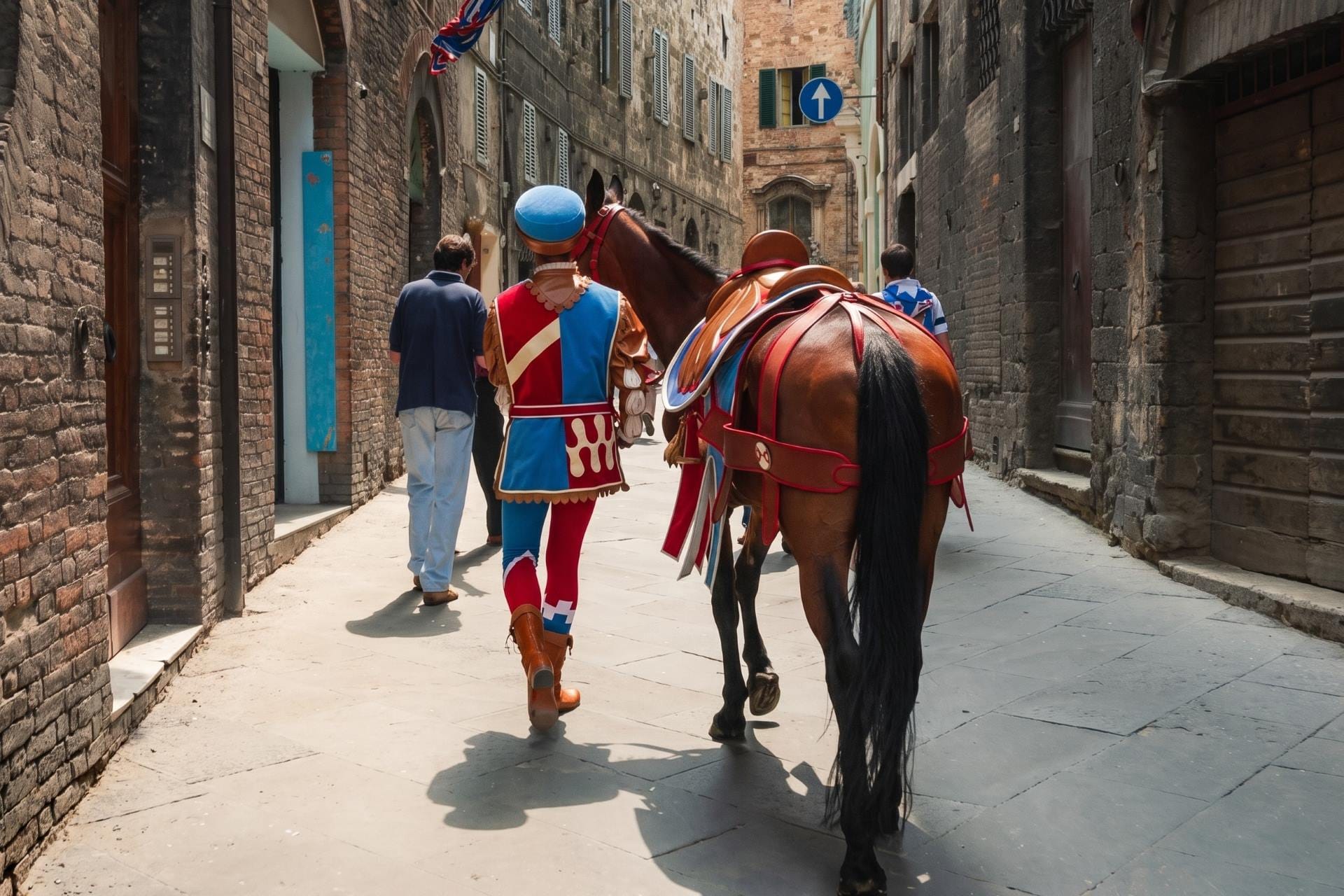
On the eve of the race the streets of every running contrada fill with long tables for the cena della prova generale, a vast open-air dinner of the district at which outsiders are genuinely welcome if they ask. On race day, in the early afternoon, the most charged ritual of all takes place inside each contrada's own church: the blessing of the horse, the only occasion on which an animal is led to the altar, where the priest sends it out with the words va' e torna vincitore, go and return a winner. Then the Corteo Storico, hundreds of figures in fifteenth-century costume with drums and flags, processes from the cathedral into the Campo, and only when it is finished do the horses come out.
Contrada rivalries, victory, and the drappellone
The relationships among the contrade are formal, lasting, and codified over centuries into three kinds: declared alliances, declared enmities, and a careful absence of relations. Almost every contrada has at least one historic enemy, and some of these hatreds are older than most of the nations of Europe, hardened rather than eased by the passing of generations. The most famous of them runs between the Oca, the goose of Fontebranda, and the Torre, the tower, the only enmity between two non-adjacent contrade and, by the reckoning of the city itself, the most bitterly felt of all. To see one's own contrada win is joy. To see the enemy lose can matter as much, and on some days more, which is why a great deal of the strategy of the partiti is spent not on winning but on making certain a rival does not.
Defeat has its own long memory. The contrada that has gone longest without a victory is known as the nonna, the grandmother, and is said to wear the cuffia, the bonnet, a title the whole city carries with a kind of tender mockery until the drought finally ends. A win can be waited for over decades, and the weight of that waiting is part of what gives a single afternoon its almost unbearable charge.
Victory, when it comes, is total, and it is celebrated as a rebirth. The winning contrada takes the drappellone, the painted silk banner that is the only prize, known affectionately as the cencio, the rag, and also as the cittino, the baby. In the triumphal parades that follow, grown men and women march through the streets sucking on pacifiers and baby bottles, the ciuccio, acting out the newborn state of a community born again in its win. The banner is carried first to church for a Te Deum of thanks, at Provenzano in July and the cathedral in August, and then kept forever in the contrada's museum. The celebrations, the dinners and processions of the cenini, run on for weeks. To take both races in a single year, the rarest triumph of all, is called the cappotto.
Ninety seconds of horse race, twelve months of preparation, and an emotional intensity that is almost embarrassing to witness as an outsider.On watching the Palio for the first time
The tears in the square at the finish are not performance, and not excess. A person may have waited half a lifetime for this victory, or watched the enemy seize it instead, and the Palio gives them one afternoon, twice each summer, to feel the entire weight of who they are.
How to see the Palio di Siena and where to stay
There are two fundamentally different ways to watch the Palio, and choosing the wrong one is the most common mistake visitors make. The center of Piazza del Campo, the earth-floored space inside the track, is free and open to all, and it is where the Sienese themselves stand. It is also a test of endurance. The crowd packs in shoulder to shoulder for hours under a high-summer sun, the entrances are sealed roughly forty-five minutes before the start, and once inside there is no leaving and no shade, no seating, and no facilities. Anyone choosing the center should arrive by mid-afternoon at the latest, bring water, a hat, and sun protection, and accept that the wait is part of the price. It is also where the atmosphere is at its most overwhelming.
The alternative is a paid seat. Temporary grandstands, the palchi, are erected around the edge of the track and sell for roughly up to 400 euros, with the best positions near the start and finish costing the most. Above them, the windows and balconies of the private palazzi looking onto the square offer the finest views and the steepest prices, generally from around 350 euros and rising well past a thousand for a balcony over the mossa. There is no central box office for any of this. Grandstand places are controlled by the businesses in front of which they stand, balconies by the families who own the buildings or by specialized agencies, and the only reliable approach is to arrange a seat months ahead, and for the most sought-after positions six to twelve months ahead.
One underused strategy is worth stating plainly. The six trial races in the days before the Palio run in the same square, with the same horses and jockeys and a real mossa, and they are free and far less crowded. For a visitor who wants to feel the Campo without the six-hour ordeal of race day, a trial is the most rational choice, and it is what many seasoned travelers quietly do.
Where to stay for the Palio: Siena, Chianti, or the Val d'Orcia
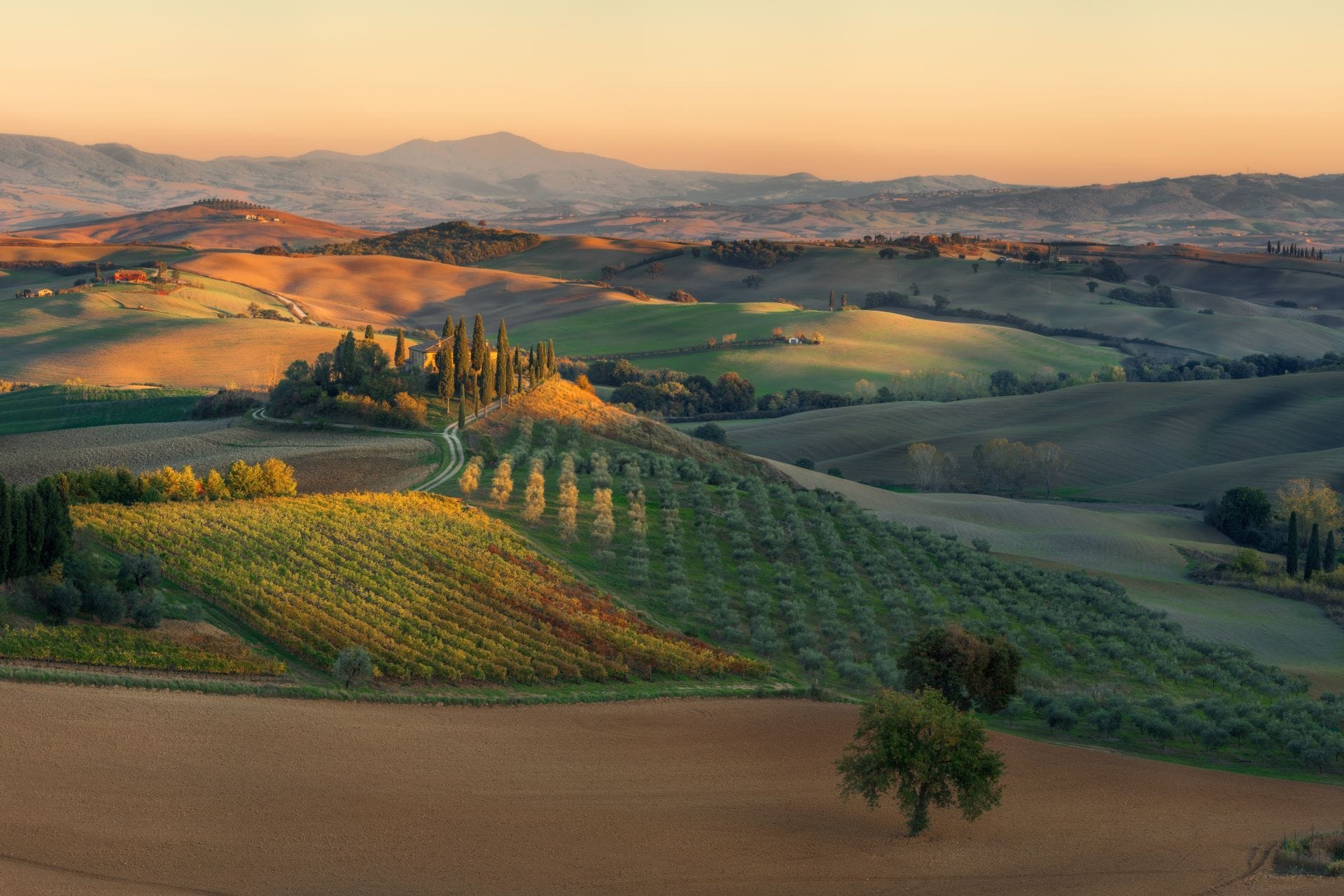
Accommodation inside the walls of Siena during Palio weeks books out far in advance, prices rise sharply, and many properties impose minimum stays of several nights. Securing a room in the historic center means committing six months to a year ahead. The considered alternative is to base in the surrounding countryside, in the Chianti hills to the north or the Val d'Orcia to the south, and come into the city for the days that matter, accepting the trade-off of a drive or transfer against the calm of a rural base and a far wider choice of serious places to stay. For a visitor building a longer Tuscan itinerary, the second approach is usually the better one.
Practical information
Practical guide
How to experience the Palio di Siena: a complete practical guide
Planning to be there for the 2 July or 16 August race? Our companion guide covers when to go, where to watch, how seats are really secured, and where to stay, eat, and behave.
The Palio di Siena 2026: dates and contrade
The two race dates never move: 2 July and 16 August, whatever the weekday. The ten contrade that will run each race, and the artist of each year's drappellone, are confirmed only in the weeks beforehand, and are noted here as soon as they are known.
The 2026 editions
Beyond the race: Siena and the contrada museums
The days around a Palio are among the most rewarding times to be in Siena, and a visit built only around the ninety seconds of the race wastes most of what the city offers. In the week before each race the historic center is dressed in the colors of the contrade, the fountains run with the songs of rival districts, and the museums of the seventeen are open to respectful visitors, each holding the banners of past victories, the costumes, and the relics of a particular community. A single morning spent in two or three contrada museums explains more than any guide could.
Siena itself rewards the longer stay, from the marble interior of Siena Cathedral, the Duomo, and the frescoes of the Palazzo Pubblico, the city's medieval town hall, to the steep streets that empty the moment the crowds leave. The city sits at the heart of southern Tuscany, within easy reach of the wine country to the north and the broad valleys to the south, and a Palio is best understood as the anchor of a wider itinerary rather than a day trip on its own.
Destinations
Siena: the insider's guide to the city of the Palio
The Palio belongs to Siena, and the city rewards far more than a single race day. Our complete guide to where to stay, where to eat, and what to see, from the cathedral to the contrada museums.
FAQs: Frequently asked questions about Palio di Siena
July or August: which Palio is better to attend?
Neither is objectively better, and the choice is mostly logistical. The 2 July race falls before the deepest heat and the August holiday crush, which makes it marginally easier for travel and rooms. The 16 August race carries the heavier historical weight, as the older of the two civic feasts, and comes with the full intensity of high summer in Siena. A traveler whose Tuscan trip naturally falls near one date should simply go to that one.
How does a visitor reach Siena, and is driving possible during the Palio?
Siena's historic center is a restricted-traffic zone largely closed to cars, so visitors arriving by car park in the paid structures around the walls and continue on foot. The city is roughly an hour and a quarter from Florence, with frequent coaches that are generally more convenient than the train, whose station sits below the center and requires a connecting bus or escalators up the hill. On race days access tightens further and the streets around the Campo are closed well before the start. For anyone based in the countryside, the calmest approach is to drive to a peripheral car park or arrange a private transfer, and to allow far more time than usual for the final approach on foot.
Can the Palio di Siena be watched on television or online?
In recent years the race has been broadcast live within Italy on La7, with a live stream on the broadcaster's website and app, and the network has carried it on an exclusive basis for several consecutive years. Arrangements are confirmed year by year and international availability varies, so the safest course is to check the broadcaster and any streaming options shortly before each edition.
What happens if it rains on the day of the race?
Heavy rain in the hour before the start, or a start that drags on until darkness falls, will postpone the race to the following day, signaled by a green flag from the Palazzo Pubblico. Postponements are not unusual, and anyone holding a seat or planning around the race should keep the next day open where possible.
Can someone who is not Sienese belong to a contrada?
Membership is rooted in birth and baptism within a district's territory, so it is not something a visitor acquires. What is possible, and warmly received, is to be a guest: to attend a contrada dinner, visit its museum, learn its colors, and be informally taken in for the days of the Palio. The contrade are active communities all year, and they tend to welcome outsiders who approach with genuine respect rather than as spectators.
Is the Palio di Siena cruel to the horses?
The race is genuinely demanding and falls remain a real risk on the banked dirt track, and animal welfare is part of the wider debate around the event. The city operates veterinary checks before the trials and the race, protocols for the selection and care of the horses, and ongoing changes to the course and surface intended to reduce injury. A visitor should know the criticism exists and form their own view rather than have it presented as settled either way.
Is photography permitted during the ceremonies?
The blessing of the horse inside the contrada church is a solemn religious moment and photography is generally not welcome there, though quietly sketching is considered respectful. In the Campo and during the Corteo Storico, photography is expected and unproblematic. The simplest rule is to read the room: where the moment is devotional, the camera should rest.
Why the Palio di Siena is worth traveling for
Most visitors leave the Palio describing the noise, the heat, and the astonishing speed of it, and they are not wrong to. The deeper memory belongs to those who arrive already knowing what they are looking at: who can tell the goose from the wave, who understand why the rider of the rincorsa is waiting and what is being settled in those long minutes at the rope, who feel, in the silence that drops over the square the instant before the start, the held breath of an entire city. For them the race is not a spectacle. It is the moment a year of devotion, a lifetime of belonging, and seven centuries of inheritance are compressed into ninety seconds, and then released.
That is the thing worth traveling for, and it cannot be bought as a seat or booked as an experience. It can only be understood, and then witnessed. The Campo will be covered in earth twice again this summer, as it has been for longer than most of the world's nations have existed, and the city will gather around it exactly as it always has, indifferent to whether anyone has come to watch. To be there, knowing what it means, is to stand for ninety seconds inside one of the last places in Europe where the past is not remembered but still, fiercely, alive.
Destinations
The Val d'Orcia: the complete guide
The valley south of Siena, a considered rural base for the Palio and a UNESCO World Heritage landscape in its own right. Where to stay and how to travel the Val d'Orcia slowly.
Latest Info
You can also find all the latest information on the official Palio di Siena website.
palio.comune.siena.it
Guide to Italy is a letter from an Italy that doesn't write to everyone.
Become a member


