
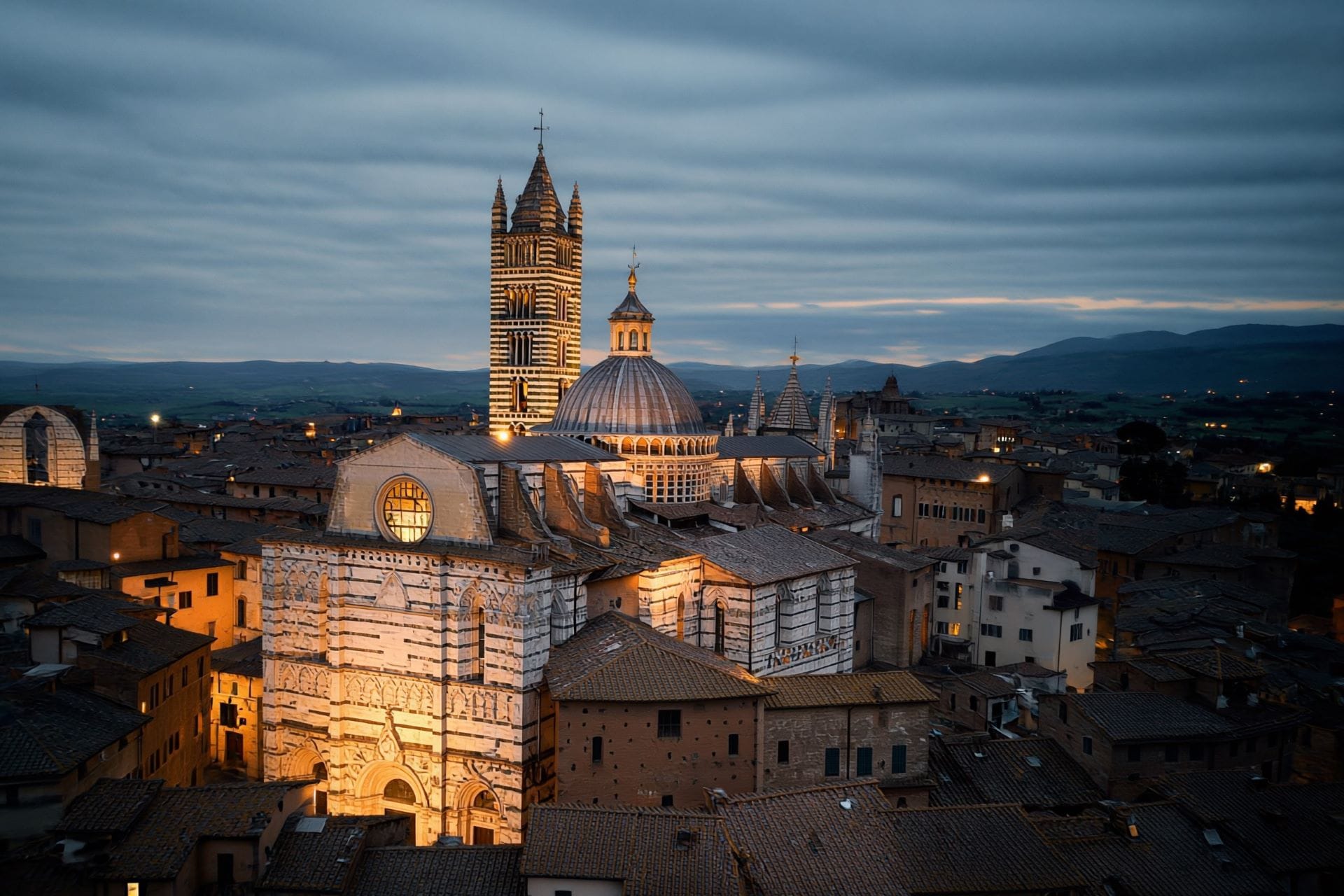
In the Piazza del Campo, the whole story of Siena is told in a single material. The brick that paves the square and climbs the facades around it turns, as the light goes, the exact warm earth tone that took its name from the city: the burnt sienna of a painter's box. The square slopes like the inside of a shell toward the Palazzo Pubblico, its surface divided into nine segments for the nine merchants who governed Siena at its medieval height. It was built not as a piazza in the Florentine sense, a civic drawing room, but as a stage, a place for a republic to perform itself.
This is a city whose ambition was arrested in the middle of the fourteenth century and never resumed. In 1339 Siena began a cathedral so vast that the existing one would have served only as its transept. Within a decade the plague had killed more than half the population, the work stopped for good, and a single colossal wall was left standing against the sky as a monument to everything that did not happen. What survives around that wall is one of the most complete Gothic cities in Europe: a near-intact argument in brick and stone about how a medieval commune wished to be seen, made by a republic that lost. It rewards slowness, and gives almost nothing to anyone in a hurry.
In this article
The essentials
Why visit Siena? The Gothic republic that defeat preserved
The honest answer to why visit Siena begins with what the city is not: it is not a smaller Florence, and it punishes the traveler who arrives looking for one. A guide to Siena has to start with the rivalry between the two cities, because that rivalry explains almost everything Siena built. For two centuries the Sienese republic competed with Florence in banking, in arms, and in art, and for a long stretch it was holding its own. In 1260 a Sienese-led alliance destroyed a Florentine army at Montaperti, the high point of a long contest the city never stopped commemorating. Under the merchant oligarchy known as the Nove, the council of nine that governed from the late thirteenth century until 1355, Siena built its monumental center and supported a generation of painters, Duccio di Buoninsegna, Simone Martini, and the brothers Pietro and Ambrogio Lorenzetti, whose handling of space and feeling rivaled anything in Tuscany.
Then the line broke. The plague of 1348 cut a population of roughly fifty thousand by more than half, the grand projects stalled, and the city entered two centuries of decline that ended with the fall of the republic. After an eighteen-month siege Siena surrendered in 1555, and the last republican holdouts, a government in exile at Montalcino, gave up only in 1559. That defeat is the reason to come. Siena stopped, more or less, at the height of its medieval self, and was too poor afterward to rebuild in the next fashion. Florence kept growing into the Renaissance and past it. Siena did not. What survives is the civilization that lost, preserved by its own losing, and listed since 1995 as a UNESCO World Heritage Site for exactly that intactness.
Siena sits along three ridges, and its bones follow them. The old town divides into three terzi, the thirds that organize it: Città to the south and west around the Duomo, Camollia to the north, and San Martino to the southeast. The unit beneath them is the one that matters to a visitor. Siena is carved into seventeen contrade, the neighborhood communities that are the living social fabric of the place. A contrada is closer to a clan than a postal district: a person is born into one, belongs to it for life, and competes through it in the palio, the bareback horse race run twice a year in the Campo. These are not folklore staged for tourists. They are why the city still behaves like a federation of villages inside a single wall.
Everything in Siena orients around two poles: the Piazza del Campo, the shell-shaped civic square and secular heart, the seat of government and the site of the race, and the Duomo, on the highest point of the Terzo di Città, the sacred one. Between them run the steep streets that knit the terzi together and drop to the medieval gates. For the traveler who has already done Rome and Florence, that is the case for Siena: not another hill town and not a Florentine annex, but the capital of a rival culture that built its own art and its own idea of belonging, and then froze at the moment it was most itself.
Historical note
The intactness that the UNESCO listing recognizes is a side effect of failure. The Florentine conquest of 1555 ended Siena's independence and, with it, the money and the will to keep rebuilding. The city was frozen in its fourteenth-century form not by preservation but by poverty, which is why it reads today as a single medieval intention rather than a collage of later centuries.
How to plan a trip to Siena
Planning a trip to Siena comes down to a handful of decisions, and settling them in order removes most of the friction: when to come, how to arrive, whether to bring a car, where to sleep, and how long to stay.
When is the best time to visit Siena
The best time to visit Siena falls in two windows: late April to early June, and September to mid-October. The days are long, the countryside is green or harvest-gold, and the temperatures make the climbs a pleasure rather than a trial. July and August are hot, and the clay hills of the Crete Senesi to the south bake without the relief of a coastal breeze. Winter is quiet and often beautiful, with the Campo nearly empty, though the days are short and some country restaurants and smaller sites keep reduced hours.
One pattern holds year-round and is worth planning against. By late morning the day-trippers arrive from Florence and the cruise ports, and the Campo, the Duomo, and the short stretch between them saturate. The city belongs to its visitors at midday and returns to itself in the early morning and the evening, which is the single strongest argument for sleeping inside the walls rather than visiting on a day trip.
The Palio is the exception to all of it. The race runs on 2 July, the Palio di Provenzano, and on 16 August, the Palio dell'Assunta, with trial heats in the days before each; ten of the seventeen contrade run in each one. Those days are extraordinary to witness and brutal for an independent traveler who came for the city rather than the event. Rooms vanish and prices climb months ahead, and the Campo is given over to preparation for the better part of a week. Worth a journey for the race itself, the wrong time to come for the Duomo and the museums. Siena is also not the place for anyone whose trip is built around nightlife or the sea; for that, the coast and the larger cities are a short drive but a different world.
How to get to Siena from Florence, Pisa, and Rome
Getting to Siena starts with accepting that the city has no convenient airport of its own. The nearest are Florence (FLR) and Pisa (PSA); long-haul travelers usually arrive through Rome or Bologna and continue overland. From Florence the quickest connection is often the coach rather than the train: the 131R rapida run by Autolinee Toscane reaches Siena in about an hour and a quarter and stops at Piazza Gramsci, a flat ten-minute walk from the center. The regional train takes about an hour and a half, since there is no high-speed line to Siena, and it arrives at a station below the old town, connected upward by a series of escalators. By road it is roughly seventy-five kilometers from Florence on the Florence to Siena dual carriageway, about an hour's drive.
Getting around Siena on foot and by car
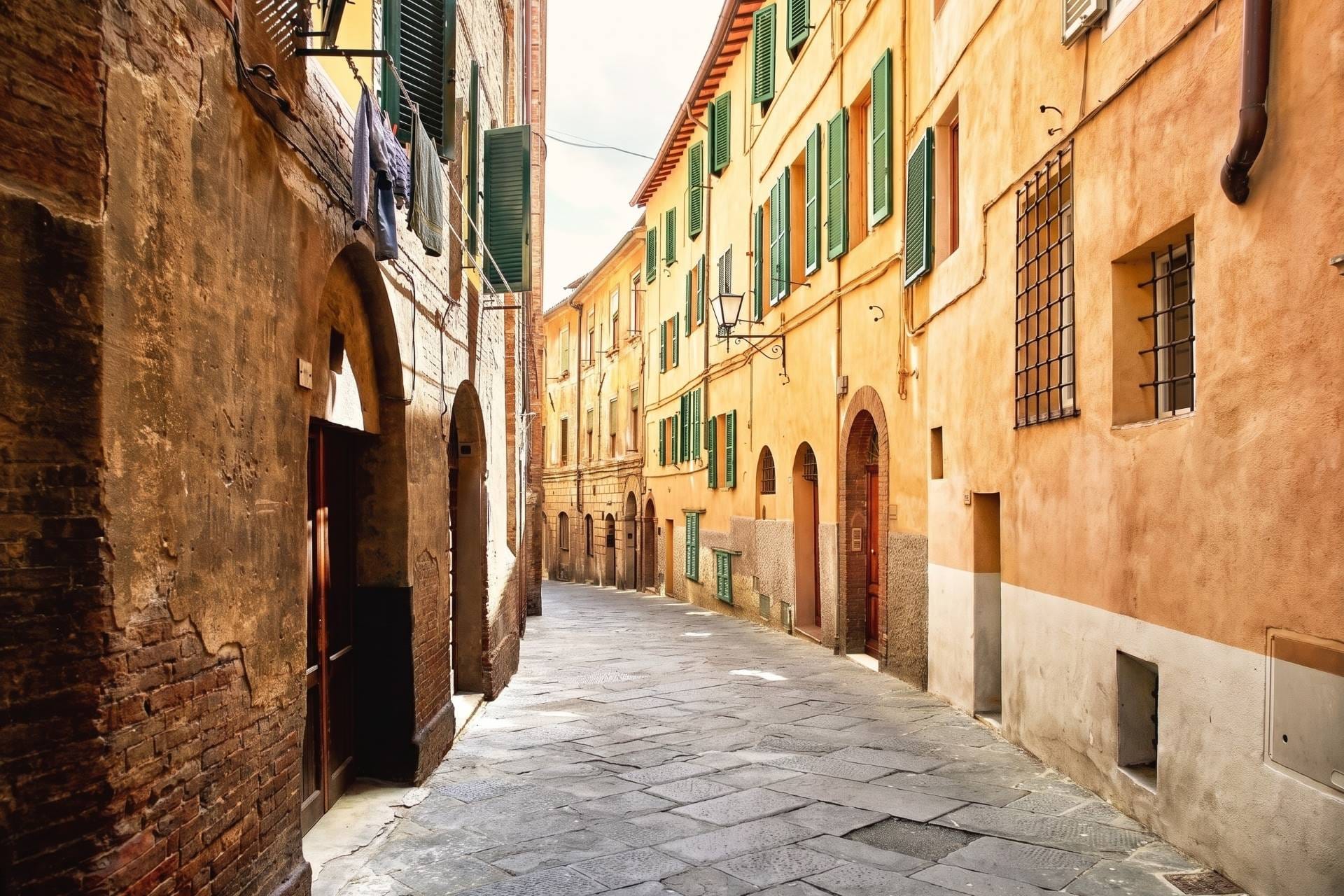
Getting around Siena inside the walls means walking, and walking uphill. The centro storico is effectively pedestrian, governed by a zona a traffico limitata (ZTL), the limited-traffic zone whose cameras fine unauthorized cars. The terzi connect on foot along the ridgelines, and almost everything a visitor wants sits within a slow twenty minutes of the Campo, so sound shoes matter more than any map. A frank word on terrain belongs here too: the old town is genuinely steep, the Torre del Mangia is a climb of more than four hundred steps with no lift, and the station below the walls connects to the center by a long run of escalators, all worth weighing for anyone with limited mobility.
A car is a liability within the walls and an asset beyond them. For the Crete Senesi, the abbeys, and the vineyards of Montalcino and Montepulciano it is close to essential, since public transport into the deep country is thin. The sensible arrangement is to leave the car at the walls and not touch it until a day in the province. Among the perimeter car parks, Parcheggio Il Campo (reached from the Siena Sud motorway exit) and Parcheggio Il Duomo (from Siena Ovest) are the most convenient for the center, both linked upward by escalators or a short climb.
Getting to Siena
Where to stay in Siena: inside the walls or in the country
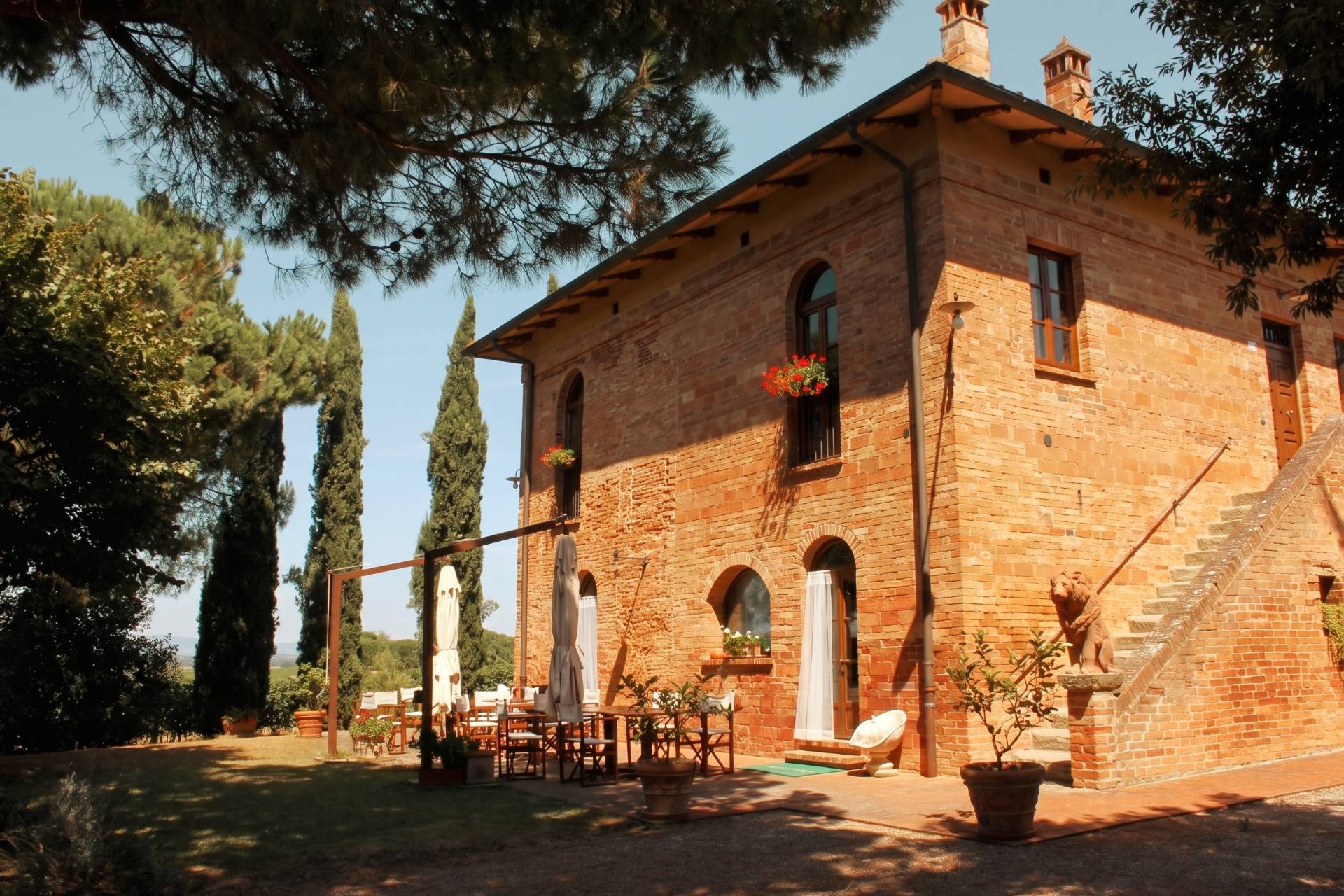
Where to stay in Siena is really one question: inside the walls, or out in the country. Sleeping inside means waking to the city before the day-trippers, walking everywhere, and stepping out at night into streets that have emptied of visitors; the trade-offs are narrow staircases, some evening noise near the Campo, and the parking problem. Within the walls, the Terzo di Città around the Duomo is the quiet, refined choice, Camollia along Banchi di Sopra is livelier and more lived-in, and a room on the Campo itself buys atmosphere at the cost of sleep. Basing in the countryside reverses the equation, trading the early-morning city for silence, long views over the Crete, and easy reach of the wine towns, at the price of needing a car for everything.
How many days in Siena
How many days in Siena depends on whether the city is the destination or the doorway to its province. The three sensible shapes of a visit are these:
- A day trip from Florence: possible, but the city is seen at its worst, in the saturated midday hours, and missed at its best, in the early morning and the evening.
- Two to three days: the city itself, unhurried, taking in the Campo and the Palazzo Pubblico, the Duomo complex, the Pinacoteca, and Santa Maria della Scala, with an early morning in the empty square.
- A week or more: Siena as a base for the Crete Senesi, the abbeys, and the wine towns, with the car used only for days in the province.
The better frame is not a rigid day-by-day but a few days in the city and as many again with the car.
Top things to do in Siena
The top things to do in Siena are concentrated and close together, which is both the pleasure and the trap: they can be ticked off in a single long day, and almost nothing is gained by doing so. Taken in order of importance, these are the experiences that earn the time.
Piazza del Campo and the Palazzo Pubblico
The Piazza del Campo and the Palazzo Pubblico on its low edge are the place to begin. The town hall, built between 1297 and 1310, holds the Museo Civico, and inside it the frescoes that justify the trip from Florence: Ambrogio Lorenzetti's Allegory and Effects of Good and Bad Government, painted in 1338 and 1339 for the very room where the council of Nine deliberated, the largest secular fresco cycle to survive from the European Middle Ages and the first true cityscape in Western painting. In the adjoining Sala del Mappamondo hangs Simone Martini's Maestà of 1315, and on the facing wall the equestrian portrait of Guidoriccio da Fogliano, long given to Martini and now the subject of one of art history's longest attribution debates. At the square's upper edge stands the Fonte Gaia, the fountain whose reliefs of the Madonna and the Virtues answer Lorenzetti's Good Government across the Campo; what stands there now is a nineteenth-century copy by Tito Sarrocchi, the damaged originals by Jacopo della Quercia, carved between 1409 and 1419, preserved in Santa Maria della Scala.
Climbing the Torre del Mangia
Rising from the same palace is the Torre del Mangia, the slender brick tower built between 1338 and 1348 to the exact height of the cathedral's bell tower, a deliberate statement that civic power stood equal to the church. At about eighty-eight meters it was among the tallest secular structures in medieval Italy, and the climb up its more than four hundred steps gives the only view that takes in the whole shape of the city and the hills beyond.
Siena Cathedral and the marble floor
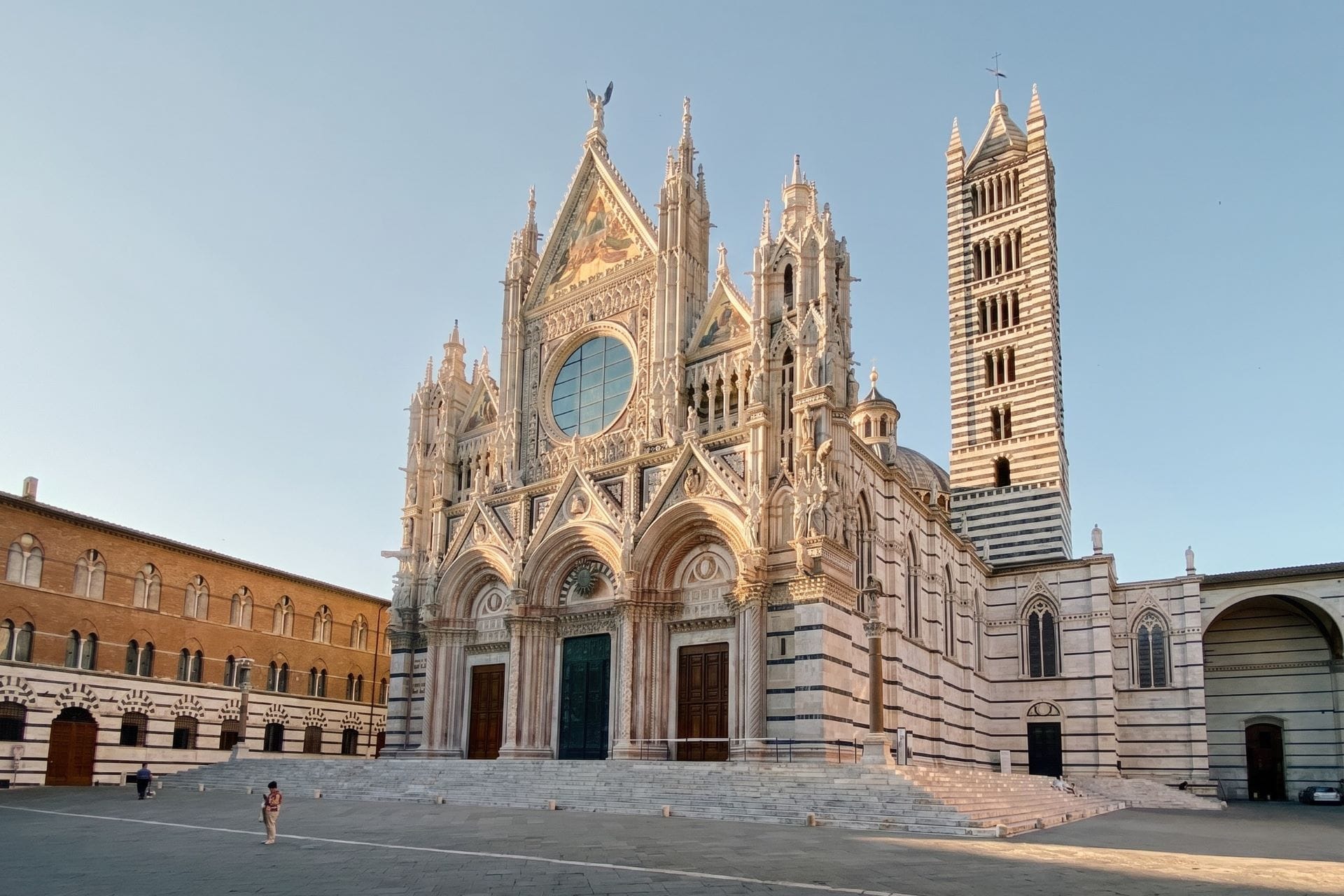
Siena Cathedral, the Duomo, is the other pole and the denser experience: outside a banded composition of white and dark marble, inside a floor that is the thing. The inlaid marble pavement is a program of figured panels worked by some forty artists between 1369 and 1547, and for most of the year much of it lies protected under boards, uncovered in full only for a limited stretch, generally from late summer through October and around the Palio, with separate ticketing. The rest of the cathedral repays slow looking: the pulpit by the sculptor Nicola Pisano, the banded piers, and the gold of the vault. One practical note worth settling in advance: the combined OPA SI Pass covers the cathedral, the Piccolomini Library, the Crypt, the Baptistery, the Museo dell'Opera, and the Facciatone, and is valid for three consecutive days; current hours, the floor-uncovering dates, and tickets are best confirmed with the cathedral authority, the Opera della Metropolitana, at operaduomo.siena.it.
The Piccolomini Library and the Gate of Heaven
Off the nave, the Piccolomini Library preserves Pinturicchio's fresco cycle on the life of the Sienese pope Pius II, born Enea Silvio Piccolomini, painted in the first decade of the sixteenth century and still startling in color, one of the best-preserved Renaissance interiors in Tuscany. For those willing to climb again, the Gate of Heaven, the Porta del Cielo, leads on a timed visit across the cathedral's high interior and out onto its roofline. It is a separate booking from the standard pass, with limited timed slots that sell out in peak season, and should be reserved well ahead through operaduomo.siena.it.
The Facciatone and Siena's unfinished cathedral
The colossal nave begun in 1339, the Facciatone, is the single most eloquent thing in Siena: the building that was never finished. It would have turned the existing cathedral into a transept of the largest church in Christendom; the plague ended it, and the half-built wall still stands as the literal monument to arrested ambition, reached through the Museo dell'Opera and climbable for a view back over the Duomo it was meant to dwarf.
The Pinacoteca Nazionale and the Sienese school
The painters seen in fragments around the city are gathered, in sequence, at the Pinacoteca Nazionale di Siena, the place to read the Sienese school as a tradition rather than a set of highlights. Its supreme work, though, hangs elsewhere: Duccio's great Maestà, the double-sided altarpiece made for the cathedral between 1308 and 1311, is shown in the Museo dell'Opera del Duomo, housed inside the unfinished nave.
Siena off the beaten path
Getting past the obvious in Siena means stepping out of the short triangle of Campo, Duomo, and souvenir shop into the parts of the medieval city that the day-tripper's clock does not allow. These are the places that reward a second or third day.
Santa Maria della Scala, the medieval pilgrim hospital
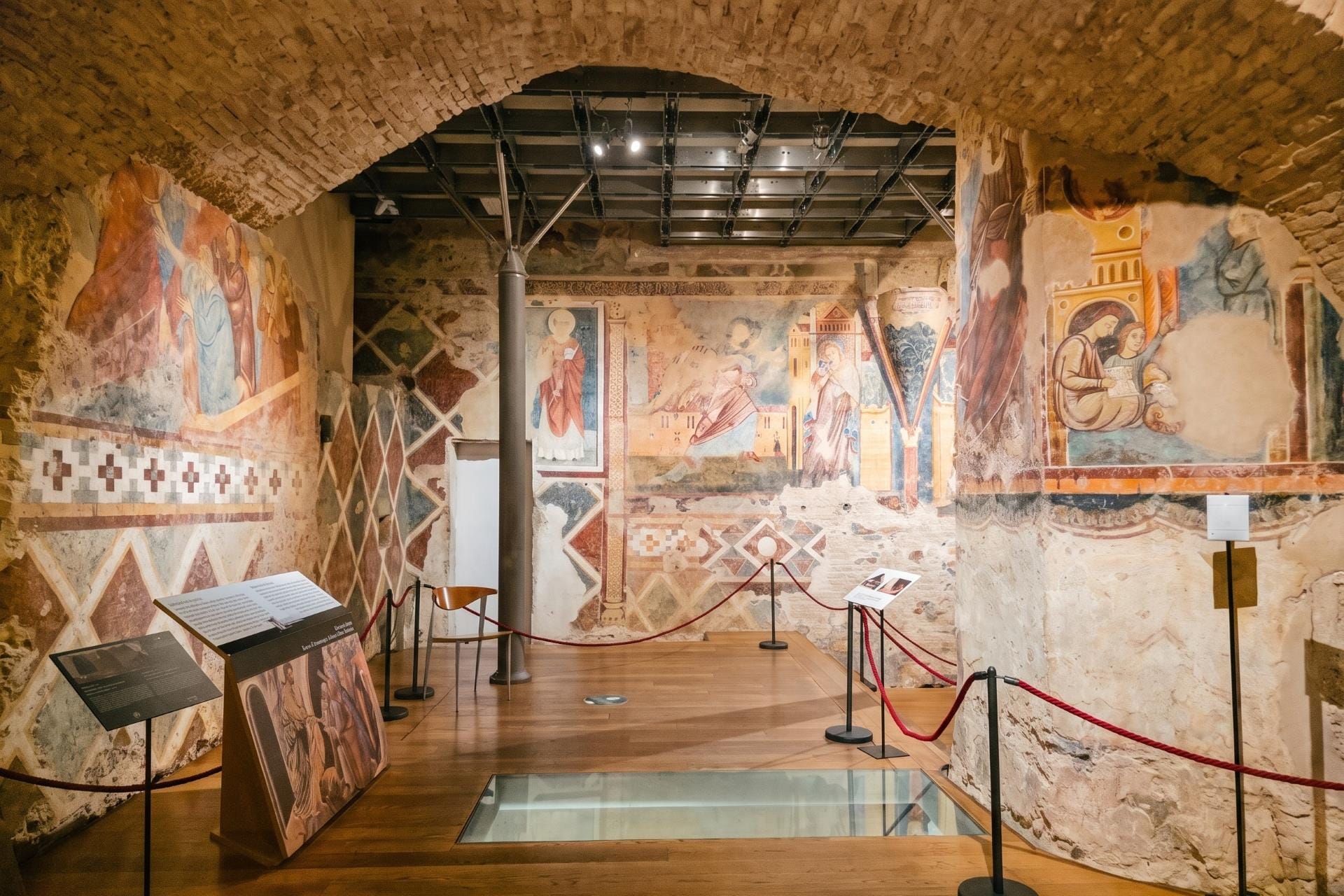
Directly across the cathedral square, Santa Maria della Scala was for centuries one of Europe's great hospitals, sheltering pilgrims on the Via Francigena, the medieval pilgrim road to Rome, raising foundlings, and caring for the sick. It is now a layered museum descending through floors and crypts, and the place where the original reliefs of the Fonte Gaia are now kept. Its Pellegrinaio hall, frescoed by Domenico di Bartolo with scenes of the hospital's own work, is a rare medieval picture of welfare as civic pride: the hospital and the cathedral facing each other as the two faces of a single idea of the common good.
Saint Catherine of Siena and the Basilica of San Domenico
The city's other great presence is a person. Saint Catherine of Siena (1347 to 1380), a Dominican mystic who pressed the papacy to return from Avignon to Rome, is a patron saint of Italy and a Doctor of the Church, and Siena is her birthplace. Her family home in the Fontebranda district below the Duomo is now the Santuario di Santa Caterina, a complex of chapels on the ground where she lived, and the great brick Basilica of San Domenico on the hill above it, the church where she prayed, preserves the relic of her head in a chapel painted by Il Sodoma. The basilica's terrace also gives one of the finest framed views back across the rooftops to the Duomo and the Torre del Mangia.
The contrade of Siena, their museums and fountains
Siena's seventeen contrade are the thing most visitors pass without noticing. Each keeps its own small museum, its church or oratory, and the fountain where new members are received, and each guards its trophies and rivalries with a seriousness that has nothing to do with tourism. The museums are visited by arrangement rather than on a whim, and the effort is the point: it is the difference between watching the Palio as a spectacle and understanding why a grown adult weeps when a rival contrada wins.
The Piazza del Campo before the crowds
The simplest of the deeper experiences costs nothing: the Campo at six in the morning, before the first coaches, with a few residents crossing it and the slope and the silence doing the work the midday crowd erases. It is the same square, and a completely different place.
The Crete Senesi and the abbeys of Monte Oliveto and Sant'Antimo
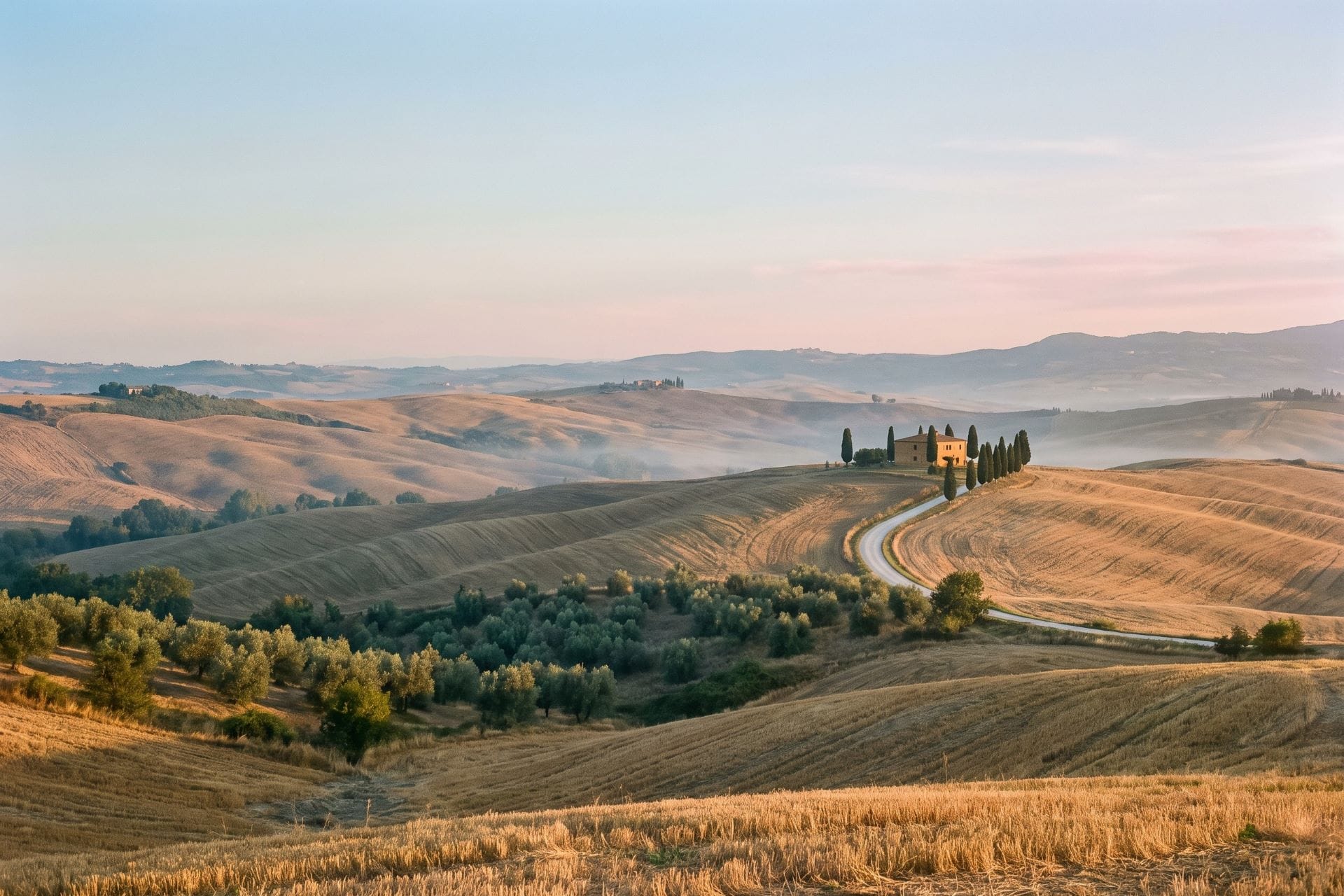
Beyond the walls, the Crete Senesi are the real reward for a longer stay: bare clay hills of furrowed ridges and solitary farmhouses to the south, a landscape that looks painted because the Sienese painted it. Among them stand the abbeys: Monte Oliveto Maggiore, with its great cloister cycle on the life of Saint Benedict by Luca Signorelli and Il Sodoma, and the Romanesque Sant'Antimo in its valley near Montalcino.
Day trips from Siena: San Gimignano, Monteriggioni, and the wine towns
San Gimignano, Monteriggioni, and the wine towns of Montalcino, Montepulciano, and Pienza ring the city within an easy drive and make the case for a car. San Gimignano keeps its skyline of medieval towers, Monteriggioni its small intact circuit of walls, and the wine triangle its hill-town centers and its cellars. The clay hills around them join naturally to a day in the Val d'Orcia, the World Heritage landscape immediately to the south.
Destination guide
The Val d'Orcia: the complete guide
The World Heritage valley south of Siena, a considered rural base for a longer stay and a destination in its own right. Where to stay, the wine towns within reach, and what the landscape rewards season by season.
Food and wine in Siena
Food and wine in Siena are inseparable from the land immediately around it, and the cooking is plainer at its root than the city's art would suggest. The signature on every serious table is pici, a thick hand-rolled pasta made without egg, irregular and chewy, dressed most classically as cacio e pepe, with sheep's cheese and pepper, or all'aglione, with tomato and the large mild garlic of the Valdichiana, and in autumn under duck or wild boar. Around it sits the wider Tuscan repertoire of frugality made good: ribollita, the reboiled bread, bean, and cabbage soup, and pappa al pomodoro, bread cooked down with tomato. The meat that belongs to these hills is the cinta senese, the belted black pig that walks through Lorenzetti's frescoes, now a protected breed whose salumi and roasts have a depth that confined pork does not. The city's sweets are older still, medieval and shaped by the spice trade: panforte, a dense slab of fruit, nuts, and spice; ricciarelli, soft almond lozenges; and the harder, anise-touched cavallucci.
Siena sits at the center of the richest cluster of top-tier wine denominations in Italy, and a base in the city is within an easy drive of all of them:
- Chianti Classico, in the hills to the north between Siena and Florence
- Brunello di Montalcino, the powerful, long-aged Sangiovese of the hill town to the south
- Vino Nobile di Montepulciano, its slightly softer neighbor to the southeast
- Vernaccia di San Gimignano, the province's distinctive white, to the northwest
Frequently asked questions about Siena
When is the marble floor of the Duomo uncovered?
The full pavement is uncovered only for a limited stretch each year, generally from late summer through October and around the Palio, with separate ticketing. Dates shift from year to year and should be confirmed with the cathedral authority, the Opera della Metropolitana, at operaduomo.siena.it before planning a visit around it.
How does the Palio work, and is it worth attending?
The Palio is a bareback horse race run by the contrade twice each summer, on 2 July and 16 August, after days of trial heats; ten of the seventeen districts run each time. The center of the Campo is free but means hours of standing in a dense crowd with no easy exit, while grandstand and balcony seats run into the hundreds of euros and are booked far ahead. It rewards travelers who come for the event itself and is the wrong time to come for the quiet city.
Is a car needed in Siena?
Not inside the walls, where the centro storico is pedestrian and a ZTL fines unauthorized vehicles. A car is close to essential for the Crete Senesi and the wine country, where public transport is thin. The usual solution is to park at the walls and use the car only for days in the province.
When is the best time of year to visit?
Late April to early June and September to mid-October: comfortable temperatures, long light, and the countryside at its best. High summer is hot, especially in the Crete; winter is quiet and atmospheric but short on daylight.
Does Siena suit a first visit to Tuscany?
Yes, with one caveat: it is a different register from Florence, quieter, more medieval, more inward, and it works best for a traveler who wants depth over a checklist. A first trip pairing a few days in Florence with a few in Siena and its province is among the strongest introductions to the region.
What Siena's defeat preserved
At the end of the day the Campo empties again. The coaches have gone, the light is leaving the brick, and the square returns to the color that gave it its name, the warm burnt earth that deepens as the sun drops behind the Palazzo Pubblico. This is the hour the city keeps for itself. A few residents cross the slope, a bell sounds from the tower built to stand level with the cathedral, and for a moment Siena is exactly what it was: a medieval republic talking quietly to itself across a sloping square.
Everything that makes the city worth the journey comes from a single source, the moment in the fourteenth century when the future it was building was taken away. The cathedral that would have been the largest in Christendom stopped at one wall. The painters who were inventing a new way of seeing died in the plague or worked on into a poorer age. The republic that triumphed at Montaperti and governed itself for four hundred years was starved into surrender and folded into the territory of the rival it had spent its history resisting. Florence took the future and became the Renaissance. Siena kept the past, because there was never again the money to replace it.
That is the rare thing a traveler comes to Siena to feel, and it cannot be felt at midday in a crowd. It asks for an evening in the emptying Campo, a morning in the silent one, a few unhurried days given to a city that rewards exactly the kind of attention Florence, for all its glory, no longer demands. The reward is not a smaller version of somewhere already seen. It is the whole shape of a medieval idea, held intact, and the strange beauty of a civilization that its own defeat preserved.
Continue reading
The Palio di Siena: the complete guide
The bareback race run by the contrade on 2 July and 16 August, beyond the few minutes of the carriera. How the districts, the trials and the rivalries work, whether to attend, and what the race means to the city.
Guide to Italy is a letter from an Italy that doesn't write to everyone.
Become a member


