
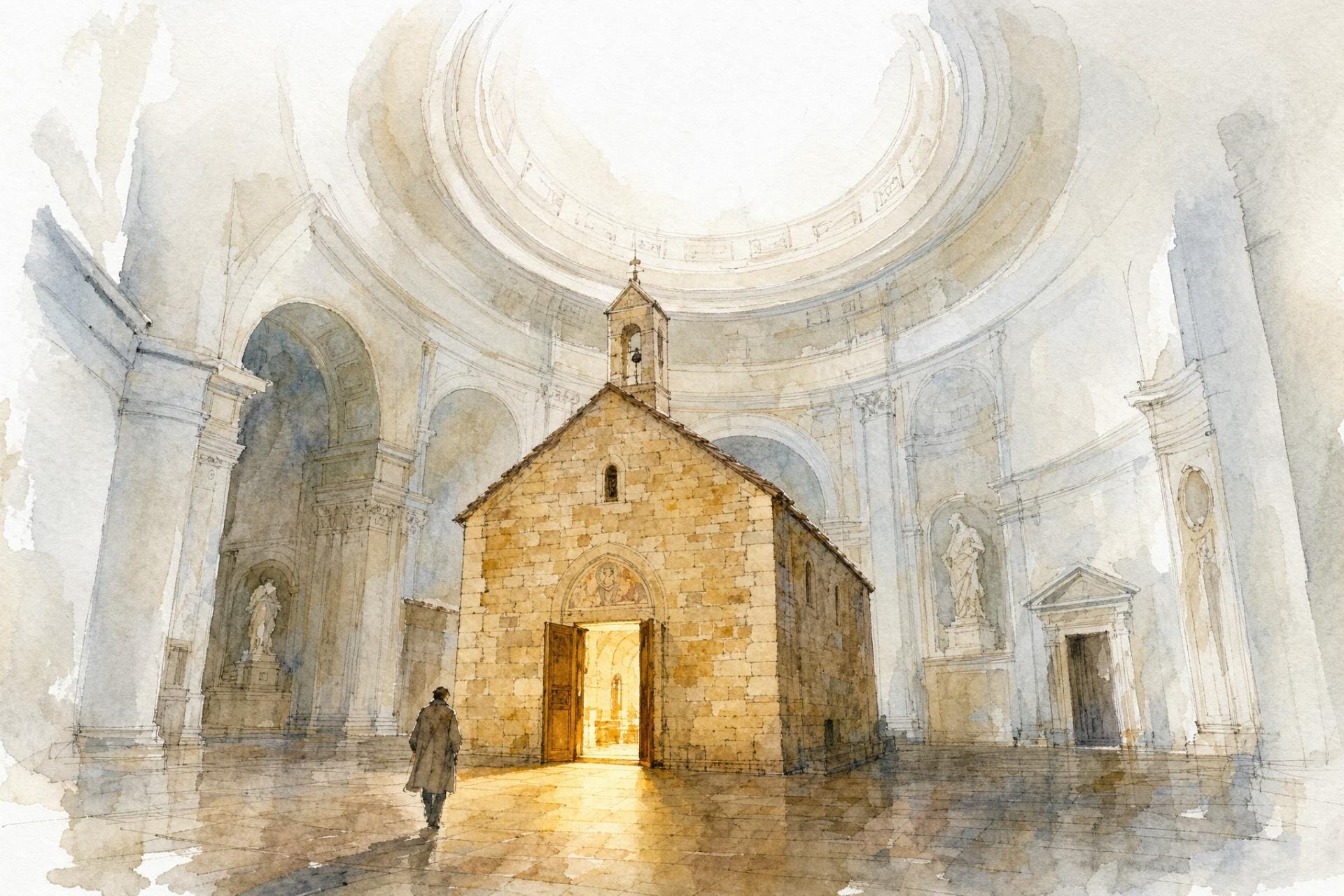
On October 3, 1226, inside the Porziuncola (the small chapel now enclosed within the basilica of Santa Maria degli Angeli), Francis of Assisi asked the friars to lay him naked on the naked earth, faithful to the last to the life he had chosen. He died at sunset. A year earlier, by then blind and worn by illness, he had composed in the same place the Cantico delle creature (the Canticle of the creatures), the immortal verses that praise the sun, water, fire and "our sister bodily death." Eight hundred years later, the memory of that evening has expanded to fill an entire year.
2026 carries, across all of Italy and not only in Assisi, the solemnity and the celebration of an anniversary built one piece at a time since 2023. This guide gathers the facts of this extraordinary year, from the institutions that promoted it to the places that hold its meaning, and offers a map for navigating our contents of San Francesco 800th anniversary in the upcoming few months.
In this article
- 01 Why 2026: four years leading to the 800th anniversary
- 02 The jubilee year opened by Leone XIV
- 03 Face to face with Francis: the exposition of his remains
- 04 The Porziuncola in August: a youth gathering and a papal visit
- 05 Visiting Assisi during the centenary months
- 06 October 4 becomes a national holiday again, almost
- 07 Sìamo Francesco and Italy's national network of celebrations
- 08 The Guide to Italy special
- 09 The legacy of a gesture
Why 2026: four years leading to the 800th anniversary
The centenary does not end in 2026: it is the culmination of a path marked by four stages, each tied to a key episode from the saint's final years. 2023 recalled the drafting of the Rule and the first nativity scene at Greccio (1223); 2024 marked the gift of the Stigmata at La Verna (1224); 2025 celebrated the composition of the Cantico delle creature (1225). 2026 closes the cycle with the Transito (the term used within the Franciscan tradition for the saint's passing into eternal life), which took place on the evening of October 3, 1226.
Law no. 140 of August 31, 2022 established the National committee for the celebration of the eighth centenary of the death of Saint Francis of Assisi, made operational by a decree of the Presidency of the Council of Ministers on April 27, 2023, and placed under the oversight of the Ministry of Culture. The same law allocated funding of 4,510,000 euros distributed between 2022 and 2028. The committee is chaired by the poet Davide Rondoni; the mayor of Assisi sits on it by right, alongside eighteen other members representing the ministries, the region of Umbria, the municipality of Assisi, the diocese, the Franciscan families and academia. The official calendar of initiatives can be consulted on the portal sanfrancesco800.cultura.gov.it
In October 2024, the National committee adopted an identifying logo designed by the Rimini-based graphic artist Isabella Manucci. The promotional campaign Sìamo Francesco (a play on words meaning "we are Francis") is a separate matter, an initiative promoted independently by the municipality of Assisi.
The jubilee year opened by Leone XIV
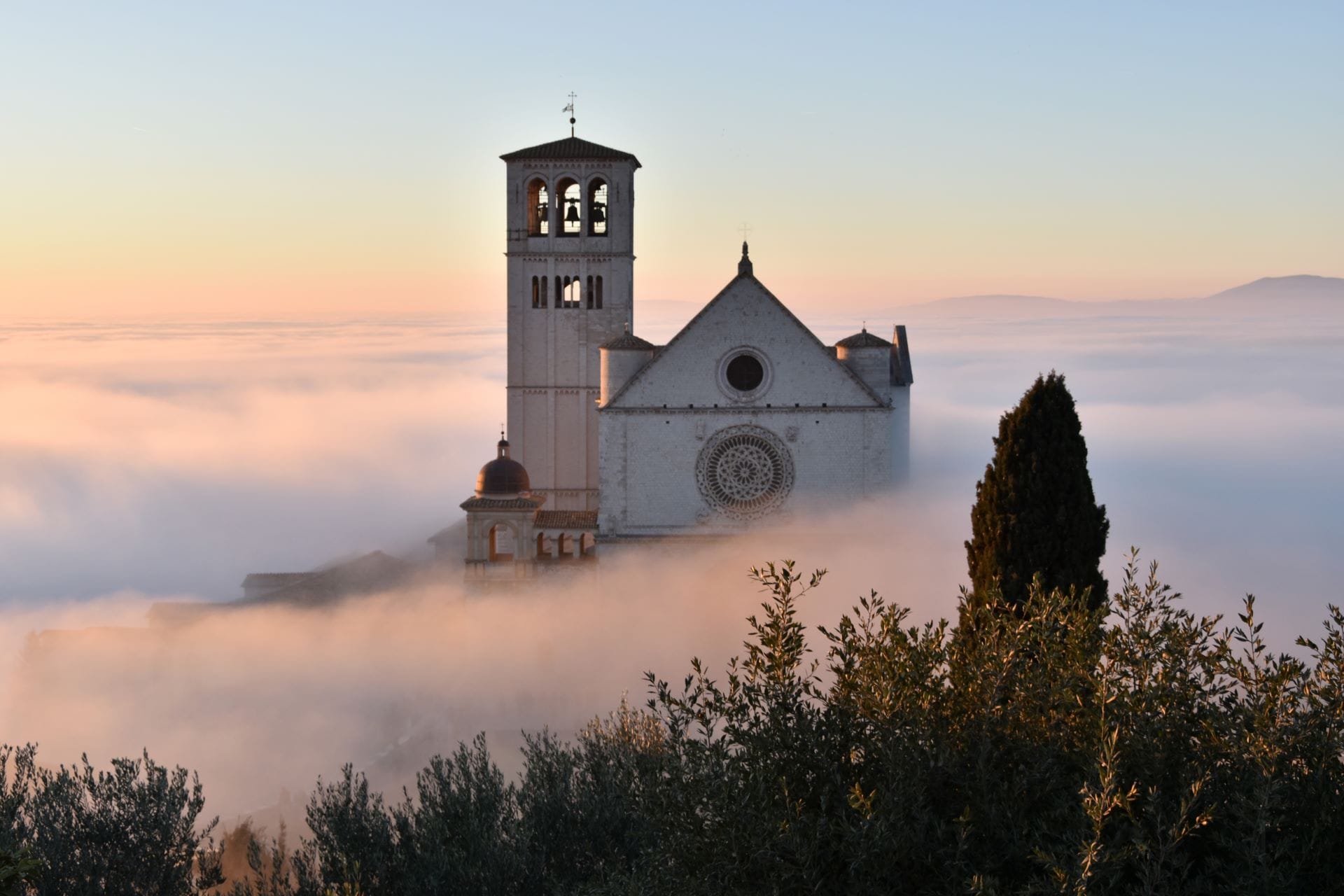
Pope Leone XIV proclaimed a Franciscan jubilee year, from January 10, 2026 to January 10, 2027, running alongside the civil track led by the National committee and conceived as an ideal continuation of the ordinary jubilee of 2025. The solemn opening took place in the basilica of Santa Maria degli Angeli, before the Porziuncola. During the jubilee year, the Apostolic Penitentiary (the Vatican tribunal responsible for matters of conscience and indulgences) grants a plenary indulgence (a full remission of temporal punishment for sin, under the usual spiritual conditions) to those who make a pilgrimage to Franciscan conventual churches or to places of worship dedicated to the saint anywhere in the world. The benefit extends to those unable to travel, who can join the celebrations spiritually instead.
Face to face with Francis: the exposition of his remains
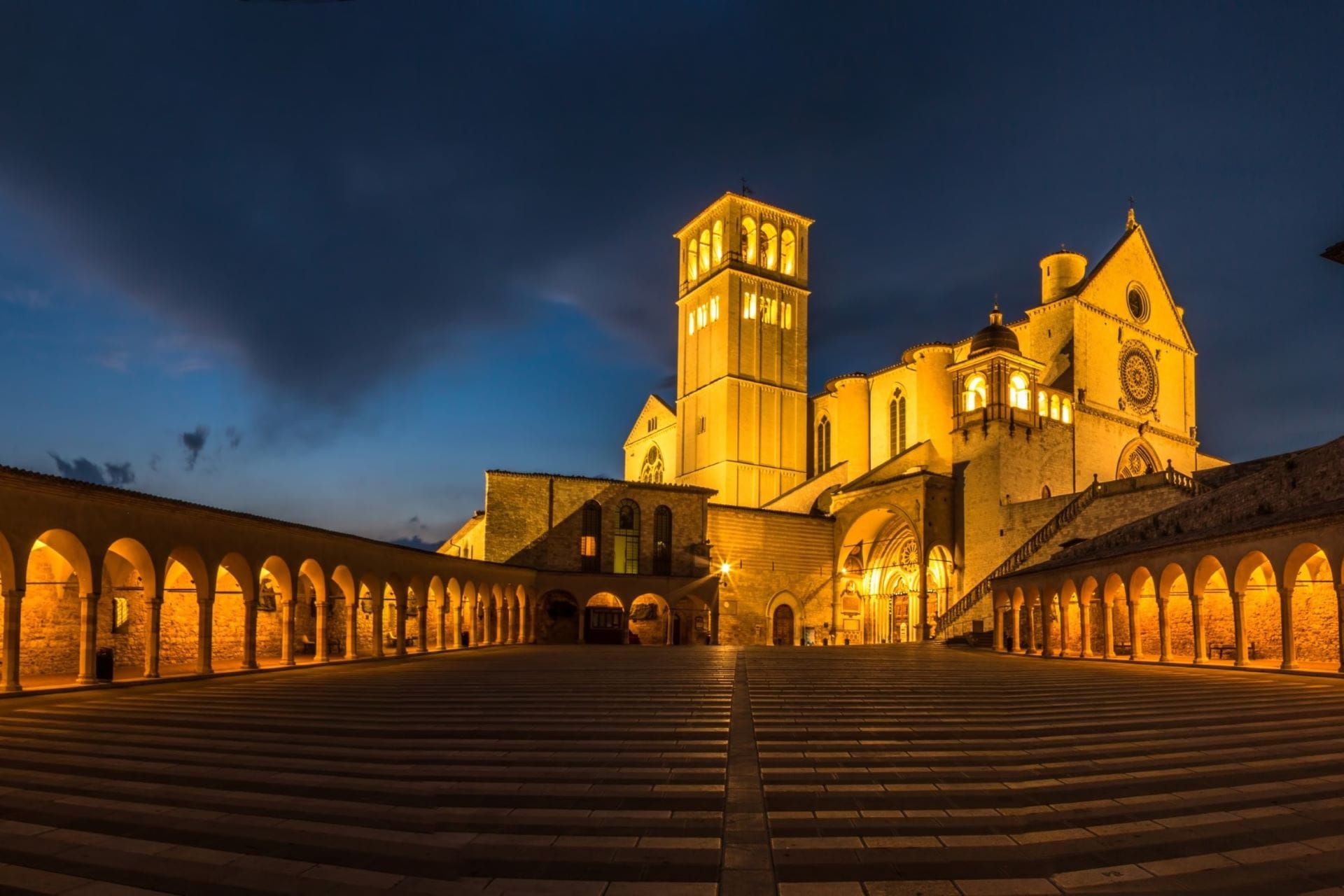
From February 22 to March 22, 2026, for the first time in history, the saint's relics were exposed to the faithful's veneration for an extended period, a full month at the foot of the papal altar in the lower church of the basilica of San Francesco: the centenary's first major public milestone.
In the weeks leading up to the opening, the body was carefully moved from its tomb in the underground crypt to the case prepared for the exposition, in a series of preparatory rites carried out by the friars of the Sacro Convento together with the diocesan bishop. On that occasion the sarcophagus, sealed with two keys (marked "S" and "F" and held respectively by the bishop and the father guardian), was opened. The exposition, authorized by Pope Leone XIV through the Vatican Secretariat of State and accessible only with a mandatory, had been announced on October 4, 2025 from the loggia of the basilica's lower square.
The Porziuncola in August: a youth gathering and a papal visit
From August 3 to 6, 2026, Assisi became the epicenter of the GO! Franciscan Youth Meeting, an international gathering that drew more than 2.500 young people from across Europe and the world, continuing the centenary's celebrations well beyond the rites of spring.
Organizers deliberately echoed a famous historical episode in that turnout: the Capitolo delle Stuoie (chapter of the mats) of 1221, when thousands of friars gathered around Francis at the same site. The high point came on August 6 with a visit from Pope Leone XIV, who traveled to the Porziuncola to meet the young people and preside over the eucharistic liturgy, attended among others by Cardinal Pierbattista Pizzaballa, Latin patriarch of Jerusalem. The event showed how the spiritual legacy of the Poverello (the poor man, one of Francis's traditional epithets) continues to cross the boundaries of the small Umbrian town.
Italy, Privately Yours
A seasonal newsletter on Italy, unscripted
Long reads on the places and anniversaries that never make the usual itinerary, starting with the year Assisi has waited eight centuries for.
Visiting Assisi during the centenary months
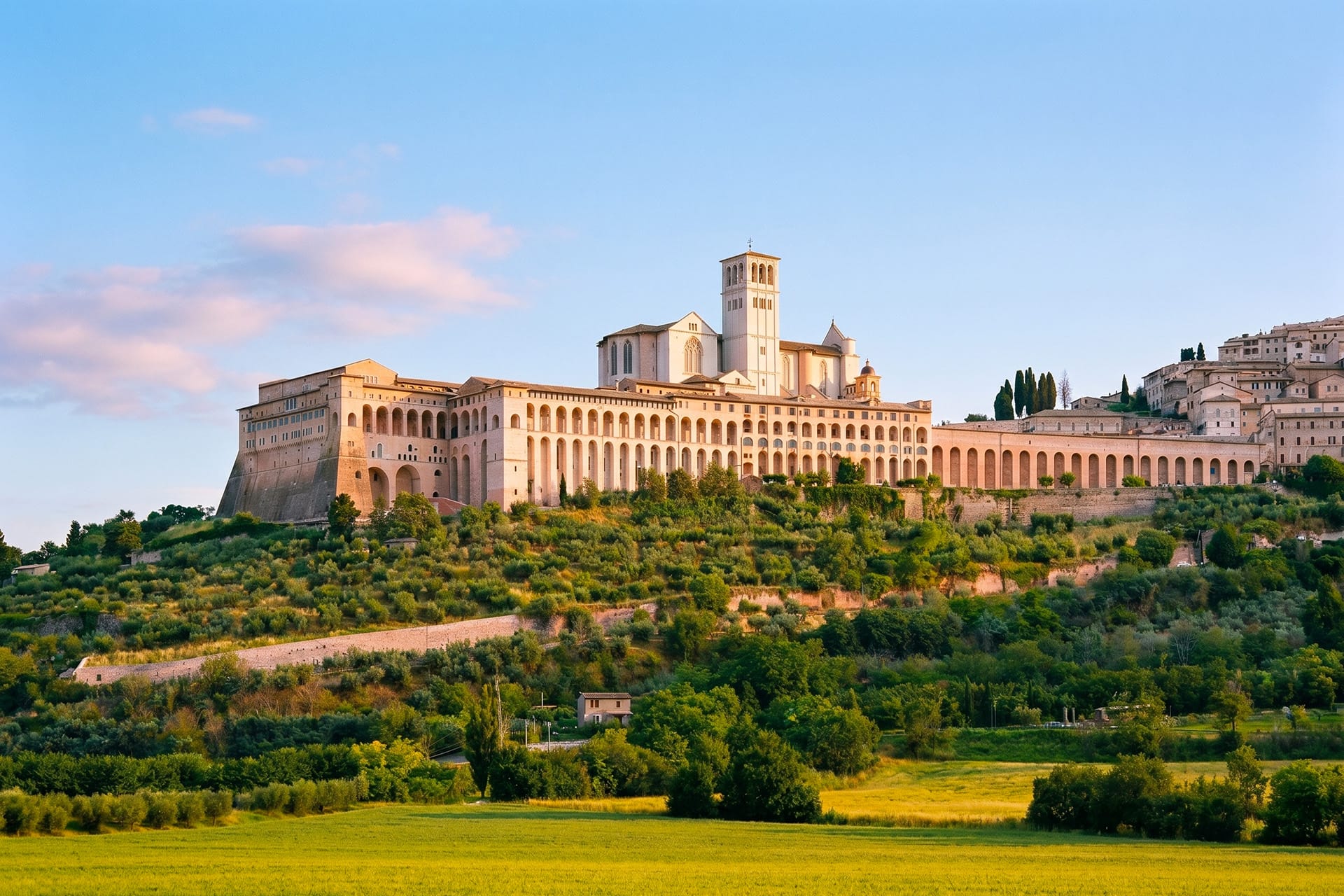
Assisi is used to visitors, but not usually in early October. Its calendar already carries its own busy points, Easter week, the first days of August for the feast of the Pardon, and October 4 itself as the patronal day. What 2026 does is compress several of these forms of significance into a single, narrow window rather than spreading them across the year as usual.
The whole comune, hilltop town and outlying villages together, counts around 27,000 residents, and much of the available lodging sits inside converted convents and small family-run hotels within the walls, not the kind of capacity that expands easily for a single peak weekend. A traveler who remembers Assisi as quiet once the summer crowds thin should not expect that quiet this particular October. None of this makes the visit less worthwhile, only differently timed.
Visiting during the centenary months
October 4 becomes a national holiday again, almost
October 4 has been tied to the memory of Francis since 1939, the year Pope Pius XII proclaimed him patron saint of Italy; in 2005, law no. 24 also established it as the "day of peace, fraternity and dialogue." Its status as a full civil holiday, however, had been abolished in 1977. Parliament decided to restore it precisely ahead of the eighth centenary: the Italian Chamber of Deputies approved the bill on September 23, 2025, and the Senate gave its final approval on October 1, 2025. The resulting law no. 151 of October 8, 2025, was published in the Gazzetta Ufficiale on October 10, 2025, and took effect on January 1, 2026.
One technical detail deserves clarification: in 2026, October 4 falls on a Sunday. As a result, the first actual weekday closure of schools and public offices (with the corresponding calendar benefit for workers and students) will only occur on October 4, 2027, which falls on a Monday. This year, the anniversary retains an eminently symbolic, liturgical and solemn value, without translating into a day off work.
Sìamo Francesco and Italy's national network of celebrations
The municipality of Assisi presented its own tourism campaign, Sìamo Francesco, on April 21, 2026, ahead of the spring and summer season (creative direction by Raffaele Balducci), one of two distinct tracks along which promotion of the centenary runs. Built around billboards, web channels and social media, the campaign spans four main themes (art, music and performance, nature, and pilgrim trails) and forms part of the wider municipal project Vivi Assisi, dedicated to promoting the city's Franciscan heritage sites, which receives support from the Ministry of Tourism. It remains a project of the local administration, distinct from the National committee's activities.
In partnership with ANCI (the National Association of Italian Municipalities), the second and more national track sees the committee inviting municipalities across Italy to map and highlight local initiatives tied to Francis's figure and values, standing out for its wider reach. This capillary network explains why the celebrations extend well beyond Umbria to embrace the entire country, offering the basis for an editorial narrative told from many voices.
The Guide to Italy special
The itineraries and analyses of the San Francesco 800 special will unfold gradually over the coming months, along three complementary lines, an invitation to discover Francis one piece at a time rather than all at once.
- Places and history will trace a journey through Franciscan sanctuaries beyond the boundaries of Assisi (from La Verna to the Valle Santa Reatina, from Greccio to Gubbio), rediscovering each stop for its historical and biographical value rather than for a generic, formulaic backdrop. This approach mirrors Cammino di Francesco: il Cammino della Luce (the Way of Francis: the way of light), a 1,546-kilometer network of walking routes across six regions (Abruzzo, Emilia-Romagna, Lazio, Marche, Tuscany and Umbria), all converging on Assisi. Presented on July 30, 2026 at the Presidency of the Council of Ministers, the route was validated historically by the National committee and is promoted by the Ministry of Tourism together with the Associazione Vie e Cammini di Francesco, with a listing on the official tourism platform Italia.it.
- Practical guides and logistics will bring information and advice for planning a visit to the areas involved during a year of exceptional turnout, identifying the best periods and explaining how to get around on the busiest days.
- Cultural legacy will gather essays and features on Franciscan thought's influence on art, landscape and contemporary Italian culture.
The legacy of a gesture
At the Porziuncola, every evening of October 3, the friars recall the saint's last words, spoken as he welcomed "sister death" without fear. In 2026, that ancient rite seals a year dense with pilgrimages, celebrations and legislative acts. But at the center of it all remains the simplicity of eight centuries ago: a small church, the naked earth, the song.
It is from this essentialness, even before the centenary's figures, that one must start to understand why all of Italy has chosen to look again toward Assisi.
Official sources for the centenary
Guide to Italy is a letter from an Italy that doesn't write to everyone.
Become a member


