
In January or February of 1206, before the bishop of Assisi and a crowd of citizens, a young man gives back to his father what he has received from him, including the clothes he is wearing. Francis of Assisi has no plan, no following, and no name for what he is doing. Seventeen years later, on November 29, 1223, Pope Honorius III signs at the Lateran the papal bull that closes the origins of the Franciscan order, confirming the rule of an order with a cardinal protector, a mandatory novitiate, and a legal text in twelve chapters. In between come an oral approval whose date is not known with certainty, a council that forbids new orders, a first text now lost, and two successive versions. It is the story of a fraternity that wanted to live the Gospel with no other rule, and that had to let itself be written down, one step at a time.
In this article
- 01 Origins of the Franciscan order: a penitent and the first companions, 1206-1208
- 02 Innocent III and the oral approval of the Franciscan rule, 1209-1210
- 03 Clare and the Poor Ladies of San Damiano, 1212
- 04 The Fourth Lateran Council and the friars minor, from 1215
- 05 Cardinal Ugolino and the Franciscan novitiate, 1220-1221
- 06 The Regula bullata: Fonte Colombo and the bull Solet annuere, 1221-1223
- 07 Regula bullata and Regula non bullata: the two texts and the rift
Origins of the Franciscan order: a penitent and the first companions, 1206-1208
Bishop Guido of Assisi, who had advised Francis to renounce the inheritance, embraces him and clothes him before everyone, according to the entry on Guido in the Dizionario biografico degli italiani, the national biographical dictionary published by Treccani. The renunciation and the years that led to it are told in a separate piece on the early life of Francis. Francis remains a penitent, and as such subject to the bishop's authority: a condition from which, as the same entry puts it, the Franciscan project sought to emancipate itself.
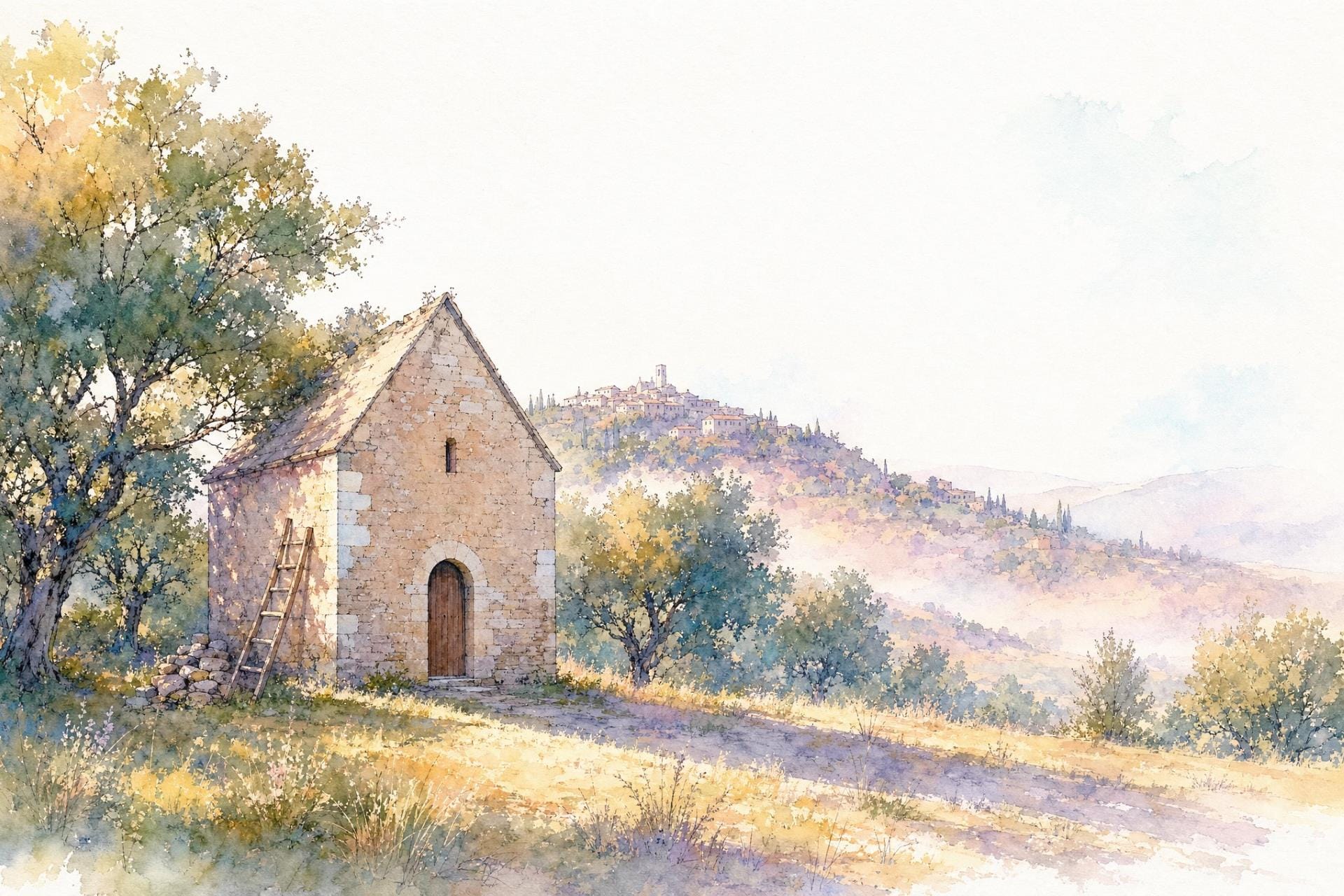
For two years, from the summer of 1206 to the first months of 1208, Francis repairs ruined churches: San Damiano, San Pietro, and the Porziuncola, the small chapel known in English as the Portiuncula. No one follows him. The turning point comes in the spring of 1208. On April 16, according to the Franciscan chronology, Bernardo di Quintavalle and Pietro Cattani, both of Assisi, ask to share his life. Francis does not know how to proceed and leads them to a church in Assisi, San Nicolò, where the Gospel is opened three times. The Legend of the Three Companions has Francis declare that this is their life and their rule. A week later, on April 23, Egidio joins the group at the Porziuncola.
The rule, at that moment, is a book opened three times. No text, no superior, no approval: only men who have stripped themselves of what they owned, and a place, the Porziuncola, where they can gather. In the spring of 1208 the first mission follows: Francis and Egidio go to the March of Ancona, the other two companions in the opposite direction. The group keeps growing, and by the time it goes to Rome the oldest biographies count twelve brothers.
Innocent III and the oral approval of the Franciscan rule, 1209-1210
Francis writes a form of life in a few words, founded mostly on passages of the Gospel, to submit to the pope: a group of men in rough tunics, without a name and without authority, cannot remain long without recognition. That text has not survived: the first version known today is much later and is a development of it, not a copy.
The circumstances are reconstructed from the Legenda maior of Bonaventure of Bagnoregio (chapter 3), written decades after the events. According to that tradition the group is introduced in Rome by the bishop of Assisi, and in the Curia the request meets objections: the rule is new and too austere. Cardinal Giovanni di San Paolo answers that to reject a man who asks to live according to the Gospel, on account of its novelty and austerity, would risk offending the Gospel itself. Pope Innocent III approves by word of mouth, vivae vocis oraculo (by the oracle of the living voice), and entrusts the friars with the mandate to preach penance. Bonaventure also records the pope's dream: a small, despised man holding up the basilica of the Lateran on his shoulders.
No bull and no sealed document record the approval. As for the date, the question is open, and the note that follows sets it out.
Historical note
No document fixes the day on which Innocent III approved the first form of life. The date rests on later accounts, and the sources divide between 1209 and 1210.
Franciscan chronologies place the approval in 1209; other scholarship, in 1210. The circumstances are known mainly from later accounts such as the Legenda maior of Bonaventure of Bagnoregio, written decades after the events, which is why the question stays open.
The approval itself was given by word of mouth, vivae vocis oraculo, "by the oracle of the living voice". No bull and no sealed document record it, and the first text Francis submitted to the pope is lost.
The link between the two moments is written down only in 1223: in Solet annuere, Honorius III confirms the rule that his predecessor Innocent had approved. That is why the sources answer "when was the Franciscan order founded" with a sequence, not a single date.
Clare and the Poor Ladies of San Damiano, 1212
While the friars still live on an oral approval, the fraternity widens. On the night of Palm Sunday in 1212 (some sources give 1211), Clare degli Offreducci leaves her father's house and reaches the Porziuncola, where Francis and his companions receive her. After two stays with other women's communities, at San Paolo in Bastia and at Sant'Angelo di Panzo, she settles at San Damiano, the church Francis had repaired years earlier, together with her sister Agnes and other companions. By the summer of 1212 the sisters named in Clare's canonization process already number five.
The community of San Damiano was called, during Clare's life and long afterward, the Povere Dame (Poor Ladies); the name Poor Clares is later. Clare's own path deserves a treatment of its own. In this story San Damiano matters for one precise reason: the Franciscan fraternity is born plural, male and female together, before its male branch has a text.

The Fourth Lateran Council and the friars minor, from 1215
On November 11, 1215, the council convened by Innocent III opens at the Lateran. Canon 13 forbids founding a new religious order: whoever wishes to enter religious life must choose an order already approved, and whoever founds a new house must take the rule of an approved order. Dominic, the founder of the Dominicans, adopts for this reason the Augustinian rule for his preachers.
A letter of Honorius III, Cum dilecti, dated June 11 (1218 in some editions of the sources, 1219 in others), recommends the friars minor to the bishops and prelates of the Church, asking that they be received as "Catholic and faithful men." The letter comes as the friars begin to travel beyond Italy, after the Pentecost chapter of 1217.
Cardinal Ugolino and the Franciscan novitiate, 1220-1221
In the spring of 1220 Francis returns from the East alarmed by the state of the order. The vicars left in his absence, according to the Catholic Encyclopedia, had made innovations against the spirit of the rule, and Francis, with the help of Cardinal Ugolino, put an end to the disorders. Francis asks Honorius III to give the order Ugolino as protector. Ugolino of Ostia will become pope in 1227 as Gregory IX.
On September 22, 1220, Honorius III issues from Viterbo the letter Cum secundum consilium: it introduces the year of novitiate, in conformity with other orders, forbids leaving the order afterward, and provides censures for transgressors. That same year Francis resigns the governance and appoints Pietro Cattani as vicar, one of the two first companions of 1208. Cattani dies on March 10, 1221.
The Regula bullata: Fonte Colombo and the bull Solet annuere, 1221-1223
The version of 1221, called the Regula non bullata (the rule without a bull, that is, without the papal seal), has twenty-three chapters and is dense with Gospel texts. It is judged too severe and too confused for an order grown beyond all expectation, and Cardinal Ugolino and Brother Elias press Francis to write another. Francis withdraws to Fonte Colombo, near Rieti, to pray and work on the new text; Ugolino, the sources report, modifies some points and gives it a legal form.
The Regula bullata that comes out of Fonte Colombo has twelve chapters and is much shorter. Its opening line defines the rule and life of the friars minor as the observance of the holy Gospel of Jesus Christ, in obedience, without property, and in chastity. Immediately afterward Francis promises obedience to Pope Honorius and his canonically elected successors. It is the formula that closes the circle begun in a church in Assisi: the Gospel as rule, but within the Church of Rome.
On November 29, 1223, in the eighth year of his pontificate, Honorius III issues the bull Solet annuere at the Lateran. The document presents itself as a confirmation of the rule that Innocent III had approved by word of mouth. Asked when the Franciscan order was founded, the sources therefore answer with a sequence: an oral approval in 1209 or 1210, a papal bull on November 29, 1223.

Regula bullata and Regula non bullata: the two texts and the rift
The two texts differ in more than length. The non bullata of 1221, longer and richer in Gospel passages, never received papal confirmation; the bullata is the version confirmed in 1223. After the death of Francis, the question of how to observe the confirmed rule divided the order: the Zelanti wanted to observe it literally, together with the Testament of Francis, while the friars of the Community followed it through papal interpretations. The first of these, the bull Quo elongati of September 28, 1230, declared the Testament not binding.
The Regula bullata remains the legal reference of the Friars Minor, the Conventuals, and the Capuchins. It joins "rule and life" in a single phrase, and the sequence is exact: the life came first, in 1208, with a book opened three times in a church in Assisi. The rule came after, written by a man who had already lived what he wrote.
Special series
2026, the year of Francis: a guide to his 800th anniversary
Eight centuries after his death, the institutions, events and open questions behind Italy's yearlong commemoration of Francis of Assisi.
Dates, places and routes of the anniversary year, from the Porziuncola to the Cammino di Francesco.
Guide to Italy is a letter from an Italy that doesn't write to everyone.
Become a member


