
There is a precise moment each autumn when the air changes character, turns clearer and colder, and Italy's forests begin their quiet transformation. It arrives as the scent of wet earth, mornings sharp with the first frost, and a sun that still warms the skin without burning it. Along a mountain trail, a slow rain of gold leaves settles on the path. From a valley floor, a hillside turns the color of amber and rust, one slope at a time. Italy does not simply change its wardrobe in this season: foliage retraces the country's own geography in color, an argument for slowing down and following the pace of the season rather than a fixed itinerary.
The valleys of Valle d'Aosta and the Dolomites open the season first. The vineyard-covered hills of lower Lombardy and the larch forests of the Stelvio carry it into mid-autumn. The chestnut groves of the Apennines close it toward November, alongside a quieter thread that ties together shepherds, forests, and the science of color change itself.
In this article
- 01 Why foliage in Italy is a mosaic, not a single wave
- 02 Foliage in the Alps: the first wave
- 03 Franciacorta and Stelvio: foliage among vineyards and centuries-old larches
- 04 Foliage in the Apennines: the chestnut groves
- 05 Foliage in the south: the country's least-told wave
- 06 The historic gardens: the latest foliage of all
- 07 Transumanza: a season that moves on the same trails as foliage
- 08 How to plan a foliage trip in Italy
- 09 A closing thought: a mosaic in motion
Why foliage in Italy is a mosaic, not a single wave
In many of the world's best-known foliage traditions, the phenomenon compresses into a short window, often two or three weeks, because a pronounced continental climate produces a sharp swing between day and night temperatures that synchronizes the color change across wide areas at once. Most of Italy runs on a different climate regime. The country splits between a temperate, humid climate in the north and a Mediterranean climate, with dry summers, across the rest of the peninsula: along the Ligurian, Tyrrhenian and southern Adriatic coasts, the swing between day and night stays modest, while it widens sharply in the interior alpine valleys and across the Po valley, where the low plain is known for its pronounced swings between a cold, foggy winter and a hot, humid summer. This difference carries directly into foliage. Where the thermal swing is sharp, as at altitude and in the alpine valleys, the color change moves fast and stays fairly synchronized. Where the Mediterranean climate softens the gap between day and night, as along the coasts and in the hill country of the center and south, the transformation moves slower and spreads across weeks, with tones that run, on average, less vivid.
Altitude adds a second variable, one that Italy works across a scale few other countries share. Hikers call the pattern a long wave: it starts at the highest elevations of the Alps and the Apennines, where larches and beeches, respectively, are the first to turn, and moves progressively down toward the mixed woods and chestnut groves at lower elevations. This combination, elevation dropping as latitude climbs south, spreads Italy's foliage across a good two months instead of three weeks, and makes it harder to catch in a single trip. Travelers chasing the most vivid colors find them, in pockets, but have to look area by area: in Italy, foliage does not arrive everywhere at once, and that is exactly why it can be chased for longer.
The same botanical mechanism governs the color change everywhere in the world: as days shorten and temperatures drop, the tree stops producing chlorophyll, the green pigment that dominates and hides the leaf's other colors through spring and summer. As chlorophyll breaks down, carotenoids, already present in the leaf throughout the growing season, come forward and produce the yellows and oranges. Reds and purples, where they appear, come from a different, newly produced pigment, anthocyanins, which some species synthesize specifically in autumn in response to intense light and cold nights: a reaction that runs stronger where the thermal swing is sharp, weaker where the climate stays mild. This is the botanical reason, not only the climatic one, why alpine larches turn a nearly uniform golden yellow, while mixed woods at mid-elevation can show a wider range, from yellow to red, depending on the species present and the orientation of each individual slope.
Foliage in the Alps: the first wave
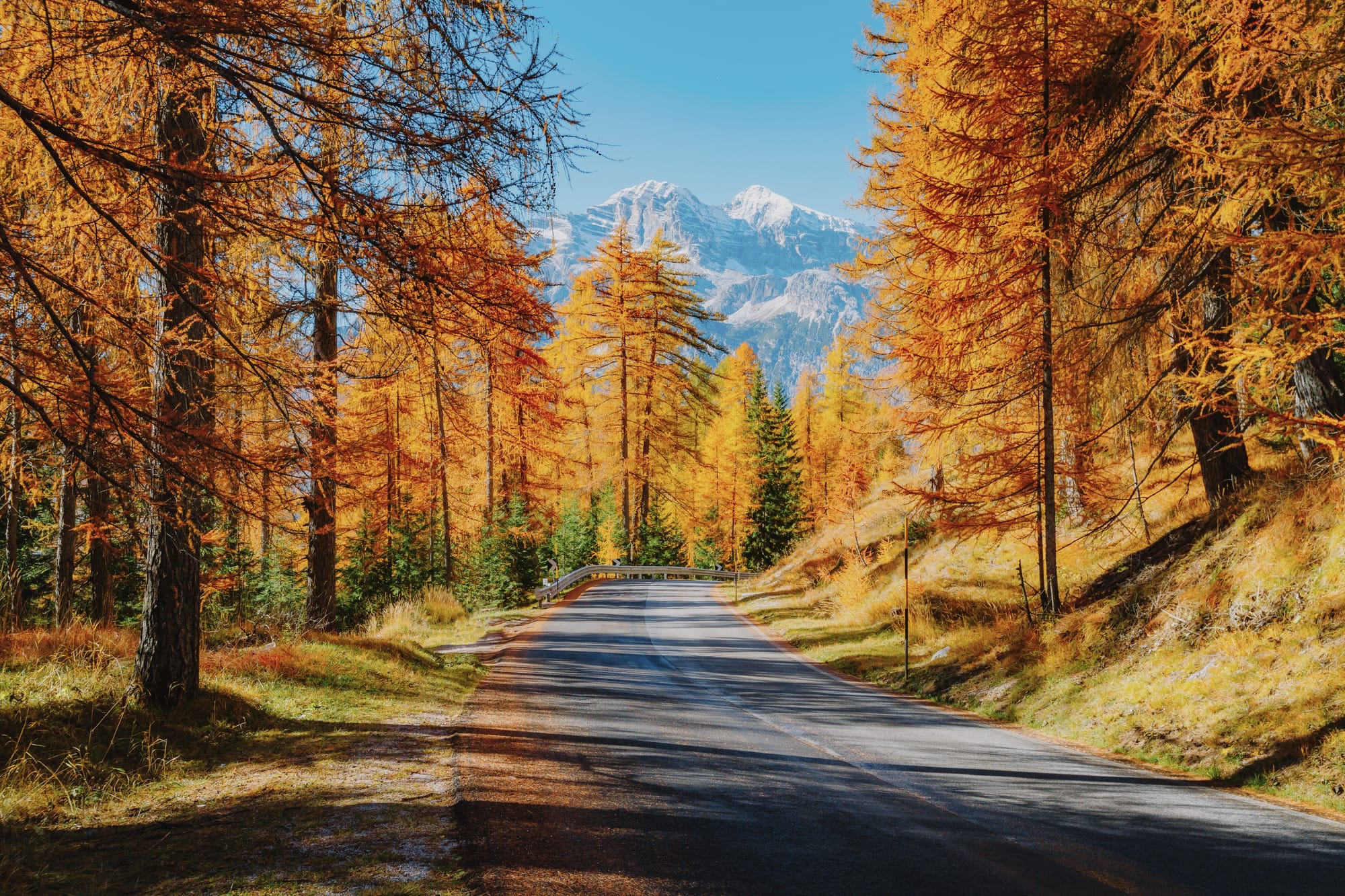
Italy's foliage season begins at high elevation, in the western and central Alps, where larches are the first to turn. On the Valle d'Aosta side of Gran Paradiso National Park, across the valleys of Cogne, Valsavarenche and Rhêmes, larch forests at high elevation offer one of the earliest readings of the season's turn, in a high-altitude light clearer than that of the lower valleys, where beech replaces larch farther down the slope. At this altitude the forest thins out, giving way to pastures already gone yellow and to a silence the busier summer months do not know.
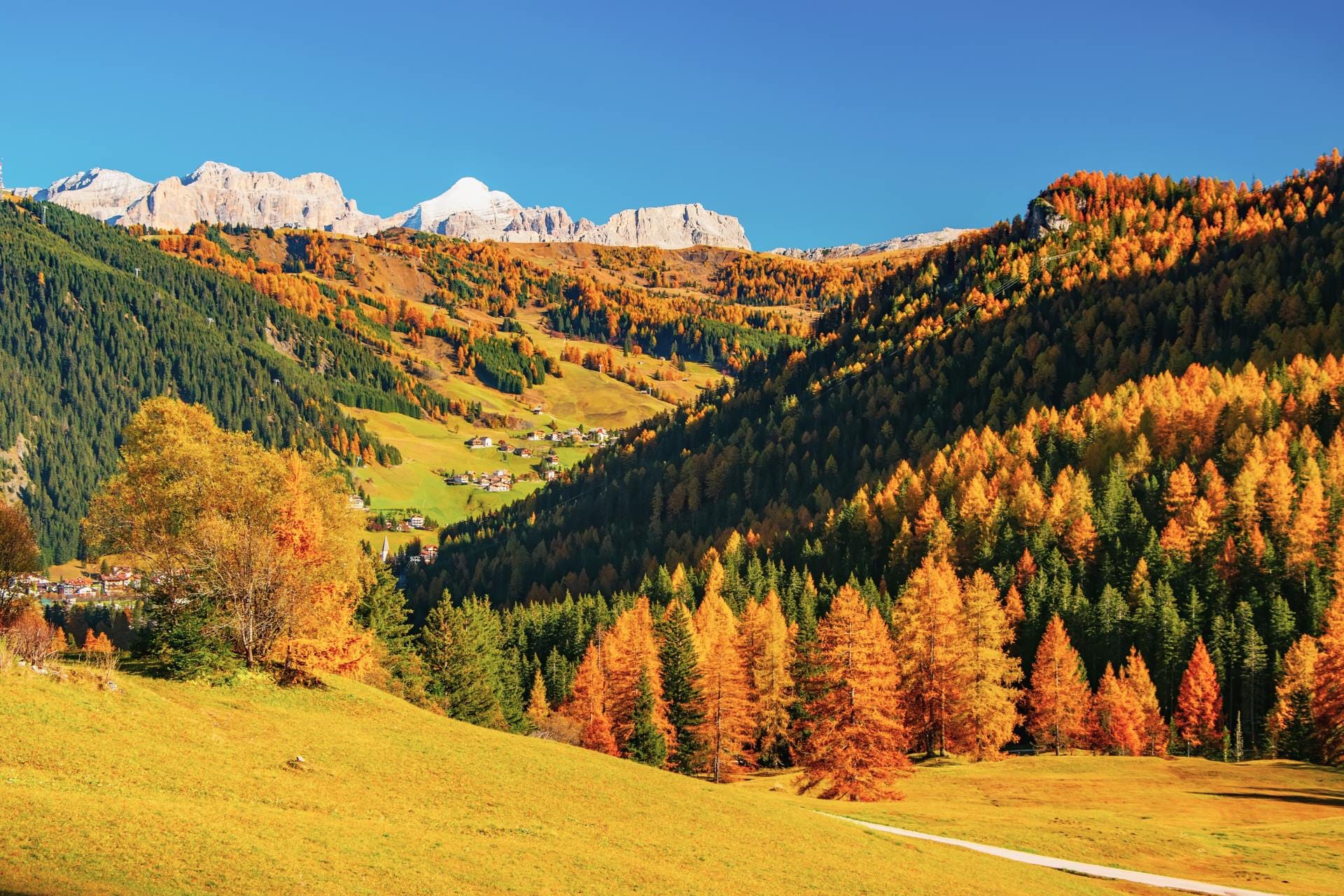
Farther east, in the Trentino Dolomites, Val di Fassa shows the same phenomenon in an entirely different setting: golden larches against the pale walls of the surrounding dolomite rock, often reachable by cable car for those who prefer not to hike, with late-afternoon light sharpening the contrast between the gold of the forest and the rock face. It is a foliage that reads as much vertically as horizontally, worth watching from below as much as from a mountain hut reached by gondola, which makes it one of the most photographed in the country, though it stays manageable outside peak weekends.
Anyone planning a trip built around this first phase of the season should build in a margin of uncertainty: the year's weather shifts the window by a few days, and slopes facing north tend to turn earlier than those in full sun.
Franciacorta and Stelvio: foliage among vineyards and centuries-old larches
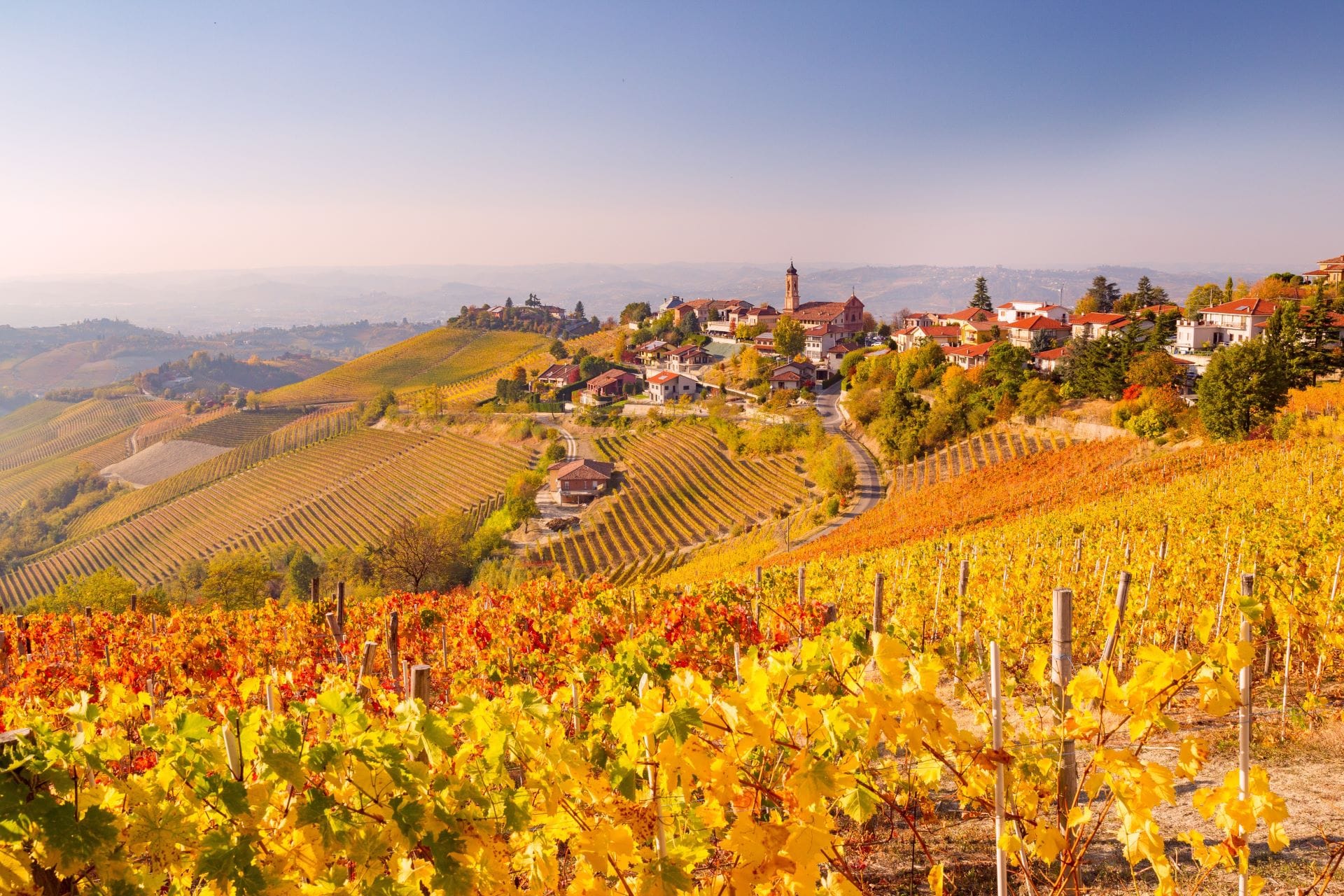
Below the highest alpine band, foliage changes character. In Franciacorta, across the morainic hills south of Lake Iseo and home to the sparkling-wine appellation of the same name, it is not the forest that turns first but the vineyards: the harvest and the season's color change overlap, producing an image rarer in Italy's foliage story, usually built around forests and mountains rather than farmed landscape. The morainic hills, low and rolling, give a more domesticated foliage than the alpine version, but no less photogenic, especially in the morning hours, as fog lifts slowly off the rows.
A little farther north, across Lombardy, Trentino and Alto Adige, Stelvio National Park holds some of the most extensive larch forests in the Italian Alps, in valleys such as Val di Rabbi, Val di Sole and the area around Bormio and Valfurva, where the forest spreads across a scale few other alpine areas in Italy can match, with a historical layer tied to the First World War front that adds a dimension rarely explored elsewhere in the season.
Franciacorta and Stelvio tell the same phase of the season, between late September and the first half of October, in two opposite registers: one agricultural and almost domestic, the other wild and marked by history. At this point in the year, the highest alpine band has already passed its peak, while the pre-alpine and mid-elevation band is still reaching it.
Foliage in the Apennines: the chestnut groves
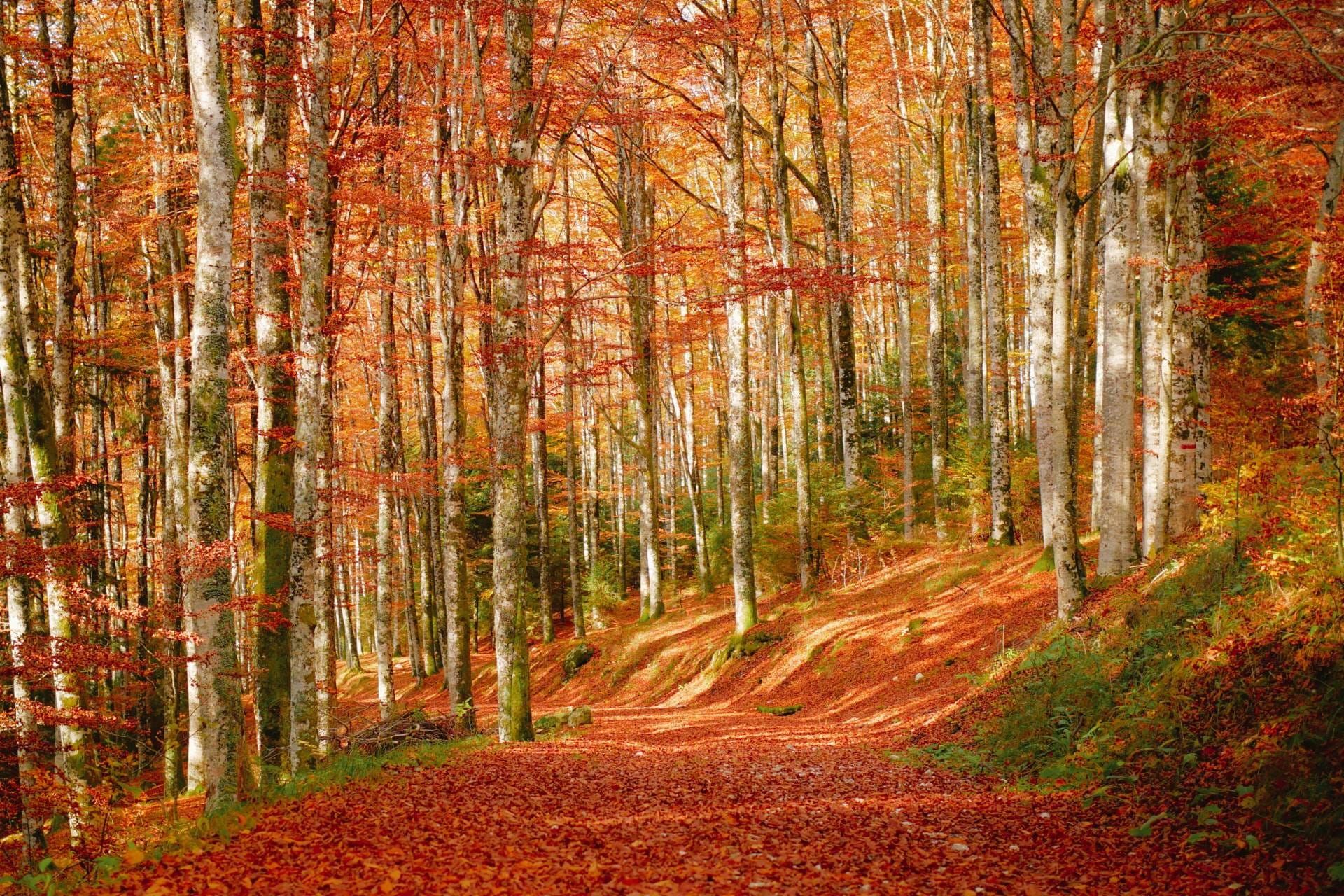
Moving down toward the Apennines and lower elevations, the lead role in foliage changes again. In place of larches and beeches come the chestnut groves, which turn between October and November and which, in Italy, are not only a visual phenomenon. Chestnut trees fed entire mountain communities across the Apennines for centuries, in an era when wheat did not reach certain elevations easily and chestnut flour replaced wheat flour in the daily diet, earning the tree the name albero del pane (the bread tree) in many areas. Chestnut-grove foliage carries that agricultural history alongside its seasonal color: walking through a chestnut grove at this point in autumn means crossing what was, for centuries, first and foremost a working landscape.
Foliage in the south: the country's least-told wave
The Mediterranean climate across most of peninsular Italy compresses the final stretch of the season more than it removes it. In the interior areas of the center and south and across the southern Apennine ridges, beeches and oaks reach their moment between late October and November, with colors generally warmer and less vivid than the alpine range, consistent with a day-night thermal swing that stays more contained across most of these areas. It is the least told foliage story in the country, not because it is less interesting but because Italy's tourism narrative stays concentrated almost entirely on the Alps: the beech forests of the southern Apennine parks, from Sicily to Calabria, remain a quieter, less traveled version of the same season.
The historic gardens: the latest foliage of all
The historic gardens of northern Italy deserve a separate note, where the latest foliage owes nothing to climate and everything to the botanical choices of the people who designed them. On Lake Como, the garden of Villa Carlotta is built around a spring identity: an eighteenth-century villa given its present, romantic layout in the nineteenth century under the Dukes of Saxe-Meiningen, its largest crowds arrive for the rhododendrons and azaleas of April and May. Its Japanese maples, non-native and planted purely for their ornamental foliage, are a quieter, later chapter of the same garden: they hold their color into October and November, well after the rhododendrons have finished and after the wild chestnut and beech forest on the hillside above has already dropped its leaves. A short walk along the lake, in Bellagio, the maple collection in the gardens of Villa Melzi tells the same story in miniature, trees small and precisely shaped, each leaf turning on its own schedule rather than the forest's. This is foliage as a final, cultivated version of the season, offered by gardens designed for an entirely different month, that happens to still be giving something when the rest of the country has gone quiet.
Transumanza: a season that moves on the same trails as foliage
In autumn, as the forests change color, another ancient seasonal movement travels the same alpine and Apennine slopes: transumanza, the seasonal descent of flocks from the summer malghe (highland pastures) along tratturi (centuries-old drove roads), recognized by UNESCO in December 2019 as an intangible cultural heritage of humanity, in a nomination shared with Greece and Austria. In every valleys, the descent has its own dialect name and its own shape as a public event. For example, in Val di Fassa, Val di Rabbi, and Val di Sole, the “desmontegada” takes place, a tradition held between September and early October, in which the cattle descend from the mountain pastures with their horns adorned with ribbons and flowers, preceded by the sound of cowbells, and are welcomed in the town center by the community, which won’t see them back on the pastures until the following summer. A handful of herders still walk the full descent on foot, driving their herds down the same mountain tracks for several kilometers rather than trucking them, a detail that ties the practice more directly to the physical landscape than the festival that follows it. The two seasonal rhythms, that of livestock and that of the forest, share the same calendar and often the same trails, though they are rarely told together.
How to plan a foliage trip in Italy
A foliage trip in Italy rewards travelers who build in flexibility, since color follows weather and elevation rather than a train schedule or a hotel's cancellation policy. Most Italian travel planning runs on fixed points: foliage runs on a different logic entirely, closer to planning around a harvest than around a monument, and the itineraries that work best treat the season as a moving target to be tracked rather than a date circled on a calendar months in advance.
Practical notes
Foliage in Italy comes with a margin of uncertainty that a museum or a restaurant booking does not: the peak window shifts from year to year with late-summer temperature and rainfall, and can move by a week or two against a given area's historical average.
Flexible cancellation terms are worth paying for in the high-altitude areas, where that window is narrowest. In the mid- and low-elevation areas, where the season spreads across a longer period, the margin for error in choosing dates is naturally wider.
Moving between areas takes real time: the distance between the western Alps and the central Apennines cannot be covered in a day, not if the landscape along the way is meant to be enjoyed too. A single week is better spent on one area, alpine or Apennine, than chasing the full sequence from north to south.
Public transportation reaches much of the alpine valleys covered here, often with cable cars or gondolas that shorten the hikes. For the more interior areas of the Apennines, a car remains the more practical choice.
Crowding here has little in common with peak summer crowds, but weekends at full color in the most photographed valleys of the Dolomites can still fill parking areas and mountain huts well in advance, while weekdays stay quieter under the same light. Franciacorta, the central Apennines and the south stay freer even on weekends, simply because they draw less attention than the Alps.
Checking the official channels of the parks and local authorities referenced throughout this series before departure is worth the extra step: they track the actual state of foliage on the ground, a far more reliable guide than a forecast made weeks ahead.
A closing thought: a mosaic in motion
By the end of this long sequence, one that moves from the glaciers and high-altitude larch forests to the flowering gardens of northern Italy, then on to the Apennines and even further south, what stays is the sense of an entire country changing color one piece at a time, on its own schedule rather than the calendar's. Every leaf that falls and every slope that turns amber carries a version of the same long history of altitude, climate and rural tradition, the same slow chemistry of a tree deciding, species by species and slope by slope, that the year is over. Somewhere in that sequence a bell is still sounding as the last herd comes down from a malga, and somewhere else a Japanese maple planted a century and a half ago is only now catching up with a season the rest of the forest finished weeks earlier.
To chase foliage in Italy is to accept that no single trip covers it all, and that returning, more than once, across more than one autumn, is built into the season itself. The country does not offer its color all at once. It offers it in installments, and asks the traveler to come back for the rest.
Guide to Italy is a letter from an Italy that doesn't write to everyone.
Become a member


