
September in Italy changes the light before it changes the temperature. Shadows stretch by a few more minutes each day, the late afternoon sun falls lower and warmer across west facing facades, and cities that felt saturated in July begin to breathe again on their own rhythm.
It is the month when Venice reclaims its water for one entire Sunday, as historic boats parade down the Grand Canal, and when the Lido fills with film screenings rather than swimmers. In the vineyards of the north, the vendemmia (the grape harvest) begins to set the pace of the days, while in the south the harvest calendar has yet to be written. At the same time, the country's cultural calendar wakes from its August torpor.
Travelers arriving in September find a country letting go of summer without any hurry. The sea stays warm enough to justify a swim at mid month, evenings start to call for a light jacket, and restaurant tables suddenly become easy to book again. It is no longer high season, and not yet autumn: the most generous transition of the year, the one in which Italy stops performing a role for visitors and simply goes back to being itself.
In this article
- 01 Why visit Italy in September?
- 02 Weather in September: temperatures and what to pack
- 03 Where to go and what to do in September
- 04 Events, festivals and sagre in September
- 05 What to eat in September: flavors of the month
- 06 Traveling in September: crowds, prices and booking advice
- 07 Frequently asked questions about Italy in September
- 08 September, the month Italy stops performing
Why visit Italy in September?
September restores a human scale to the travel season. In August, the art cities and the best known coastlines run close to capacity. Now the same places become walkable again, with wider booking margins and an availability unthinkable in the middle of summer.
The most concrete shift is in what a visitor actually finds waiting. Early September concentrates the traditions Italians hold closest. The Regata Storica, whose earliest records date to the middle of the thirteenth century, and the Venice Film Festival share the same handful of days on the water and the Lido, while further inland in Piedmont the Palio di Asti fills the town with more than a thousand costumed participants and a bareback horse race that has been documented, in some form, since the thirteenth century as well. In the vineyards of the north, the picking of white grapes gets underway, and on many estates visitors can watch this old labor up close, seeing a side of agricultural Italy that stays mostly hidden the rest of the year. Temporary exhibitions and concert seasons reopen at the same time, often with a program richer than June's.
September is the month when the Italy that works the land and the Italy that tends its museums both come back into view.
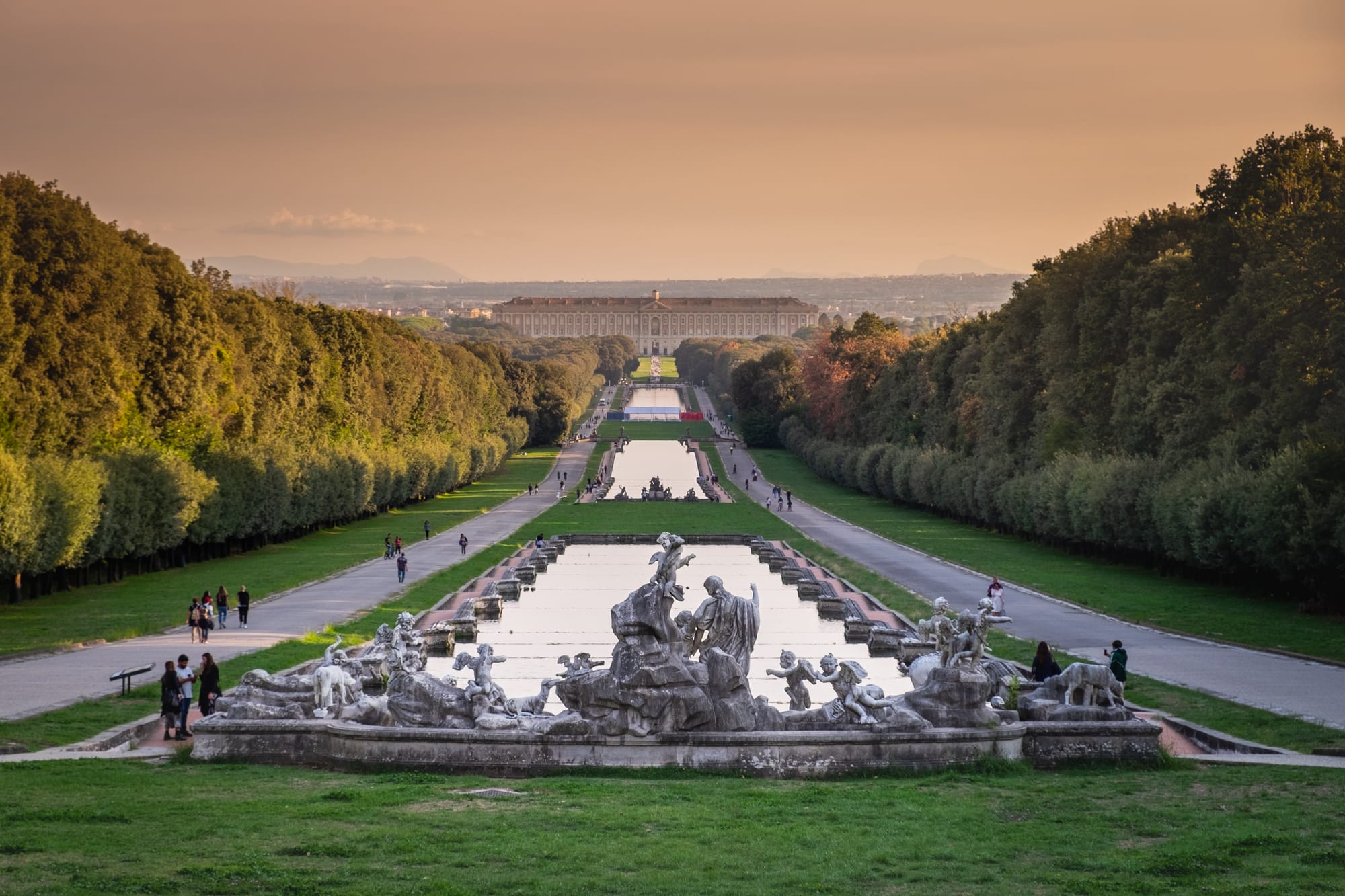
Weather in September: temperatures and what to pack
September in Italy moves at two speeds. In the first half of the month, especially in the center and south, the hottest days can still climb past 35 degrees Celsius, or 95 degrees Fahrenheit. In the second half the weather turns more unstable, as the first Atlantic disturbances reach the north with greater frequency and the passage from summer high pressure to the season's first low pressure systems can bring sudden, locally intense storms, particularly across the center and south.
Weather and packing
Average daily temperatures across the lowlands settle in familiar bands for the month: around 19 to 20 °C (66 to 68 °F) in the north, 20 to 21 °C (68 to 70 °F) in the center, and 23 to 24 °C (73 to 75 °F) in the south and the islands, where the climate generally stays warmer and more stable until the end of the month. The sea remains swimmable almost everywhere: the water touches around 22 °C (72 °F) along the northern coasts and 24 to 25 °C (75 to 77 °F) in the center and south, which makes a late summer swim entirely reasonable. The most effective approach to packing is layering, light clothing for the middle of the day, with a sweater or jacket added for the evenings, when temperature swings become noticeable, particularly in the alpine valleys. A compact rain shell becomes worth carrying as the month moves closer to October.
Where to go and what to do in September
September in Italy divides along latitude and altitude: warm coastal afternoons hold in the south, while the mountains already offer crisp, clear trekking air.
Along the Adriatic coast of Puglia, the water holds swimming temperatures well into the month, set off by a low light that warms the local Lecce stone. On the Tyrrhenian side, Calabria keeps the same climatic advantage while emptying out noticeably. Farther north, the coast of the Marche, around the Riviera del Conero, offers good swimming conditions at least through the first week, before short haul domestic tourism tapers off entirely.
In the Dolomites, September already leans toward autumn. The trails around Ortisei, in Val Gardena, including the high plateau of the Alpe di Siusi, and the area of Cortina d'Ampezzo, shed their summer crowds, and the cooler temperatures make long hikes far more comfortable. The high elevations of the Aosta Valley, toward Gran Paradiso, likewise offer strong, stable trekking windows before the first sharp cold arrives. In the Sardinian interior, in Barbagia, the island's mountainous heartland, and around the Supramonte massif, the landscape starts turning toward warmer tones, offering quiet trails and ideal walking weather.
In Piedmont's Langhe, September marks the start of the harvest for the great reds, Barolo and Barbaresco among them, an activity that builds toward the celebrated white truffle fair in Alba later in the fall. On the slopes of Etna, in Sicily, the sharp temperature swings driven by altitude set off the picking of native red grape varieties such as Nerello Mascalese, a ritual that looks and feels distinct from anything happening along the coasts.

Events, festivals and sagre in September
September fills the Italian calendar with sagre, the small town festivals built around a single local specialty, a saint's day, or the start of a harvest. New olive oil, the first porcini of the season, or the grapes already coming in: on any given weekend, any of these gives a piazza reason enough to fill with long tables and a local band. Alongside this scattered, hyperlocal calendar, the month also holds some of the country's oldest and most structured public traditions, built around a fixed date and centuries of precedent rather than a single harvest. Five of them are worth building a trip around this year.
Events this month
Venice, the first Sunday of the month (September 6, 2026): the Regata Storica transforms the Grand Canal. The event reenacts the welcome given in 1489 to Caterina Cornaro, queen of Cyprus, who ceded her throne to Venice, and remains one of the oldest fixtures on the city's rowing calendar, the day Venetians reclaim their own waterfront.
Monza (September 4 to 6, 2026): the Formula 1 Italian Grand Prix returns to the Autodromo Nazionale Monza, the only Italian round on the world championship calendar and, this year, a race weekend that shares its Sunday with both the Regata Storica and the Palio di Asti. Monza has hosted the race every world championship season since 1950, with the sole exception of 1980, when it moved to Imola.
Venice, the Lido (September 2 to 12, 2026): the Venice Film Festival, officially the Mostra Internazionale d'Arte Cinematografica, reaches its 83rd edition under director Alberto Barbera, with Maggie Gyllenhaal presiding over the international jury and career Golden Lions going to George Clooney and Ellen Burstyn.
Asti, the first Sunday of the month (September 6, 2026): the Palio di Asti, marking the 751st anniversary of its first documented running, fills the town with more than a thousand costumed participants, propitiatory dinners the night before, and a bareback horse race through Piazza Alfieri, run in three qualifying heats of seven horses followed by a final of nine.
Naples (September 19): the Festa di San Gennaro and the ritual liquefaction of his blood, one of three such occasions each year and the one marking the anniversary of his beheading in 305 AD, draw out the city's religious and visceral character, followed by days of celebration through the historic center.
What to eat in September: flavors of the month
September cooks like a month in transition, not quite done with summer and already looking toward autumn. It is the month of mosto (the sweet, unfermented juice pressed from the earliest grapes) and of the first tastes of vino novello (the new wine), both rare finds away from the vineyards themselves. It is the last turn for figs, which produce a late flowering in the south, and the debut of the season's first porcini (the wild mushrooms roused from the ground by the first rains in the Apennines and the Alps).
On market stalls, the first table grapes and early pumpkins sit alongside the last tomatoes destined for winter preserves. In restaurants across the wine regions, it is not unusual to find a menu that pairs pesce azzurro (small oily fish such as anchovies and sardines, still central along the coasts) with a mushroom scented pasta course. Neither will feel out of place on a September table.

Traveling in September: crowds, prices and booking advice
September is Italy's most generous shoulder season, and the room to maneuver on lodging and restaurants widens considerably compared with August, especially from the second week onward. The staggered reopening of Italian schools marks the real end of the heavy domestic travel season.
Prices at seaside destinations drop noticeably, while art cities hold steady, supported by strong international demand. There are important exceptions tied to major events: visiting Venice during the Regata Storica or the Film Festival, Asti during the days of the Palio, or Monza during the Formula 1 Italian Grand Prix weekend, calls for booking months ahead, since availability tightens and prices climb sharply across all three at once, given that the Regata Storica, the Palio, and the Monza race weekend fall on the same days this year. For the rest of Italy, four to six weeks of lead time is generally enough.
One note for wine travelers: many estates suspend guided visits during September to focus on the harvest itself. Contacting wineries directly, rather than relying on general booking intermediaries, helps avoid arriving to closed doors.

Frequently asked questions about Italy in September
Is it still hot in Italy in September?
In the first part of the month, yes, especially in the center and south, where temperatures can pass 35 degrees Celsius (95 Fahrenheit) with mild nights. Toward the end of the month, temperatures align with autumn averages: the north cools noticeably, while the south eases down more gently. In the mountains and inland areas, a jacket becomes necessary even during the day.
Is the sea still swimmable in Italy in September?
Along most of the coastline, absolutely. The water stays around 22 degrees Celsius (72 Fahrenheit) in the north and 24 to 25 degrees Celsius (75 to 77 Fahrenheit) in the center and south, at least through the middle of the month. In the southern regions and on the islands, a swim often remains a pleasure through the final week.
What is the best time in September to visit Italy?
It depends on the priority. The first week holds the heart of the cultural and historic calendar, though prices run higher and the atmosphere turns more social. The second half of the month delivers close to ideal temperatures for exploring, quieter beaches, and considerably better rates, even if the events calendar thins out.
When does the grape harvest start in Italy?
Timing varies by region and grape variety. In the north and at altitude, where white grapes dominate, picking often begins in the first two weeks of September. In the regions known for great reds, such as the Langhe, the harvest reaches its peak in the second half of the month, continuing, especially in the south and Sicily, well into October.

September, the month Italy stops performing
The light of September, stretching a little further with each afternoon, is the same light that marks the end of the beach season and the start of the harvest. Italy lives this month twice: once through those who stay in swimsuits until mid month, and again through those already watching the mist rise from the rivers of the Po Valley or the crews moving between the vine rows.
Travelers who arrive during this stretch of the year find both seasons overlapping. They meet a country that, for a few weeks, needs to perform nothing at all to live up to expectations.
The month-by-month hub
The best time to visit Italy: a month-by-month guide
How September compares with the other eleven months, region by region.
Guide to Italy is a letter from an Italy that doesn't write to everyone.
Become a member


