
The Italian landscape is a complex mosaic where history, geography, and culture converge in small, concentrated centers of excellence. For the discerning international traveler, the true soul of the peninsula is rarely found in the bustling corridors of major metropolitan hubs like Rome or Florence. Instead, it resides in the borghi: the small, fortified villages that have preserved their architectural integrity, local traditions, and a distinct way of life for centuries.
The official association, I Borghi più belli d’Italia (the most beautiful villages of Italy), acts as a rigorous curator of this heritage. Founded in 2001 under the auspices of the National Association of Italian Municipalities (ANCI), the club recently expanded its prestigious list to include seven new members for the 2026 season. This selection is not merely an aesthetic accolade; it is the result of a stringent certification process designed for those seeking an authentic Italian experience far from the standardized circuits of mass tourism. These new entries represent the frontier of high-quality, independent travel and sustainable exploration.
- Understanding the philosophy of the "Borghi più belli d’Italia" association
- Limone sul Garda: a Mediterranean enclave in the Alpine foothills
- Pieve di Teco: the architectural elegance of the Arroscia Valley
- Castelvetro di Modena: the checkerboard of the Renaissance
- Cusano Mutri: a white stone fortress in the Matese Mountains
- Rivello: the Byzantine and Latin synthesis of Basilicata
- The guest members: historic districts and unique heritage destinations
- Navigating the borghi: a practical guide for the cultural traveler
- The borgo as a definitive model for conscious travel in Italy
Understanding the philosophy of the "Borghi più belli d’Italia" association
To appreciate the significance of these new entries, one must first grasp the underlying philosophy of the association. The term borgo implies far more than just a "village": it suggests a historical settlement, often fortified, that maintains a harmonious relationship with its surrounding natural landscape. The mission of the association is to combat the depopulation of Italy’s rural heartlands by transforming these small centers into focal points of cultural and economic attraction.
The selection process is highly rigorous and structured, designed to ensure that only municipalities of outstanding historical and urban quality are admitted to the network. The association applies a certified evaluation system based on 72 distinct parameters, which together assess the overall excellence and coherence of each village.
- Architectural and urban integrity, with particular attention to the preservation of original urban layouts, the harmony of buildings, and the consistent use of traditional materials, colors, and forms. The visual coherence of the historic center and its relationship with the surrounding landscape are essential elements of the assessment.
- Quality of the environment and landscape, focusing on the protection of natural settings, the integration of the built environment within its context, and the overall balance between heritage and contemporary use.
- Quality of services and hospitality, including the availability of facilities and infrastructure capable of supporting visitors while preserving the authenticity and livability of the village.
Together, these criteria ensure that membership in I Borghi più belli d’Italia represents a genuine seal of excellence rather than a purely aesthetic recognition. For the modern traveler, this certification serves as a guarantee of authenticity: a promise that the destination offers a well-preserved environment where the layers of Italian history—from the Roman and Medieval periods to the Renaissance—are visible, respected, and lived daily.
Limone sul Garda: a Mediterranean enclave in the Alpine foothills
Among the most celebrated additions to the 2026 list is Limone sul Garda, situated on the dramatic western shores of Lake Garda in Lombardy. Its inclusion is a testament to its unique microclimate and an architectural typology found nowhere else in Europe. Historically, Limone was an isolated fishing community, accessible only by water until 1932. This long-standing isolation preserved a vertical urban layout where narrow alleys climb steeply toward the limestone cliffs of the Dosso dei Roveri.
The village’s defining characteristic is its limonaie: historic stone and wood greenhouses built in the 17th century to protect citrus trees from sub-alpine winters. Today, these structures are icons of pre-industrial engineering.
- The longevity gene: Limone is globally famous for the A-1 Milano protein found in the blood of its residents, which promotes cardiovascular health and extraordinary longevity.
- Ciclopedonale del Garda: experience the newly inaugurated "floating" bicycle path, an engineering marvel that suspended over the water, offering a breathtaking perspective of the village’s precarious beauty.
- Limonaia del Castèl: a must-visit museum that showcases how 17th-century pillars and glass panels created a Mediterranean oasis at an alpine latitude.
Pieve di Teco: the architectural elegance of the Arroscia Valley
Hidden in the Ligurian hinterland, far from the crowded resorts of the Italian Riviera, lies Pieve di Teco. This village serves as the gateway to the Arroscia Valley and is a masterclass in medieval urban planning. Its inclusion highlights the historical importance of the salt routes that once linked the Mediterranean coast to the northern plains.
The heart of the village is the Corso Ponzoni, a street defined by its 15th-century porticos. These vaults were designed for trade, allowing merchants to display goods regardless of the weather—a tradition that continues today through artisanal leatherworking and traditional shoemaking.
- Teatro Salvini: discover one of the smallest theaters in the world, built in 1834 with an elegant wooden structure that seated the 19th-century elite.
- Ormeasco wine: the surrounding hills produce this rare, bold red wine; a visit to a local enoteca is essential for understanding the Ligurian viticultural heritage.
- Gateway to the Alps: Pieve di Teco acts as a cultural bridge between the maritime spirit of the coast and the rugged traditions of the Ligurian Apennines.
Castelvetro di Modena: the checkerboard of the Renaissance
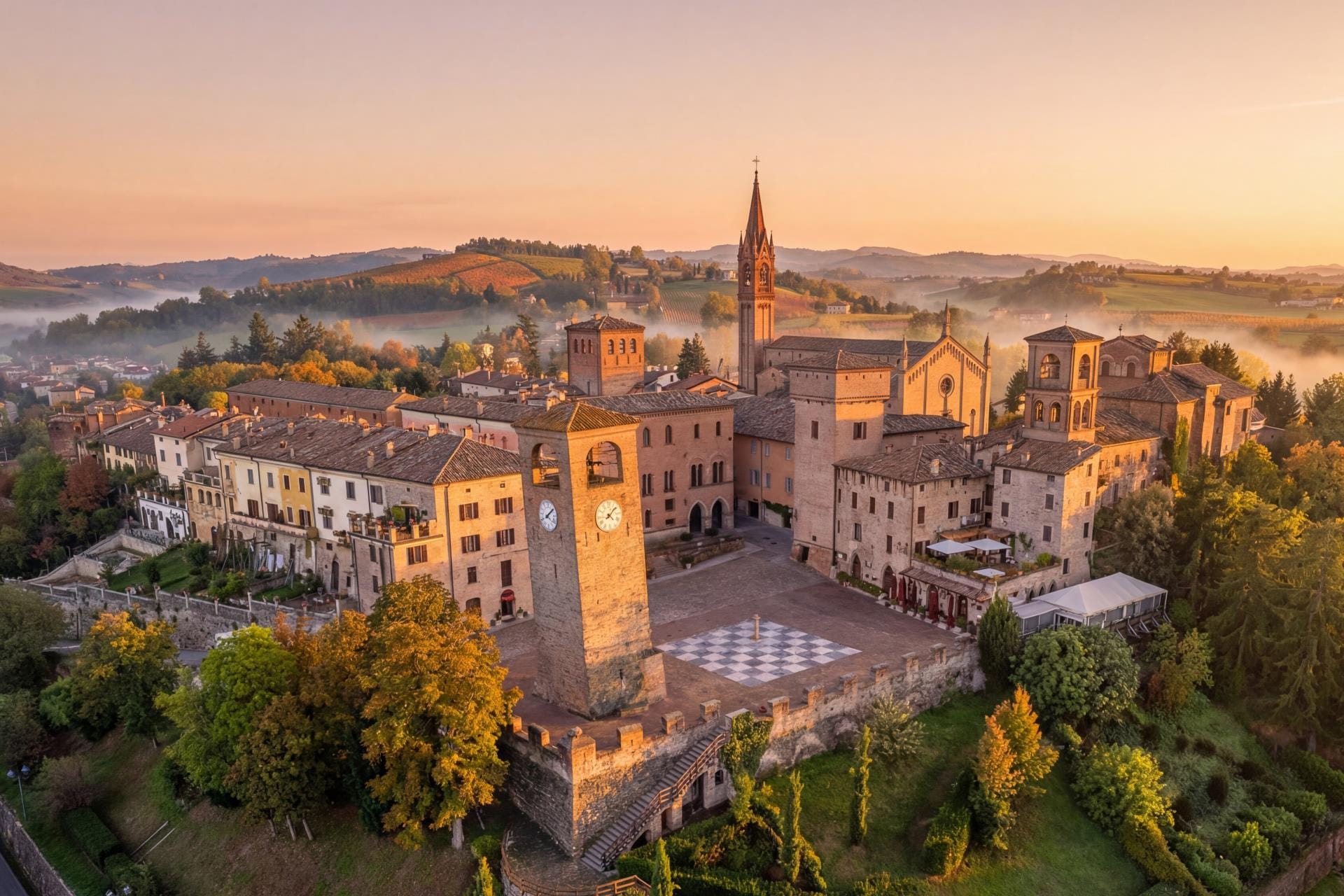
In the culinary heart of Emilia-Romagna, Castelvetro di Modena offers a sophisticated exploration of the bond between fertile land and urban form. The village sits on the first slopes of the Apennines, surrounded by undulating vineyards of Lambrusco Grasparossa—the deep, structured sparkling wine that defines the local identity.
The focal point of the village is the Piazza della Dama, paved in a striking black-and-white checkerboard pattern that serves as the stage for the Dama Vivente, a human chess match performed in period costume.
- Medieval skyline: the village is dominated by the Torre dell’Orologio (Clock Tower) and the Torre delle Prigioni, symbols of its strategic feudal power.
- The food valley experience: Castelvetro is an ideal base for exploring Traditional Balsamic Vinegar of Modena and Parmigiano Reggiano producers.
- Castello di Levizzano: located just minutes away, this castle offers the most panoramic views of the viticultural landscape in the region.
Cusano Mutri: a white stone fortress in the Matese Mountains
In Campania, the village of Cusano Mutri presents a rugged, monochromatic aesthetic. Perched on a rocky spur within the Matese Regional Park, it is a town built entirely of white limestone. Its inclusion in the Borghi più belli d'Italia recognizes it as one of the most impeccably preserved medieval centers in Southern Italy.
The urban fabric is a labyrinth of supportici (underpasses) and vicoli (alleys) that seem to grow directly out of the mountain. The Church of SS. Pietro e Paolo, reachable via a majestic stone staircase, provides a vantage point over the deep gorges of the Titerno river.
- Sagra dei Funghi: if visiting in autumn, this legendary Mushroom Festival is a pilgrimage for gourmands seeking high-altitude porcini and wild truffles.
- Outdoor adventure: the village is the primary hub for trekking in the Matese, offering access to pristine forests and limestone canyons.
- Authentic Campania: unlike the Amalfi Coast, Cusano Mutri offers a glimpse into the unpolished, rural soul of the Italian interior.
Rivello: the Byzantine and Latin synthesis of Basilicata
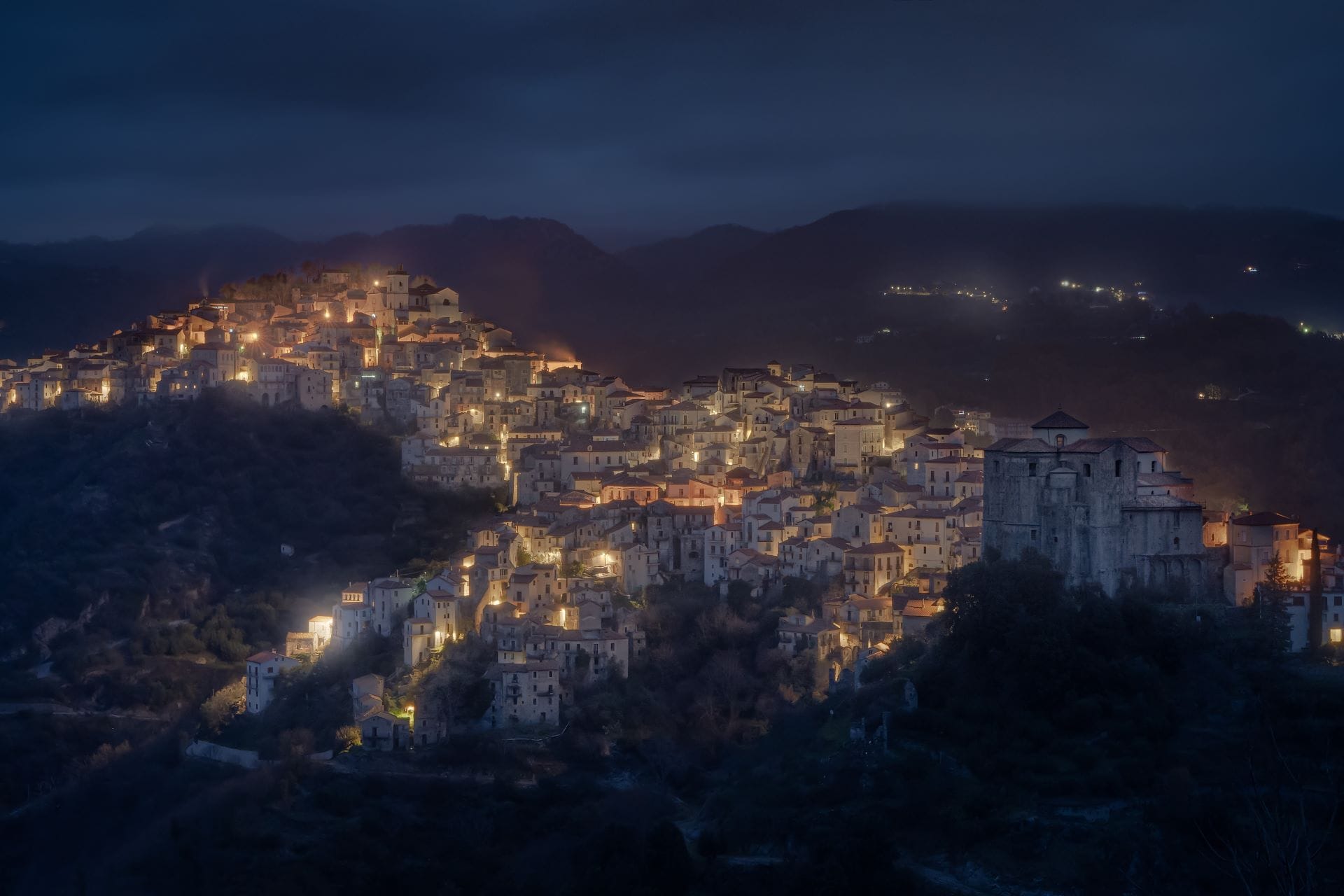
Rivello is perhaps the most visually arresting of the 2026 entries. From a distance, it appears as a white limestone cascade flowing down three distinct hills—Motola, Serra, and Poggio—overlooking the Noce Valley. Its history is a fascinating study in cultural friction: for centuries, the town was split between a "Latin" quarter and a "Byzantine" quarter, each maintaining its own liturgical rites.
The cultural anchor of the village is the Monastery of Sant’Antonio, which houses a refectory featuring 16th-century frescoes that are among the finest in the Basilicata region.
- The Poggio district: wander through the upper town to see noble palazzi with wrought-iron balconies that reflect the 18th-century economic boom.
- Artisanal legacy: Rivello is one of the last centers for traditional copper beating and gold filigree, crafts that have defined the village for half a millennium.
- Proximity to Maratea: located just a short drive from the "Pearl of the Tyrrhenian," Rivello offers a cool, mountainous retreat after a day on the coast.
The guest members: historic districts and unique heritage destinations
Beyond the standard classification, the association also grants the prestigious status of Borghi Ospite (guest members) to specific locations. This designation is a recognition of excellence reserved for historic districts that possess exceptional artistic and environmental value but are located within municipalities exceeding the 15,000-inhabitant limit. For the independent traveler, these guest members offer a sophisticated blend of small-town intimacy and the cultural infrastructure of larger urban centers.
Borgo il Piazzo: the medieval soul of Biella
Located in the heart of Piedmont, Borgo il Piazzo represents the historical and aristocratic core of Biella. Perched on a hill overlooking the modern city, this district is an island of Medieval and Renaissance elegance. To reach it, visitors utilize a 19th-century funicular, a nostalgic journey that immediately creates a sense of detachment from the industrial valley below.
The district is a masterclass in urban preservation, where the wealth of the Biellese textile dynasties is reflected in the architecture.
- Piazza Cisterna: this is one of the most evocative urban spaces in Northern Italy, characterized by its medieval porticos and the striking Palazzo Pozzo.
- Architectural harmony: the streets are lined with noble palazzi featuring ornate terracotta decorations and hidden courtyards that reveal the district’s private, sophisticated history.
- Textile heritage: the proximity to the Cittadellarte-Fondazione Pistoletto and the historic wool mills along the river makes Piazzo an essential stop for those interested in the intersection of industrial archaeology and fine craftsmanship.
Borgo Vecchio of Termoli: a maritime citadel in Molise
The second guest member, the Borgo Vecchio of Termoli, offers a completely different aesthetic experience. Located on the Adriatic coast of Molise, this village is a seafaring fortress built on a rocky promontory. Surrounded by high defensive walls, it served as a primary bulwark against maritime invasions for centuries.
The layout of the Borgo Vecchio is a labyrinth designed to break the force of sea winds, featuring some of the narrowest streets in Italy.
- Swabian Castle: the Castello Svevo is the iconic symbol of Termoli, a massive fortification dating back to the 11th century that dominates the coastline.
- The Cathedral of Santa Maria della Purificazione: a masterpiece of Apulian Romanesque architecture, this cathedral houses the relics of Saint Timothy, discovered during a 1945 restoration.
- A Rejecelle: do not miss the opportunity to walk through one of the narrowest alleys in the world, a testament to the dense, protective urban planning of the medieval era.
Choosing to visit these guest members allows the cultural traveler to experience the authentic diversity of Italy, where the mountain-bound elegance of Piedmont meets the salt-washed resilience of the Molise coast. These districts prove that certified beauty can thrive even within the boundaries of modern, vibrant cities.
Navigating the borghi: a practical guide for the cultural traveler
Organizing a journey to these certified villages requires a different logistical mindset than a standard urban city-break. These locations are often situated in Italy's "internal areas"—regions where the geography is rugged, public transport is sparse, and the pace of life is dictated by centuries-old customs rather than modern convenience. For the traveler, mastering these logistics is the key to unlocking an authentic experience.
Logistics and transportation: driving through the heart of Italy
The most effective way to reach these secluded destinations is via a private rental vehicle. While major cities are seamlessly connected by the Frecciarossa high-speed rail, the borghi typically require navigating Strade Statali (state roads) and Provinciali (provincial roads) that wind through valleys and climb steep ridges.
Accommodation: the albergo diffuso hospitality model
For a truly immersive experience that transcends the standard hotel stay, the traveler should seek out an albergo diffuso. This unique Italian hospitality model, translated as a "scattered hotel," does not house guests in a single building but distributes rooms across various restored historical houses within the village.
This model is a form of sustainable social enterprise: the reception, breakfast area, and common spaces are integrated into the existing urban fabric. This allows the guest to "live" the village as a temporary resident rather than a mere observer. By staying in an albergo diffuso, you contribute directly to the structural preservation of historic buildings and support the local economy in a way that traditional hotels cannot.
The gastronomic vernacular: tasting the territory
Dining in a borgo is an exercise in "zero-kilometer" consumption, where the distance from farm to table is often measured in footsteps. The menus in local trattorie are frequently unwritten or change daily based on the morning's harvest and the chef's inspiration.
To fully engage with the local culture, prioritize these seasonal specialties:
- Limone sul Garda: seek out extra virgin olive oil from the northernmost groves in Europe, known for its delicate acidity, and pair it with fresh coregone (lake fish).
- Castelvetro di Modena: experience Traditional Balsamic Vinegar of Modena (DOP), which is aged for a minimum of 12 years and is best enjoyed over flakes of 36-month Parmigiano Reggiano.
- Cusano Mutri: focus on the forest’s bounty, specifically porcini mushrooms and wild mountain herbs that define the hearty cuisine of the Matese region.
The concept of the sagra (village festival) is also vital. These are not tourist traps but deep-rooted communal celebrations of a specific crop or historical event. Planning a visit to coincide with a sagra—such as the mushroom festival in Cusano or the wine festivals in Castelvetro—offers unparalleled access to local folklore and culinary rarities that are never exported.
Cultural etiquette and timing: embracing the local rhythm
The rhythm of the borgo is traditional and unhurried. To travel with sophistication, one must respect the local clock. Many shops, and even some smaller parish churches, observe a siesta or riposo between 1:00 pm and 4:00 pm. During these hours, the streets may seem deserted; this is not a lack of activity, but a sacred time for rest and family.
- The afternoon walk: join the locals in the late afternoon for the passeggiata: the communal stroll through the main streets that precedes dinner. It is the social heartbeat of the village.
- Respectful engagement: respecting the silence of the borgo, especially after sunset, is considered a mark of a welcome guest. These are living communities, and the quiet is a cherished part of the rural Italian lifestyle.
- Slow exploration: do not attempt to "check off" multiple villages in a single day. The value of the borgo is found in the hours spent sitting in a piazza, observing the play of light on ancient stone, and engaging in the slow travel philosophy.
The borgo as a definitive model for conscious travel in Italy
The inclusion of these seven new members into the official "I Borghi più belli d’Itali"a network is far more than a simple administrative update: it represents a vital expansion of the Italian cultural map. For the traveler, these villages offer a rare and precious commodity in a homogenized world: the luxury of slow time and the depth of an authentic historical context.
Choosing to visit a borgo is a profound act of conscious travel. This intentional choice shifts the economic benefits of tourism away from oversaturated markets—addressing the global challenge of over-tourism—and redirects resources toward fragile, high-value ecosystems. These communities work tirelessly to preserve their heritage, ensuring that the unrevealed Italy remains vibrant for future generations.
Why the borgo model defines the future of authentic travel
These destinations do not offer the flashy, manufactured experiences of a standard resort: instead, they offer a sensory immersion into a living history. When you choose to explore these new entries, you engage with:
- Human-centric craftsmanship: the sound of a stone-carver’s chisel in a Ligurian workshop or the rhythm of a copper beater in Basilicata.
- Agricultural heritage: the scent of blooming citrus on a Garda hillside and the ancient viticultural traditions of the Emilian hills.
- Architectural harmony: the visual perfection of a Renaissance square or a medieval limestone labyrinth where every stone tells a story of resilience.
As the global travel landscape becomes increasingly predictable, the borghi stand as resilient islands of specificity. They serve as a reminder that the true measure of a journey is not the quantity of monuments checked off a list, but the degree to which one has connected with the Genius Loci: the unique spirit of the place.
Whether you are navigating the white stone alleys of Cusano Mutri or admiring the vertical urban masterclass of Rivello, the traveler who ventures into these new 2026 entries will discover an Italy that is not only breathtakingly beautiful but profoundly real. This is the frontier of sustainable tourism, where the traveler ceases to be a mere spectator and becomes a guardian of the world’s most celebrated cultural heritage.


